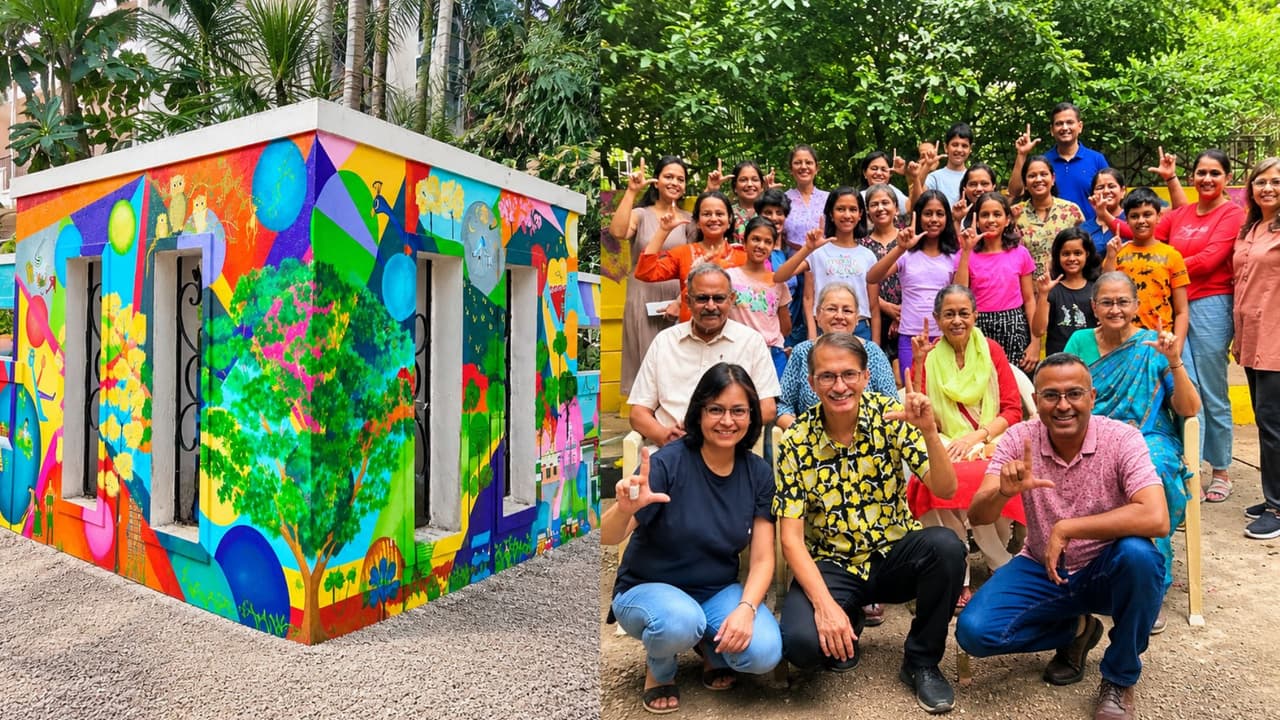
Bengaluru’s L Street in Koramangala has transformed from a garbage hotspot into a vibrant community space featuring colourful murals, greenery, benches and a tiny library, thanks to residents who joined hands to clean and beautify the street.
People once knew this 500-metre stretch of road in Koramangala 3rd Block, Bengaluru, for garbage bags, foul smells and piles of waste. Today, the same street has been transformed with colourful murals, greenery, seating benches, a tiny community library and spaces where residents can come together. What was once a persistent garbage hotspot is now a vibrant example of how a neighbourhood can transform its surroundings through community participation. This is the inspiring story of ‘L Street’, where residents gradually turned a neglected stretch into a lively space celebrating art, nature and community spirit.
The transformation began after the street faced a severe garbage problem in 2011. Instead of waiting for a solution, local residents decided to take matters into their own hands. Over the years, they cleared the waste, planted greenery, introduced artwork and created spaces where people could gather. What began as an effort to keep the road clean eventually evolved into a larger community-led initiative.
Residents Turn Into Garbage Detectives
Two lanes meet on this street in Koramangala 3rd Block, surrounded by three apartment complexes and more than 30 independent houses. In 2012, around 75 residents joined hands to tackle the growing garbage problem. However, they soon realised that simply removing the waste would not address the root cause.
The residents formed a core committee and began taking turns to monitor the street and identify people dumping garbage. They even checked bills found inside the garbage piles to trace the addresses of those responsible.
The committee found that waste was reportedly coming from around 14 houses. According to the residents, garbage collectors were not visiting these homes. The garbage collectors, however, claimed that the residents were not handing over their waste.
A Dustbin Every 10 Metres
The residents pooled their own money to find a practical solution. They installed dustbins at intervals of around 10 metres along the road. Since the number of civic workers assigned to clean the inner roads was insufficient, the residents also hired private cleaning staff using their own funds.
A 95-year-old resident named Padma came up with another idea. She planted saplings in pots along the road in an effort to discourage people from throwing garbage there. Other residents were inspired by her initiative and began watering and caring for the plants.
The greenery soon became part of the street’s identity. One resident even wrote a poem about a bougainvillea plant growing along the road and hung it from one of its branches.
Art Brings The Clean Street To Life
Once the road was clean, the residents turned their attention to art. Art enthusiasts Carol Pinto and Ritu Rai joined other residents to paint murals on the walls.
The artistic transformation began in 2022 with paintings of bulbuls, cats, roses and a man walking his dog. Over time, the project grew, and the community began inviting professional artists to create new murals across the street.
The artwork has since become one of L Street’s defining features, adding colour and character to what was once a neglected stretch.
The Story Behind ‘The Street Is Alive’
One of the main attractions on L Street is a mural titled ‘The Street Is Alive’. It depicts the everyday lives of people who keep the neighbourhood running, including vegetable vendors, civic workers, delivery personnel, domestic workers and office employees.
Another section, known as ‘Cow Corner’, features paintings of cows. Interestingly, residents shared a video showing real cows appearing confused when they encountered their painted counterparts.
The residents have also transformed electrical and utility boxes into colourful works of art, ensuring that even functional elements of the street contribute to its visual character.
The Bright Yellow ‘L Corner’
One particular spot on the road is popularly known as the ‘L Corner’. Residents painted the area bright yellow and added benches made from fallen tree trunks.
The space has become a place where residents can sit, relax and celebrate festivals together. Next to it stands a tiny, house-shaped library painted in yellow, blue and red.
Resident Uday Prabhu built the library, while local residents contributed books. The small space has since become another distinctive feature of L Street.
The street also has a special notebook called the ‘L Street Storybook’. Initially created so passersby could write their own stories, the notebook has evolved into a space where people also share their thoughts, feelings and personal experiences.
Entire Koramangala On A Single Wall
The ‘Spirit of Koramangala’ is one of the largest murals on L Street and can be found at the end of the road.
The mural captures various aspects of life in Koramangala, including the Koramangala BDA Complex, flower sellers at Madiwala market, local party culture, food stalls, startups, educational institutions and supermarkets.
In many ways, the artwork attempts to capture the character of the neighbourhood and its everyday life on a single wall.
A Tiny Natural History Museum
The special features of L Street extend beyond its murals and community spaces. Residents have installed information boards next to trees to explain their origins and distinctive characteristics.
The boards also feature QR codes that visitors can scan with their mobile phones to access additional information.
The street has information boards about local wildlife and biodiversity too, including common tailorbirds, cotton stainer insects and parrots found in the area.
What began as a neighbourhood effort to tackle a garbage problem has gradually evolved into something much larger. L Street now brings together art, greenery, local history, biodiversity and community spaces, showing how residents can reshape their surroundings through sustained collective effort.
From garbage bags and foul smells to murals, plants, books and community gatherings, the transformation of L Street is a reminder that meaningful change can begin with something as simple as a group of residents deciding to care for the street they call home.