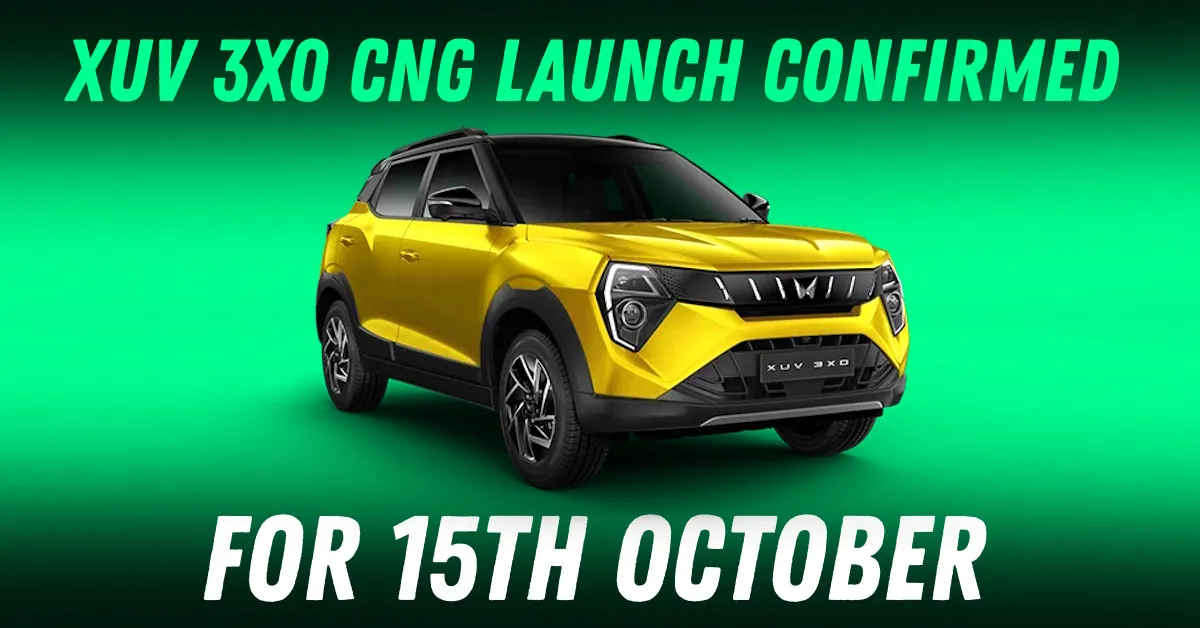
Mahindra is preparing to enter the factory-fitted CNG passenger vehicle market with the XUV 3XO CNG, which will make its debut on October 15. The move marks an interesting shift for a company that has traditionally focused on diesel-powered SUVs, performance-oriented petrol engines and, more recently, electric vehicles.

The development is particularly noteworthy given Mahindra senior management’s earlier position that CNG was not part of the company’s DNA. However, the Indian car market is changing rapidly, and the ability to adapt to evolving customer preferences is what separates successful companies from those that struggle to keep pace.
The XUV 3XO CNG could be Mahindra’s attempt to do precisely that. Rather than abandoning its traditional strengths, the company could be looking to combine them with the lower running costs that CNG-powered vehicles offer.
Why Mahindra Is Entering The CNG Market

CNG has evolved from being primarily an economical alternative for hatchbacks and fleet vehicles to becoming a viable option for buyers looking at premium compact SUVs. Tata Motors has played an important role in this transition with the Nexon iCNG, while Maruti Suzuki has built a substantial CNG portfolio across multiple segments.
For Mahindra, the XUV 3XO is a logical candidate for a CNG powertrain. It competes in the highly competitive sub-4-metre SUV segment, where fuel efficiency and ownership costs can significantly influence buying decisions. A factory-fitted CNG option could attract customers who like the XUV 3XO’s styling, features and driving experience but find the running costs of a petrol SUV less appealing.
There is also a regulatory consideration. With tighter Corporate Average Fuel Efficiency norms expected from April 2027, adding more fuel-efficient powertrain options could help Mahindra manage its fleet-average emissions alongside its growing electric vehicle portfolio. In other words, CNG is not necessarily a departure from Mahindra’s identity. It could be a practical response to market realities.
The 111 Bhp Turbo-Petrol Engine Is The Key
The upcoming XUV 3XO CNG is expected to use the SUV’s 1.2-litre MPFI turbo-petrol engine rather than the more powerful direct-injection TGDi unit.
In petrol mode, the MPFI engine produces approximately 111 Bhp and 200 Nm of torque. It is available with a six-speed manual gearbox and a six-speed torque-converter automatic in the existing XUV 3XO range.
The choice of an MPFI engine makes technical and commercial sense. With fuel injected into the intake manifold, adapting the engine for CNG operation is generally simpler and less expensive than developing a CNG system for a direct-injection petrol engine.
Using a turbocharged engine gives Mahindra an opportunity to offer a more engaging driving experience than buyers might expect from a conventional CNG-powered SUV. If the company manages to retain strong low- and mid-range performance in CNG mode, the XUV 3XO could stand out as a more enjoyable option for enthusiasts who also want to keep fuel bills under control.
Tata Nexon iCNG Will Be The Main Rival
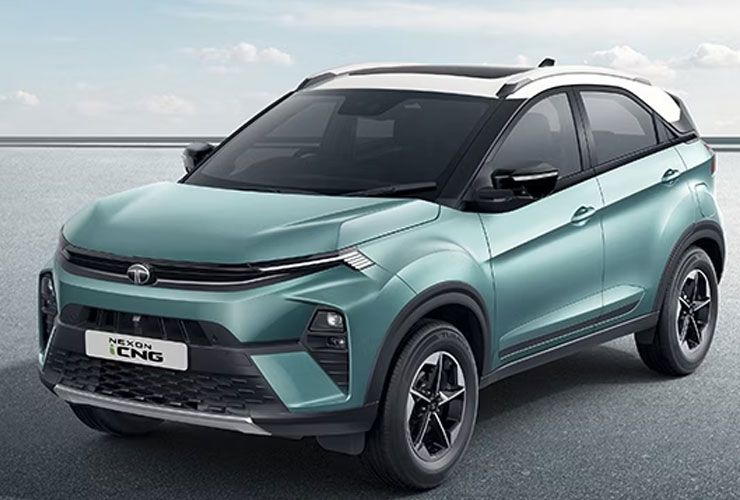
The Tata Nexon iCNG is currently the most relevant benchmark for the upcoming Mahindra. It combines a 1.2-litre turbocharged petrol engine with a factory-fitted CNG system, producing 100 PS and 170 Nm in CNG mode. The Nexon iCNG is offered with a six-speed manual gearbox. It does not get an AMT or a conventional automatic transmission in its CNG configuration.
This creates an opportunity for Mahindra. If the XUV 3XO CNG delivers competitive power and torque figures, it could position itself as a fun-to-drive alternative to the Nexon iCNG. The comparison will ultimately depend on the officially declared CNG-mode outputs, gearing and real-world performance of both SUVs.
Mahindra could further strengthen its position by offering a six-speed torque-converter automatic alongside the manual gearbox. Such an option would appeal to urban buyers who want the convenience of an automatic without moving away from CNG. Whether Mahindra will actually offer an automatic transmission with the CNG version remains unconfirmed.
Underbody CNG Could Be A Major Advantage
The other big question is how Mahindra will package the CNG tank. The XUV 3XO already has relatively limited boot space, and a conventional cylinder could make it less practical for families.
Mahindra could explore a twin-cylinder arrangement or an underbody tank layout, although neither solution has been confirmed. An underbody arrangement, if technically feasible and properly engineered, could preserve more luggage space and make the SUV more versatile for family use.
A well-integrated CNG system, a manual and potentially an automatic gearbox, and competitive CNG-mode performance would give the XUV 3XO a strong set of talking points.