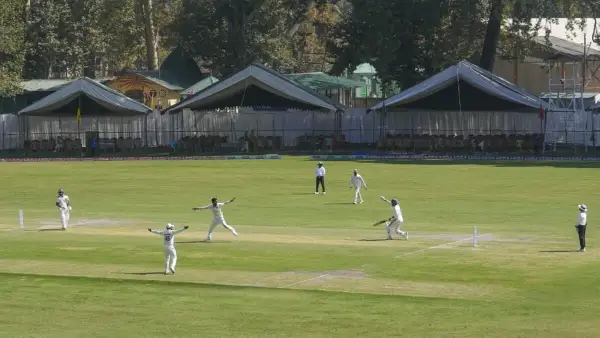
Srinagar: The Rest of India were bowled out for 237 on the opening day of the Irani Cup in Srinagar on Thursday, but the scoreline was only part of the story at the Sher-i-Kashmir Stadium in Srinagar.
The same ground where a section of the crowd reportedly shouted pro-Pakistan slogans and few spectators dug up the pitch during an India-West Indies ODI in 1983 was hosting Jammu and Kashmir as the reigning champions of India’s premier first-class competition.
J&K, led by Paras Dogra, entered the five-day contest against a Rest of India side captained by India wicketkeeper-batter Rishabh Pant after winning their maiden Ranji Trophy title earlier this year.
The contrast is striking because the stadium’s cricketing history has mirrored the disruptions Kashmir experienced over four decades.
In October 1983, barely four months after India won the World Cup, Kapil Dev’s team arrived in Srinagar to face the mighty West Indies in the first international at the venue.
A section of the crowd jeered the Indian players, waved pro-Pakistan material and, during the interval, some spectators entered the field and damaged the pitch.
Ten people accused of digging up the pitch were eventually acquitted in 2011 after the prosecution failed to produce evidence.
International cricket returned three years later when India played Australia in 1986. It has not returned since.
The onset of militancy in 1989 further disrupted cricket at the stadium. There was no cricket there between 1989 and 1996, while the venue later saw long interruptions and security-related difficulties in hosting domestic matches.
A planned Ranji fixture in 2009, for instance, was affected after Services declined to travel to Srinagar citing security concerns.
Yet cricket did not disappear from Kashmir.
Ranji Trophy matches gradually returned to Srinagar, including a game in 2018 after a three-year gap. Domestic cricket has continued in the years since, even as the stadium has undergone changes in infrastructure and security arrangements.
The bigger transformation, however, has been on the field.
J&K’s first Ranji Trophy victory came only in 1982, after 23 years and 99 matches. This year, the team went all the way, beating eight-time champions Karnataka to win the title for the first time.
Baramulla-born pacer Auqib Nabi finished that campaign with 60 wickets, the most in the tournament, and subsequently earned selection for India.
Nabi is absent from the Irani Cup because he is with Team India, leaving J&K to defend its new status without the bowler who spearheaded its historic Ranji campaign.
That is perhaps the clearest measure of how far the game around the Sher-i-Kashmir Stadium has travelled.
In 1983, the stadium became remembered nationally and internationally for a hostile reception to India’s World Cup-winning team.
In 2026, it is providing the setting for J&K to face the Rest of India as Ranji champions – while one of its leading cricketers is away representing the country.
The stadium has seen long interruptions, security challenges and the return of domestic cricket. But the most significant change may be the players walking out onto its pitch: Kashmir is no longer merely a venue in India’s cricket map; J&K has become a champion on it.