The catastrophic flash flood that tore through Nepal’s Himalayan border region is not simply another episode in the familiar cycle of monsoon destruction.
Its probable origin in the collapse of glacial ice and rock high in the mountains points to a more disturbing reality: large parts of the Himalayan region are entering an era in which disasters may originate suddenly, far above inhabited valleys, with little warning and extraordinary destructive power.
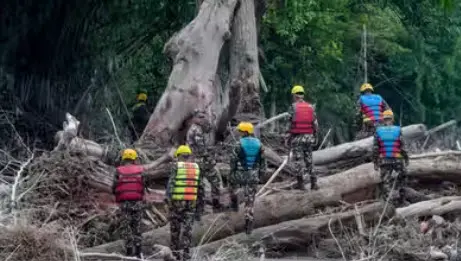
The August 26 disaster demonstrated how quickly this new danger can unfold. A massive collapse from the glaciated slopes around Langtang Lirung generated an avalanche of ice, rock and debris powerful enough to produce seismic signals comparable to a substantial earthquake. The resulting flood travelled through river valleys for scores of kilometres, destroying settlements, roads, bridges and other infrastructure before communities downstream had sufficient time to escape.
The precise relationship between this individual collapse and global warming will require scientific investigation. It would be premature to attribute every Himalayan avalanche directly to climate change. But the broader trend is difficult to dispute. Temperatures across the high Himalayas are rising, glaciers are retreating, permafrost that binds mountain slopes together is degrading, and glacial lakes are expanding. These changes are occurring in one of the world’s youngest and most geologically unstable mountain systems.
That combination fundamentally alters the region’s risk profile. The danger is no longer confined to predictable seasonal flooding or traditional landslides. Ice-rock avalanches can dam rivers temporarily, creating lakes that burst without warning. Glacial lakes themselves can breach. Landslides can fall into existing lakes and generate destructive waves. Earthquakes can destabilise slopes already weakened by thawing ice and changing rainfall patterns.
It would therefore be an exaggeration to suggest that every Himalayan valley faces the same level of danger, but communities across Nepal and the wider mountain arc must increasingly live with hazards whose timing cannot always be predicted. Similar vulnerabilities extend through parts of India, Bhutan, Pakistan and Tibet. Rivers ignore political frontiers, making Himalayan disaster management inherently transnational.
Human activity has undeniably increased the underlying pressures. Global greenhouse gas emissions are accelerating climatic changes in mountain environments, while roads, hydropower projects, tourism facilities and settlements have moved deeper into fragile valleys. Development cannot simply stop. Mountain communities need transport, electricity, employment and connectivity. But the assumption that infrastructure can be built according to historical assessments of river behaviour and slope stability is becoming increasingly unsafe.
There is also a limit to prevention. Governments cannot reinforce every mountainside or drain every unstable glacial lake. Nor can scientists reliably predict the precise moment when millions of tonnes of ice and rock may detach from an inaccessible peak. That shifts the emphasis towards preparedness: satellite surveillance, river sensors, automated warning systems, evacuation routes, resilient bridges, emergency shelters and communications networks capable of functioning after roads and power lines have disappeared.
Nepal’s handling of foreign assistance following the disaster reflects another lesson from catastrophe. Kathmandu initially declined offers from India, China, the United States, Britain, Japan, South Korea, Sri Lanka, Bangladesh and others to deploy international search-and-rescue teams, preferring its army, police and domestic agencies to lead operations.
The decision was shaped partly by Nepal’s experience after the 2015 earthquake, rather than floods, when the arrival of large numbers of international teams created formidable logistical and coordination problems. Foreign assistance offered with the best intentions can become counterproductive when airports, roads and command structures are overwhelmed.
Nepal has since adjusted its position as the scale and complexity of the current disaster have become clearer. Specialised foreign expertise is being accommodated in areas where domestic capabilities can be supplemented, including difficult rescue operations and forensic identification. Kathmandu has simultaneously sought engineering and reconstruction assistance, particularly for restoring severed transport links.
This distinction is sensible. Disaster assistance should be determined by what the affected country needs rather than by what neighbouring governments wish to display. Nepal does not necessarily require competing contingents of foreign rescue personnel arriving independently. It may desperately require portable bridges, heavy engineering machinery, helicopters, specialised tunnel teams, forensic expertise, satellite analysis and equipment capable of restoring access to isolated communities.
India’s offer of Bailey bridges and prefabricated bridge systems is particularly relevant. Scores of bridges and long sections of strategic roads have been damaged or destroyed, turning infrastructure restoration into part of the rescue operation itself. A bridge installed rapidly may be more valuable than another hundred rescuers who cannot physically reach the disaster zone.
China faces the same imperative on the Tibetan side, where communities and infrastructure around the border have also suffered enormous damage. The geography of the catastrophe makes coordination between Kathmandu, New Delhi and Beijing unavoidable. Hydrological information, satellite data and warnings about unstable lakes or blocked rivers upstream can save lives far downstream.
That cooperation should be insulated from the strategic rivalry that normally surrounds Nepal. The country has long balanced its relationship with India against its growing economic engagement with China, while both powers regard the Himalayas as a region of considerable geopolitical importance. A disaster zone is the worst possible arena in which to demonstrate political influence.
Nepal’s political establishment appears to understand this. Government and opposition have broadly avoided turning the emergency into another arena for partisan confrontation. Maintaining that restraint will become more important as attention moves from rescue to rehabilitation and eventually reconstruction, when questions about spending, contracts, infrastructure failures and responsibility will inevitably arise.
The deeper challenge extends far beyond Nepal. Himalayan governments need permanent mechanisms for sharing glacial observations, rainfall data, river levels and satellite warnings across borders. Climate diplomacy in the mountains must become as practical as disaster engineering. A lake forming in one country can become a flood in another within hours.
Nothing can guarantee that another Himalayan wall of water will not descend without warning. What governments can determine is whether the communities below it receive those precious extra minutes to move, whether bridges survive longer, whether communications continue functioning and whether neighbouring countries cooperate before catastrophe rather than negotiating cooperation after it.