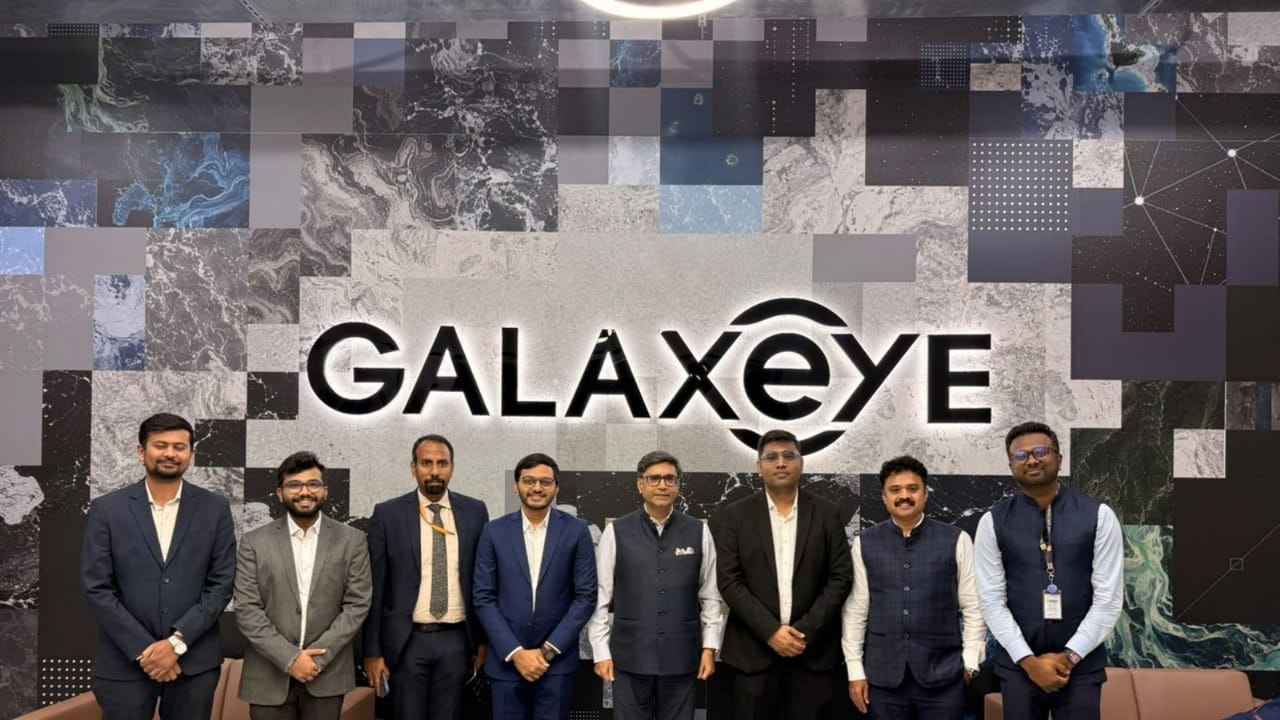
Foreign Secretary Vikram Misri met the GalaxEye team to celebrate their launch of Mission Drishti, India’s first hybrid OptoSAR satellite providing consistent, all-weather, high-resolution Earth observation data for global and defense use.
New Delhi [India], November 26 (ANI): Foreign Secretary Vikram Misri on Wednesday met with the team of Bengaluru-based startup GalaxEye and wished them success. GalaxEye is a space-tech startup that developed “Mission Drishti”, the world’s first hybrid “OptoSAR” Earth observation satellite launched in May 2026. It is India’s largest privately built satellite, combining Optical and Synthetic Aperture Radar (SAR) technologies to provide 24/7, high-resolution, all-weather imaging.
In a post on X, the Foreign Secretary reflected on his meeting and expressed pride in the young team. “It was a pleasure to spend time today with the young team at @GalaxEye- one of India’s most promising space startups and responsible for the world’s only OptoSAR satellite. Proud of them and wishing them all success in the years ahead,” he wrote. It was a pleasure to spend time today with the young team at @GalaxEye – one of India’s most promising space startups and responsible for the world’s only OptoSAR satellite. Proud of them and wishing them all success in the years ahead. https://t.co/7TL8gPtM0r — Vikram Misri (@VikramMisri) November 25, 2026
Earlier in May, Suyash Singh, CEO and Co-Founder of GalaxEye, told ANI, “The satellite is alive and kicking. We’re still in the commissioning phase. It’s all on track.” Singh’s remarks came in the wake of reports from open-source intelligence handles tracking the satellite’s initial movements that seemed to suggest that the satellite could be slowly tumbling in orbit. The IIT-Madras-alumnus who led the launch of the satellite clarified that the mission is progressing exactly as planned through its vital early stages, marking a historic leap for the Indian private space sector.
Responding to observations from independent trackers that the satellite appeared to be tumbling, Singh explained that commissioning strategies vary significantly depending on the sensor payload. “People think there are optical satellites which need to be determined on day one. Our satellite is kind of different, so we don’t follow the same strategy effectively,” Singh said, expressing confidence that the mission remains “fingers crossed” for continued success.
Unlike standard optical satellites, SAR technology enables imaging through thick clouds and total darkness, providing critical data for national security, maritime tracking, and disaster relief. Singh detailed that the GalaxEye challenged this “Space 101” textbook logic by utilising Off-Nadir Angle (ONA) imaging, synchronising both sensors to look at the same 20-degree angle. “We were aware of the fact that most of the imaging, even in the highest resolution satellites that exist today, is done at an angle called ONA (Off Nadir Angle) imaging. Radars anyway look at an angle. If I make optical look at the same angle and synchronise them, I will be able to build this particular sensor stack,” Singh said.
Before reaching orbit, this technology underwent rigorous R&D using drones, a notoriously unstable environment for radar. The team developed advanced mathematical equations and digital signal processing to correct motion errors during more than 200 test flights. The resulting commercial value lies in consistency; with 70 per cent of the Earth typically covered by clouds, GalaxEye’s hybrid approach ensures data is always available.”Our best sell to our customers is consistency,” GalaxEye CEO said. “Rain or shine, day or night, It’ll give you one data”, he said.
Weighing 190 kg, the first privately built synthetic aperture radar (SAR) imaging satellite in India is helping redefine the country’s space capabilities with technology that has major global, commercial, and defence significance. Unlike conventional optical Earth observation satellites, SAR satellites can image the Earth day and night and through cloud cover by using radar signals. The unique “OptoSAR” architecture allows Drishti to give an image of any place on earth anytime in any weather, effectively “fusing the best of both worlds.”
‘Drishti’, which integrates Electro-Optical (EO) and Synthetic Aperture Radar (SAR) sensors into a single operational platform, was launched onboard a Falcon-9 rocket of Elon Musk’s SpaceX firm and successfully placed in orbit on May 3. Explaining the technical audacity of the mission, Singh noted that cynics originally doubted the possibility of combining sensors that traditionally look at different angles, with cameras typically pointing downward (nadir) and radar at an angle.
Looking ahead, the company aims to expand its footprint with a constellation of around 10 satellites over the next three and a half years. This expansion is designed to bring the revisit rate for any location on Earth down from seven days to a daily frequency. “The goal is to absolutely take the entire Earth Observation market globally and build the number one Earth Observation company from India,” Singh said. GalaxEye has also tie-ups with ISRO, NSIL, and IN-SPACe. It signed a landmark reseller agreement with NSIL NewSpace India Limited). As ISRO’s commercial arm, NSIL will market and sell GalaxEye’s unique OptoSAR data globally, effectively making GalaxEye the first private Indian satellite operator to formally use the government’s global sales machinery. IN-SPACe acted as a “game-changer” by providing regulatory clearances and opening up ISRO’s high-end testing facilities to the GalaxEye team, which was critical for a startup with limited capital. iDEX (Innovations for Defence Excellence): Provided funding and facilitated technical challenges that helped the team gather requirements and refine their sensor stack for strategic and defence use cases. (ANI)