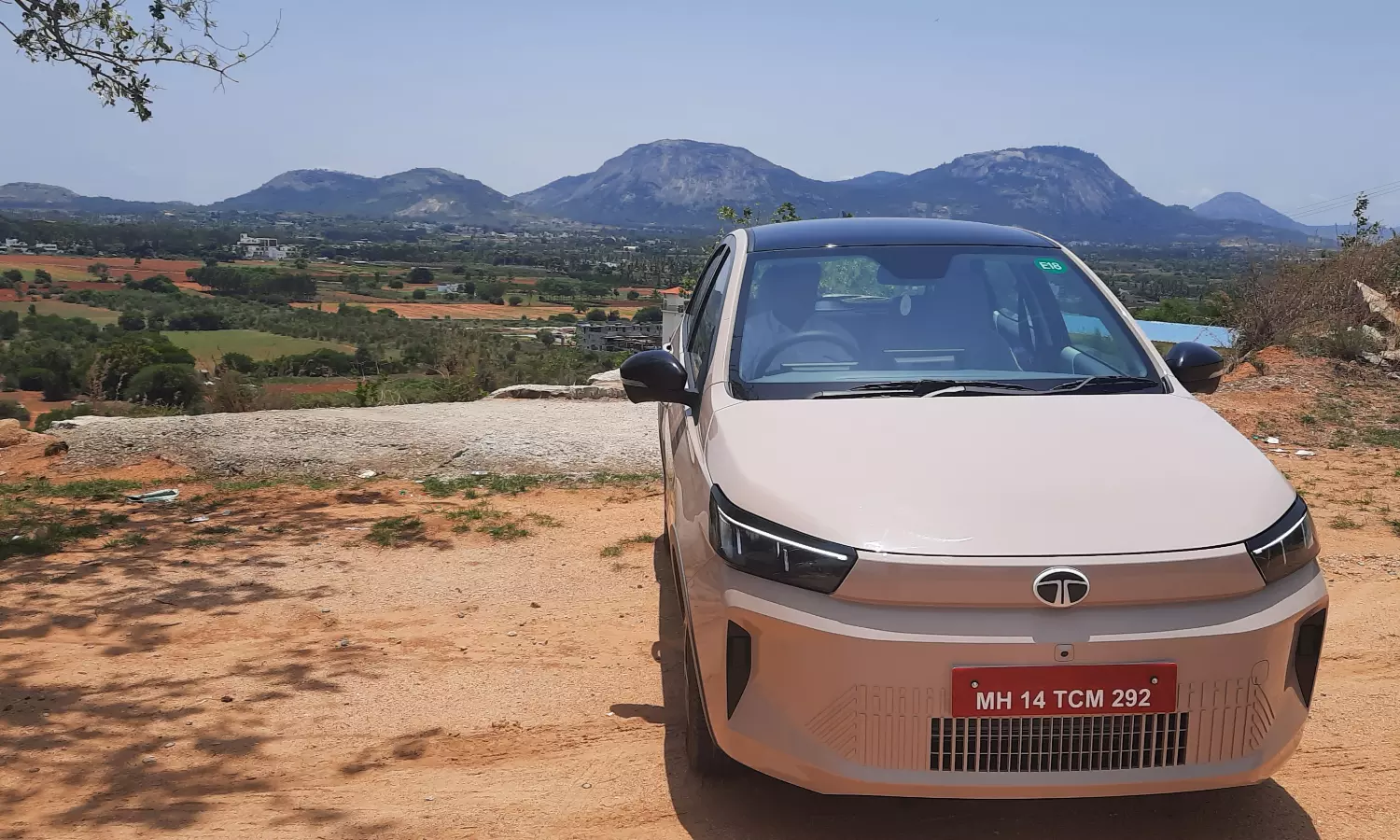
Tata Tiago hatchback has been attracting first time car buyers in India for its ease of use, low running costs and practicality for the family.
The Tiago has been Tata’s successful entry-level car in India, selling more than 7,000-8,000 units every month. However, in order to be competitive 10 years since its launch in India, the automaker has come with updates and new features. While petrol variants account for 60 per cent of total sales, the CNG and EV models contribute 20 per cent each.
With a starting price tag of Rs 6.99 lakh, the new Tiago EV is undoubtedly India’s most affordable electric car that is cheaper than its rival MG Comet EV at Rs 7.63 lakh onwards.
The company has retained its petrol and CNG engines along with the 5-speed manual and automated manual transmission priced between Rs. 4.69 – Rs 7.99 lakh.
We took it for a spin to check out what it promises.
The Exterior
At first look, it comes across as a more attractive hatchback in its class, thanks to its clean proportions and distinctive surfacing. It has got a refreshed design with swept-back multi-reflector LED headlamps, and DRLs, a slim piano black upper grille, a large air dam with a black grille and LED fog lamps, piano black ORVMs, 15-inch alloy wheels, black cladding around the wheel arches, LED tail-lamps with a red strip connecting the 2 clusters, a large black insert on the rear bumper and long vertically oriented reflectors, and a sharkfin antenna with a GPS.
While the doors, bonnet, and tailgate are quite heavy, and the car feels good, there is a little bit of flex in the metal when pressed with a thumb. With regard to the Tiago EV, it adopts a monolith-inspired front fascia with a blanked-off nose, aligning with contemporary EV design trends. But it may not appeal to all buyers.
The Interiors
The entry and exit are easy and visually the interior as whole is quite attractive. You can easily spot the redesigned dashboard with a modern look with two separate floating screens – one for the instrument cluster and one for the infotainment system.
The upgraded cabin looks nice with upmarket fabric inserts and the fabric inserts on the dash; door panels and centre armrest have a soft-touch effect. The seats get grey and black fabric upholstery. The car has got a wireless charger for two phones and rear AC vents to cool the car.
Importantly, all variants of the Tiago are equipped with 6 airbags, ABS + EBD & CSC, 3-point seatbelts with reminders for all 5 seats, and ISOFIX child seat mounts. The Creative+ (top) variant is equipped with auto headlamps, rain-sensing wipers, 360-degree camera, parking sensors, blind view monitor, ESP, traction control, hill hold and iTPMS.
The Drive Experience
The Tiago comes with two battery options: 19.2 kWh Medium Range with a claimed mileage of 226 km and a 24 kWh Long Range with a claimed mileage of 285 km on a full charge. We could not do the test drive for mileage due to time constraints.
However, driving the Tiago on city roads and highways was fun with its near zero vibrations and crisp acceleration. While it is fun driving around city roads for any household purpose, navigating easily through narrow lanes and crowded streets, it lags power in climbing up the road on highways on a hillock, for instance. However, the car remains stable at around 100 km/h speeds and is quite comfortable to drive along.
Besides the electric, the Tiago continues with its familiar 1.2-litre, three-cylinder naturally aspirated petrol engine producing 86hp and 113Nm. Performance wise, the engine has enough punch for everyday driving, and if you are in the right gear, it does not warrant frequent downshifts to maintain momentum. The new 5-speed manual gearbox is good to enjoy a comfortable drive with the light clutch which is easy to modulate.
Should I Buy One?
Tata Motors has undoubtedly built upon a good city EV with improved comfort, additional features and software enhancements. What is interesting is its Battery-as-a-Service (BaaS) programme, which lowers the upfront purchase price by up to Rs 2.3 lakh by allowing buyers to finance the battery separately and pay Rs 2.6 per km.
Also, the petrol version with its modern styling, richer cabin and expanded feature list makes it a compelling choice for a first-time buyer.