The FIFA World Cup 2026 has delivered everything football fans could have hoped for. From stunning upsets to Lionel Messi magic, fairy-tale stories like Cabo Verde’s rise and packed stadiums across North America.
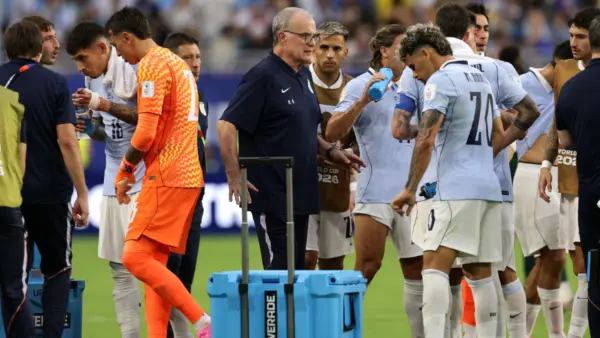
Yet one of the biggest talking points of the tournament has not been a goal, a referee decision, or a VAR controversy. Instead, it has been FIFA’s new mandatory hydration breaks.
Introduced as a player welfare measure, hydration breaks were supposed to protect footballers from the extreme summer temperatures expected across the United States, Mexico, and Canada. However, just a few matches into the tournament, they have become one of the most divisive issues of the World Cup.
The breaks after a lot of discussion were introduced by FIFA as player welfare measures to protect the footballers from the scorching summer temperatures across the United States, Mexico, and Canada. However, in a very short period of time, they have sparked a lot of controversies and debates in the ongoing World Cup.
What Are Hydration Breaks And Why Did FIFA Introduce Them?
For the first time in World Cup history, FIFA made hydration breaks mandatory in every match. A three-minute stoppage time is given to the players around the 21st or 22nd minute of each half, effectively splitting a 90-minute contest into four separate segments.
The reasons provided by FIFA were very simple. Experts all over the world have repeatedly warned that the 2026 World Cup could be among the hottest tournaments ever played.
With various matches scheduled during afternoon kick-off windows and concerns over rising temperatures, football’s governing body decided to prioritise player safety.
The idea itself is not entirely new. Hydration breaks have previously been used during extreme heat conditions in international tournaments and domestic leagues.
What makes it different this time is that they are compulsory regardless of temperature or weather conditions.
Why Has It Sparked Controversy?
The criticism centres around one simple argument: football has always been a game of rhythm. Momentum is often everything. A team dominating possession can suddenly lose its intensity after a stoppage. A side under pressure gets an unexpected opportunity to regroup.
Managers receive additional chances to reorganise tactics without waiting for half-time. The entire flow of the game can be changed cause of this break. It surely affects the team in control.
Critics argue that mandatory hydration breaks are changing the nature of the sport itself. Instead of two uninterrupted halves, matches now feel like four mini-games.
There have already been several instances where teams appeared to regain control after a hydration pause, leading many to question whether the breaks are affecting competitive balance as much as player welfare.
Managers And Players Are Not Happy
Several high-profile figures have openly questioned the policy. Uruguay manager Marcelo Bielsa became one of the strongest critics, claiming the breaks “add nothing and take away a lot” from football. According to Bielsa, the constant interruptions damage the natural flow of the game and reduce the spectacle for supporters.
Recently, Argentine head coach Lionel Scaloni also raised concerns over the break. He stated, “Perhaps it gives a hand to the weaker team because they have time to fix things. They have time to adjust.”
Later, he also shared his positive response. “The ‘four-period’ concept is real. Between the time players arrive and leave, we only have three-and-a-half minutes at halftime to talk to them.
Everything that I have in my mind can change depending on these 22 or 23 minutes. We have people analysing the game and we look for solutions. It’s what you do in a normal halftime,” the defending champions manager added.
Players have expressed mixed feelings as well. While some appreciate the opportunity to recover in demanding conditions, others have questioned whether breaks are necessary in comparatively cooler temperatures or where heat is not a serious issue.
Fans Believe The Real Winner Is Advertising
Perhaps the biggest source of frustration among supporters has been what happens during those three minutes.
Football fans are used to to a continuous viewing experience. Unlike American football, basketball, or baseball, the sport traditionally offers very few commercial interruptions. Hydration breaks have suddenly created fresh advertising windows for broadcasters.
That has triggered a growing perception that commercial interests are benefiting as much as player welfare.
Several broadcasts have inserted advertisements during the stoppages, while critics have pointed out that FIFA has effectively created hours of additional commercial inventory across the 104-match tournament. In one instance, a broadcaster was even in the spotlight for returning late from advertisements after play had resumed.
Whether fair or not, many supporters now view hydration breaks as a step to increase business revenue with unnecessary stoppages.
Necessary Protection Or Unwanted Experiment?
The debate ultimately comes down to a clash between two priorities. On one side is player welfare. With rising temperatures and growing concerns over heat-related wellness, protecting athletes is non-negotiable.
Medical experts largely support additional cooling measures, even suggesting longer breaks may sometimes be required.
On the other side is football’s identity. The sport’s uninterrupted rhythm is one of the reasons billions around the world love it. Every additional stoppage risks making the game feel less interesting and more complex.
For now, hydration breaks will continue throughout the FIFA World Cup 2026. Whether they become a permanent feature of future tournaments or remain an experiment could depend on how loudly managers, players, and fans continue to raise their concerns over the coming weeks.
FIFA World Cup 2026 Fixtures Today
|
Group |
Fixture |
Time (IST) / Result |
Venue |
|
Group J |
Argentina vs Austria |
10:30 PM |
Dallas Stadium, Texas |
|
Group I |
France vs Iraq |
2:30 AM (Tue) |
Philadelphia Stadium, Pennsylvania |
|
Group I |
Norway vs Senegal |
5:30 AM (Tue) |
New York New Jersey Stadium |
|
Group J |
Jordan vs Algeria |
8:30 AM (Tue) |
San Francisco Bay Area Stadium |