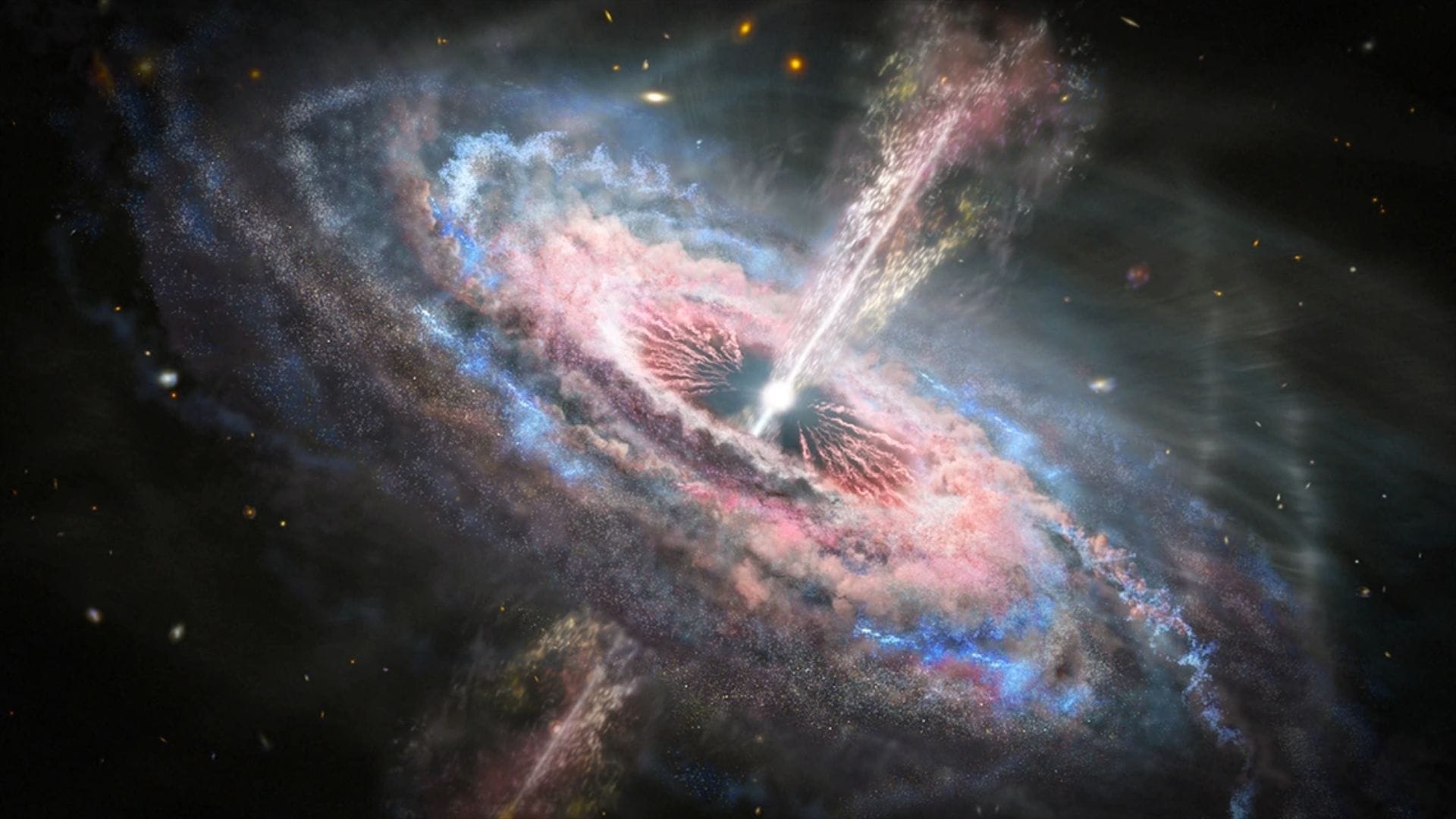
New Delhi: Observations by the James Webb Space Telescope has revealed powerful galactic winds driven by early supermassive black holes frequently swept gas out of galaxies just one billion years after the Big Bang. The findings illuminate how these exotic objects shape galaxy evolution, and explain the puzzling existence of massive galaxies in the early universe where star formation has been quenched. Astronomers have long known that most large galaxies harbour supermassive black holes at their cores. As these black holes devour the surrounding gas and dust, they create the most luminous objects in the universe, glowing accretion disks of tortured infalling material that release vast amounts of energy.
These voraciously feeding black holes in the early universe are surrounding by active galactic nuclei, a process that drives outflows of gas at tremendous velocity. Because of their incredible distances, these quasars appear as point sources, or quasi-stellar objects. Observations by the James Webb Space Telescope of 27 quasars from the infancy of the universe have revealed six that display galaxy-wide winds at speeds up to 8,000 km per second. These extreme outflows are at least four times more common than in later epochs. These super quasars can explain the rapid shutdown of star formation in early galaxies.
How star formation is quenched
The gas outflows from the quasar dissipates the gas and dust in the rest of the galaxy, the raw material from which new stars are born. Early galaxies are denser and clumpier than the spirals of today, with the radiation from the central quasar effectively spreading across multiple directions, unlike the narrow relativistic polar jets. The winds can escape into the intergalactic medium. Cosmological simulations had predicted such strong early outflows, with the JWST data now confirming that they were widespread and more vigorous than the later Universe. The discovery explains how some early galaxies grew so rapidly, but still exhibit a lack of star formation. A paper describing the research has been published Nature.