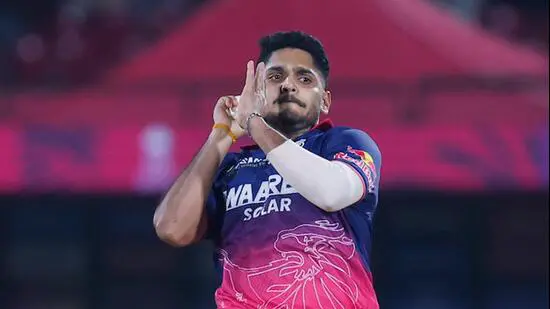
Mumbai: Tushar Deshpande has his tail up. He is gunning for his fourth wicket in the middle of a threatening post-lunch spell for West Zone in the first match of the new domestic season in the Duleep Trophy.
Soon enough, he cranks it up and a bouncer forces North Zone skipper Kanhayia Wadhawan to duck. The ball is rapid enough for wicket-keeper Harvik Desai to fumble in collection. The speed gun shows 153.9 kph-
express pace category. Deshpande’s other deliveries in the spell are not anywhere as quick, leaving people to wonder if it was a system error.
“Why is it not believable? I have bowled in the high 140s in IPL,” the 31-year-old argues. “I later went and checked with the producer. He told me I was bowling really quick.”
For the rest of the world, it may be an unsolved mystery, but the Mumbai pacer sees it as his fastest ever delivery.
“It mostly depends on rhythm,” Deshpande explains. “Sometimes when you are bowling in a good rhythm, you don’t realise how quick you are. Some balls are effort balls, yes. But in certain spells, you feel it as a fast bowler when you are running in smoothly.”
Two years back, Deshpande’s career got a leg up with an India T20I cap, following stellar performances in CSK’s winning IPL campaign in 2023. (He has played two T20Is.) Soon after, he was awarded a BCCI fast-bowling contract. Since then, the category has been abandoned and his push for national reckoning has lost some momentum. On a comeback trail, Deshpande, 31, is happy to have made a promising start to the new red-ball season.
Building workload
For fast bowlers, the lead up to a red-ball competition is the key. “When you are building up for a red-ball tournament from an off-season, the most important thing is to build your workload gradually,” he said. “A month from the Duleep Trophy, I started bowling three or four times a week, 15 overs-a-day, 20-overs-a-day followed by 25-overs-a-day. It’s like playing a three-day or a four-day match before the actual match.”
Deshpande has learnt these lessons the hard way, with knowledge acquired from physios and strength and conditioning coaches. “Earlier, I didn’t have as much of an idea about workload,” he said. “All the injury problems I got early in my career were because I would over bowl. How to space out overs, when to push is something I learnt in the last four-five years.”
He has played 47 matches since his First-Class debut in October, 2016, taking 129 wickets.
“One thing you still have to remember as a fast bowler is that there is no replacement for bowling. No matter how much gym or training you do, the bowling muscles only get activated when you bowl. When you have under-bowled or over-bowled before a match, it leads to a spike which affects your bowling rhythm and ultimately leads to injuries.”
Split Ranji season helps
At the top of his mind is to make a push for India A contention. But there’s also a Ranji Trophy season coming up in October. Bowling through an entire Indian domestic season with full intensity is the most gruelling task for a fast bowler.
“Picking up wickets in domestic cricket can sometimes be harder than in international cricket,” Deshpande said, alluding to few pitches that assist pace at home.
He welcomes the schedule changes where the Ranji Trophy league phase is split in two, with T20 Mushtaq Ali Trophy and the one-day Vijay Hazare Trophy played in between.
“Playing seven red-ball matches on the trot used to take a lot out of you. The fast bowlers were left with no energy while trying to switch to Mushtaq Ali. Even in international cricket, five-Test series come once a year. Seven red-ball matches in a row was too demanding,” he said.
“I didn’t find any trouble in switching back to the second round of Ranji Trophy after the white-ball tournaments. In fact, by the time we resumed, the winter months made it a lot easier to bend your back.”