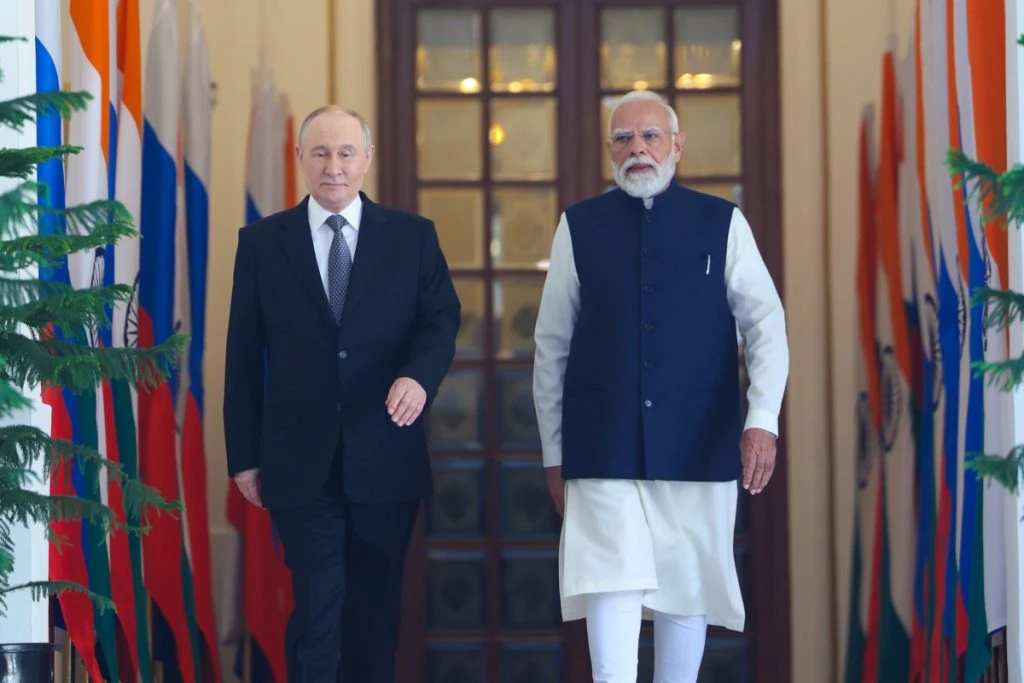
Chandigarh: India and Russia continue to advance their defence partnership quietly, operating between the lines of official communiqués, amid heightened global scrutiny of Moscow over its military campaign in Ukraine, even as New Delhi too remains mindful of potential penalties and secondary sanctions linked to continued bilateral military ties.
With Russia increasingly cautious about provoking further US- and EU-led punitive measures – including from partners like Japan and Australia – this once high-visibility defence relationship between Moscow and Delhi has shifted away from grand public signalling. Instead, both sides were now focused on discreet arrangements to perpetuate materiel commerce, a pattern evident during Russian President Vladimir Putin’s visit to New Delhi earlier this month.
Domestic and overseas analysts observed that this 48-hour visit was rich in symbolism, but produced no publicly announced defence outcomes, falling short of widely anticipated expectations. They contended that the visit – after a four-year gap from what had previously been an annual engagement – was primarily about optics, underscoring the durability of bilateral ties and signalling Moscow’s continued diplomatic relevance, rather than showcasing new military deals or joint ventures.
Despite the absence of public declarations on materiel matters, substantial bilateral defence progress was believed to be quietly underway behind closed doors. Senior security officials noted that both sides used Putin’s visit to review existing and prospective military programmes, recalibrate delayed equipment deliveries, and discreetly shape long-term defence sustainment arrangements – activities that received little public acknowledgment and were largely dismissed by domestic media as inconsequential.
Against this backdrop, one understated yet strategically consequential step was the ratification by the Russian parliament of the little-publicised RELOS (Reciprocal Exchange of Logistics Support) agreement – granting both militaries reciprocal access to bases and support facilities – just two days before Putin arrived in Delhi on December 4.
“Our relations with India are strategic and comprehensive, and we value them,” State Duma Speaker Vyacheslav Volodin said on December 2, calling RELOS “another step toward reciprocity and the deepening of our ties.”
The calculated timing of this pact signalled a deliberate intent to safeguard India’s operational readiness across Russian-origin systems that collectively constitute nearly 60% of its military’s inventory, and to institutionalise mechanisms which had previously relied on ad hoc arrangements. In doing so, official sources said, RELOS goes far beyond a conventional logistics agreement limited to ship and aircraft access, positioning itself squarely to India’s advantage by ensuring spares, maintenance, repairs, technical support, and associated supply lines.
Intentionally low-key and publicly framed as routine “housekeeping,” the RELOS pact merits closer scrutiny as a calculated device to pre-emptively bypass potential Western sanctions- should they be invoked-while preserving the continuity of India-Russia defence cooperation.
This underlying logic becomes clearer when viewed against the sanction anxieties that have steadily shaped decision-making in both Delhi and Moscow. Security officials in Delhi indicated that RELOS’s emergence was rooted in concerns over possible US penalties on bilateral defence transactions – concerns given tangible form by India’s 2018 decision to acquire five S-400 Triumf air-defence systems.
Their purchase had prompted explicit warnings under the US’s 2017 Countering America’s Adversaries Through Sanctions Act (CAATSA), enacted during Donald Trump’s first presidential term. And, while no penalties were ultimately applied, following acceptance of India’s S-400 buy by the Joe Biden administration for complex strategic reasons, the episode highlighted the need for mechanisms capable of shielding routine Russian military sustainment from financial and regulatory disruption.
In recent months, these concerns had been compounded further by far-reaching US-and EU-led sanctions on Moscow over Ukraine, which, in turn, had disrupted India’s ability to procure equipment, receive pending deliveries and access critical spares and technical support for its in-service Russian materiel. Alongside, the rupee-rouble payment mechanism, which had functioned fitfully, had also become increasingly unreliable, underlining the need for a more structured framework.
Moreover, recent turbulence in the India-US relationship, driven by Delhi’s insistence on maintaining strategic autonomy and particularly its freedom to engage in military commerce with partners of its choosing, had added urgency to developing institutionalised logistics arrangements to sustain the readiness of India’s vast Moscow-supplied arsenal.
In this context, the timing of RELOS’s ratification by the Russian parliament not only takes on added significance but also prompts the telling question of why such a logistics agreement was being signed only now, after more than six decades of defence cooperation between Delhi and Moscow.
Traditionally, maintenance of Russian platforms and equipment was managed through case-by-case contracts, informal understandings, and routine government-to-government channels. While this approach had sufficed for decades – albeit with some inefficiency – it began to falter more noticeably after Russia invaded Ukraine, followed by sanctions on Moscow.
Alongside, the rupee-rouble payment mechanism, designed to bypass sanctions, had been fitful from the start and had become increasingly unreliable. Routine dealings were turning into prolonged negotiations, underscoring the need for a structured, formalised framework like RELOS.
In response, RELOS emerged after extensive bilateral consultations as a mechanism to sustain the operational readiness of India’s Russian-derived land, air, naval, and underwater defence platforms by ensuring uninterrupted logistics, maintenance, and operational support. By institutionalising reciprocal logistics and deferred financial settlement arrangements, RELOS also reduces exposure to transactions that could trigger sanctions from the US or other Western states.
Security analysts in Delhi have described RELOS as a ‘silent, unspoken agenda-setter, between Delhi and Moscow, maintaining that through its logistical framework, India could well sustain its catalogue of Russian armaments. These included combat and transport aircraft, helicopters, an aircraft carrier with its MiG-29K/KUB air-battle group, advanced air-defence systems, main battle tanks, infantry combat vehicles, ‘Kilo’-class submarines, frigates, assault rifles, and an array of ordnance, missiles, radar, and other force multipliers.
“Keeping these platforms fully operational is one of RELOS’s objectives,” said a senior Indian Army veteran, speaking on condition of anonymity. He emphasised that the pact would quietly sustain the readiness and combat effectiveness of these systems, preserving operational continuity while avoiding public scrutiny and attention. Furthermore, under RELOS’s framework, India’s military can directly access critical components, receive repair and servicing support, and other engineering assistance without immediate, transaction-by-transaction payments, he added.
Such support would be recorded through agreed accounting mechanisms and settled later at the government level, though the precise modalities of such provisions remain unknown. But in practice, these dealings are understood to involve adjustments against ‘other’ defence services and supplies exchanged between the two countries and even settlements in kind rather than cash. Thus, by separating operational maintenance from real-time financial transfers, RELOS significantly reduces reliance on disrupted banking channels, avoids sanctions-related delays, and allows routine military support to continue despite unresolved payment constraints, said the above-mentioned Army officer.
RELOS also reportedly differs considerably from India’s earlier logistics pacts, concluded with the US in 2016, France and Singapore (2018), South Korea (2019), Australia and Japan (2020), and one nearly finalised with the UK.
All these agreements were primarily designed to facilitate interoperability between India and its logistic partners, providing reciprocal access and operational support at ports, airbases, and other designated military facilities during exercises, deployments, or humanitarian missions. All of them also operated via transparent, bank-based payment systems in financially stable and sanctions-free environments.
“RELOS is only partially about interoperability – though it does include provisions for it,” said a two-star Indian Navy veteran who had dealt extensively with Russia during his service tenure. And, while it does not bypass existing sanctions on Russia, it seeks to blunt their operational impact on India’s ability to maintain Russian-supplied military equipment,” he declared, declining to be named.
Beyond this, RELOS also incorporates operational reach and flexibility for both militaries. Through its framework, Indian forces-particularly its Navy-will now be able to secure operational Russian support for long-range deployments to regions like the Arctic, the Russian Far East, and the Mediterranean. Conversely, Russia’s military will gain corresponding access to Indian ports and designated airfields.
Meanwhile, supplementing these RELOS-associated developments were discreet discussions between defence ministers Rajnath Singh and Andrei Belousov at the 22nd India-Russia Inter-Governmental Commission on Military Technical Cooperation (IRIGC-MTC) in Delhi, a day before the Putin-Modi summit on December 4. The meeting is believed to have covered a wide-ranging agenda-from India acquiring additional S-400s and potential Sukhoi Su-57 ‘Felon’ fifth-generation fighters, to indigenously developing an ecosystem for spares and equipment upgrades.
Supplementing the RELOS were discreet talks between defence ministers Rajnath Singh and Andrei Belousov at the 22nd India-Russia Inter-Governmental Commission on Military Technical Cooperation (IRIGC-MTC) in New Delhi, held a day before the Putin-Modi summit on December 4. The meeting is believed to have covered a wide-ranging agenda – from Indian acquiring additional S-400 Triumf air-defence systems and possible Sukhoi Su-57 Felon fifth-generation fighters to indigenously developing an ecosystem for spares and equipment upgrades.
As noted earlier, there were no announcements or headlines, and security sources indicated that this restraint was intentional, indicating a deliberate focus on advancing defence cooperation away from the glare of public diplomacy. Viewed alongside RELOS, the under-wraps nature of the IRIGC-MTC deliberations also highlighted a clear pattern: India-Russia defence cooperation was steadily being pushed forward through low-visibility mechanisms prioritising continuity, sustainment, and operational readiness over public messaging.
In effect, RELOS and the ministerial talks functioned as two parts of the same strategy – quietly laying the groundwork for future deals and operational arrangements, while allowing India to perform a careful balancing act between sustaining its traditional ties with Russia and managing strategic relationships with the US and other Western sanctioning powers.