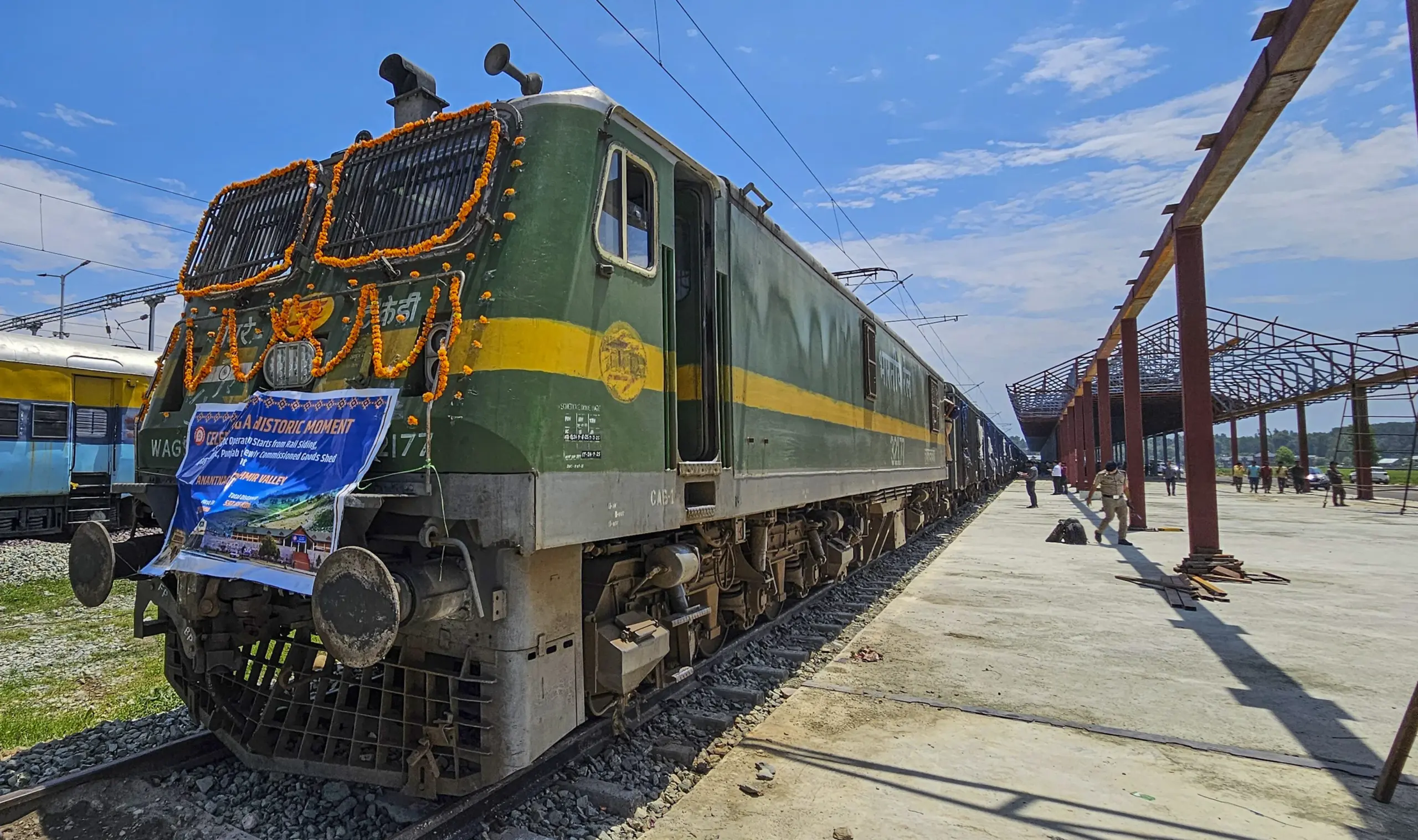
AFTER the success of the Delhi-Katra-Kashmir passenger train inaugurated by Prime Minister Narendra Modi earlier this year, the running of freight trains from Jammu marks another milestone in Kashmir’s rail connectivity.
While the move is likely to give a new lease of life to the Kashmiri fruit and handicraft sectors, providing quick and steady access to markets across India, it is also likely to bring an end to the uncertainty surrounding the supply of essential items to the Valley during inclement weather.
Continuing progress
Over the last two weeks, the Jammu division of Northern Railways has successfully brought defence equipment to the Valley and ran a freight train, bringing in foodgrains and cement. This came months after the Railways transported apple produce from the Valley to the outside markets. The Railways Ministry has termed it a “new era of logistical and economic growth” and a “powerful symbol of power and integration”.
Jammu and Kashmir Chief Minister Omar Abdullah congratulated the Railways after the first foodgrain freight train reached south Kashmir.
Why it’s significant
The running of freight trains to and from Kashmir is significant as the Srinagar-Jammu National Highway or NH-44 is weather-dependent and remains closed for any form of vehicular traffic during snowfall or heavy rains. This year, massive landslides led to the closure of the highway for several days during the peak apple season, causing heavy losses to the growers.
For the Valley, the opening of the rail track for freight trains provides an alternative that is likely to bring certainty to trade activity during the winter season and fuel economic growth. “It would also reduce the transportation costs of goods,” says a Srinagar-based businessman.
“The closure of the highway during winter results in prices sky-rocketing, especially of essential items like fruits and vegetables. With a train back-up, the market prices would stabilise and remain uniform throughout the year,” he adds.
Assessing the benefits
For the Valley’s fruit industry, a major contributor to Jammu and Kashmir’s economy, the freight service is likely to be a game-changer, especially for fruits with a lesser shelf life like cherry, strawberry and some varieties of apple. It would not only reduce the transportation costs, but also provide quick access to markets across India.
“Of course, it is likely to benefit the fruit growers of the Valley,” says Fayaz Ahmad Malik, president of the Sopore Fruit Mandi, one of the largest fruit markets of the country. “The road transportation cost for each box of apple is around Rs 100. With the train, we expect it to come down to around Rs 30. But what is more important is that our fruit can reach the markets in Delhi within 24-30 hours. Otherwise, it takes around six days as routine and over 15 days if the road is closed due to weather,” he points out.
Main concern
For businessmen and fruit growers, there is only one worry – the frequency of the freight train and the stations. “As of now, it has been done on a trial basis but for it to be a meaningful initiative, the frequency of such trains has to be sufficient,” says Malik.
The ministry, he stresses, should also look towards starting direct trains to cities like Ahmedabad, Kolkata, Mumbai and Chennai, and not just New Delhi.