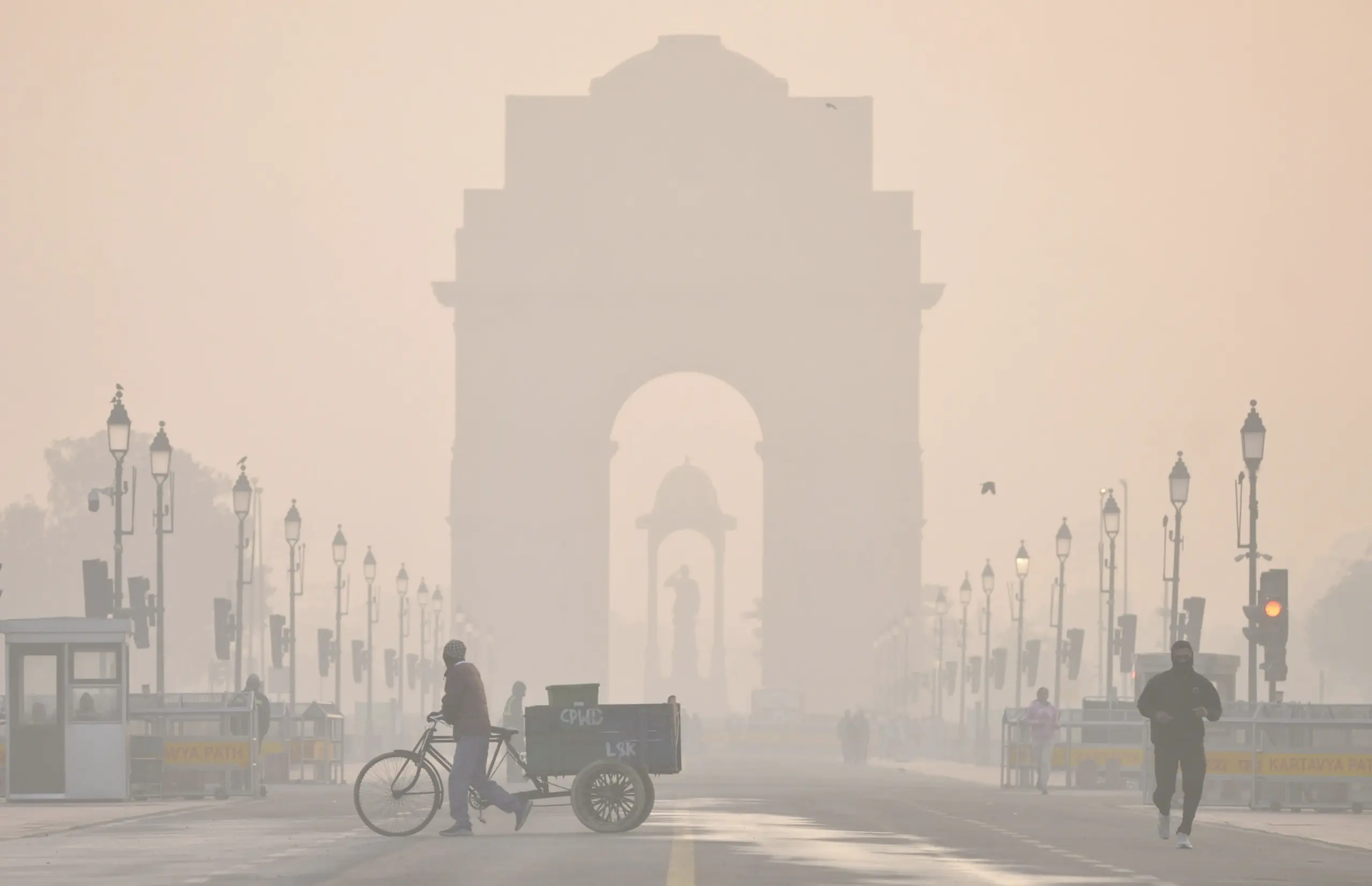
IN late December, a Right to Information reply from the Central Pollution Control Board (CPCB) said that stubble burning contributed only 3.5 per cent to Delhi’s PM2.5 levels this winter.
This fresh change in evidence reopened a curious question – why did Delhi’s air remain poor through December, after stubble burning incidents dropped? Data from the CPCB, the Indian Institute of Tropical Meteorology (IITM) and a year-end analysis by the Centre for Science and Environment (CSE) helps explain this gap.
What the CPCB figures say
According to the CPCB data, stubble burning accounted for about 3.5 per cent of Delhi’s PM2.5 between October and December. This share was 10.6 per cent last year, 11 in 2023, 9 in 2022 and 13 per cent in 2021 and 2020. The contribution is estimated using satellite-based fire counts and air quality models that track smoke movement.
The reply also notes that source contribution estimates for PM2.5 are still based on the 2018 TERI-ARAI source apportionment study.
After stubble burning ends
CSE’s December analysis compares two phases: October-November, when farm fires are active, and December, when their impact drops. The results show that air quality worsens after the stubble season ends.
During October and November, Delhi’s average PM2.5 level was 163 micrograms per cubic metre. Farm fires contributed about 4.2 per cent on an average, with short peaks in mid-November. In December, when the farm fire contribution fell to about 0.2 per cent, the average PM2.5 rose to 210 micrograms. That is a 29 per cent increase. Delhi recorded more “severe” air quality days in December than during the stubble-burning phase. The worst day of the season was December 14, when the AQI touched 461.
Not just Delhi
Across the National Capital Region, PM2.5 levels increased by 28 per cent in December compared to October-November. Noida saw a 38 per cent rise, Delhi 29, Greater Noida 28, and Gurugram and Faridabad 27 per cent each.
Between December 12 and 15, a smog episode affected multiple NCR cities. Noida recorded PM2.5 levels above 350 micrograms per cubic metre, Delhi above 340, and smaller towns like Baghpat crossed 300. This happened with little influence from farm fires.
Local versus outside sources
IITM’s decision support system (DSS) data for December 1-15 shows that only about 35 per cent of PM2.5 came from sources within Delhi. The remaining 65 per cent came from neighbouring NCR districts and other regions. Stubble burning had a negligible share during this period.
Within Delhi’s local emissions, vehicles were the largest source, contributing 46 per cent. Industry accounted for 22 per cent, households 11 per cent, with construction, waste burning, road dust and diesel generators making up the rest.
Role of secondary pollution
Data on non-refractory PM2.5 shows that only about 39 per cent of winter pollution comes from particles emitted directly by vehicles, industries or fires. Around 61 per cent forms in the air through chemical reactions involving gases such as nitrogen oxide, sulphur dioxide, ammonia and volatile organic compounds.
These secondary particles build up faster in winter due to low wind speeds and shallow mixing heights. A large share consists of aged aerosols transported from outside Delhi, which explains why local action alone does not lead to quick relief. Vehicles play a key role here too, as they emit both particles and precursor gases that later form secondary pollution.
What this means for policy
The CPCB figure of 3.5 per cent shows that stubble burning is not the main driver of December pollution. The CSE analysis supports this.
Manoj Kumar, analyst at the Centre for Research on Clean Energy and Air (CREA), says this indicates a growing role of year-round and regional sources. “As the National Clean Air Programme enters its revision phase in 2026, it’s an opportunity for Delhi-NCR to strengthen the air pollution strategy. Priority must shift toward reduction in emissions from transport, industry, power plants, and other transboundary sources, with a stronger focus on PM2.5 and its precursor gases rather than temporary PM10 centric controls,” he adds.