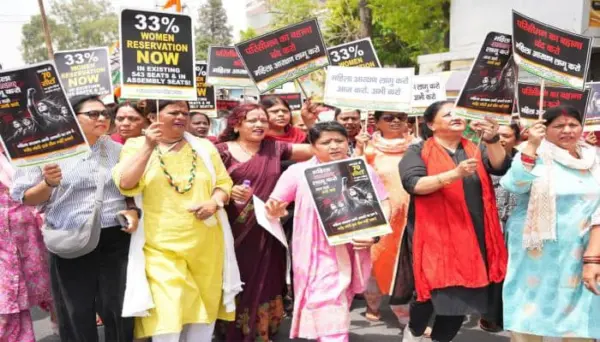
New Delhi: Debate over women’s reservation has brought an unfamiliar term delimitation back into the centre of the conversation.
Parliamentary Affairs Minister Kiren Rijiju and Lok Sabha Leader of Opposition Rahul Gandhi exchanged posts on X over the issue on Saturday (August 8).
While the former said he hoped the Congress would support the women’s reservation bill, the latter responded that the Women’s Reservation Bill had already been passed in 2023. Rijiju then explained that the reservation can take effect only after delimitation.
When Parliament has approved 33 per cent quota for women in the Lok Sabha and state assemblies, why is delimitation needed before the reservation can take effect?
The answer lies in the way the 2023 law was written and in the government’s proposed changes to the delimitation process.
What the Women’s Reservation Act says
The Constitution (106th Amendment) Act, 2023, also known as the Nari Shakti Vandan Adhiniyam, provides for one-third reservation for women in the Lok Sabha and state legislative assemblies. The quota does not apply to the Rajya Sabha or state legislative councils.
The law makes the reservation effective only after a delimitation exercise based on the first census conducted after its commencement. This makes the process dependent on three steps census, delimitation and implementation of the women’s quota.
This is where the 2029 Lok Sabha election enters the picture.
The census is scheduled around 2026-27, and a delimitation exercise based on those results is unlikely to be completed before the 2029 general elections under existing rules. That would make it difficult to introduce the women’s quota in the 2029 election without changing the legal provisions.
Why delimitation is needed
Delimitation means redrawing the boundaries of electoral constituencies and adjusting their representation according to population.
The last major delimitation exercise was carried out through the Delimitation Commission constituted in 2002, with its orders finalised in 2008. The number of Lok Sabha seats allocated to states has been frozen under constitutional provisions for several decades. The freeze was first extended in the 1970s and later continued until 2026.
The government introduced a set of bills in April 2026 to change these rules. The Constitution (131st Amendment) Bill, 2026, along with the Delimitation Bill, 2026 and related legislation, sought to enable a delimitation exercise based on the 2011 Census.
The proposal also sought to increase the maximum strength of the Lok Sabha from the present 543 elected members to 850. The proposed ceiling included up to 815 seats for the states and 35 for Union Territories.
What the proposed plan would change
The proposed constitutional changes would allow the delimitation process to begin using the 2011 Census instead of waiting for the next completed census exercise.
The plan also sought to create the legal provisions needed to implement women’s reservation after delimitation. Under the proposal, one-third of the seats in the Lok Sabha and state assemblies would be reserved for women.
The larger Lok Sabha would also change the number of seats available for women. Based on the proposed strength of 850, one-third would work out to around 281 seats.
The government’s stated aim was to make the women’s quota available from the 2029 general election. The Centre argues that waiting for the next census and a subsequent delimitation exercise can push implementation beyond 2029.
Why the bill ran into Opposition
The proposed changes need a constitutional amendment, which requires a special majority in Parliament. The Constitution (131st Amendment) Bill failed to secure the required two-thirds majority in the Lok Sabha in April. It received 298 votes in favour and 230 against and fell short of the 352 votes required. The government subsequently halted it.
The issue has since returned to political negotiations, with the government seeking support for its delimitation plan and the Opposition raising objections over how the process should be carried out.
The Congress has argued for implementing women’s reservation within the existing strength of the Lok Sabha rather than making it dependent on an increase in seats. The party has also pushed for delimitation based on 2011 census.
The disagreement goes beyond women’s reservation. Delimitation can change the number and boundaries of constituencies across states, which can also change how political representation is organised.
Can women get reservation without delimitation?
Under the 2023 Women’s Reservation Act, the reservation depends on delimitation. That is why the government has sought constitutional changes that would allow the process to be completed in time for the 2029 Lok Sabha elections.
The proposed 2026 bill was intended to provide that route. Since the amendment did not secure the required majority, it has not become law.
The debate is about how to implement the 2023 law and what changes are needed before the 2029 elections.
The 2023 law provides 33 per cent reservation for women. Delimitation will decide the new constituencies, and the proposed changes aim to make the quota possible by the 2029 Lok Sabha elections.