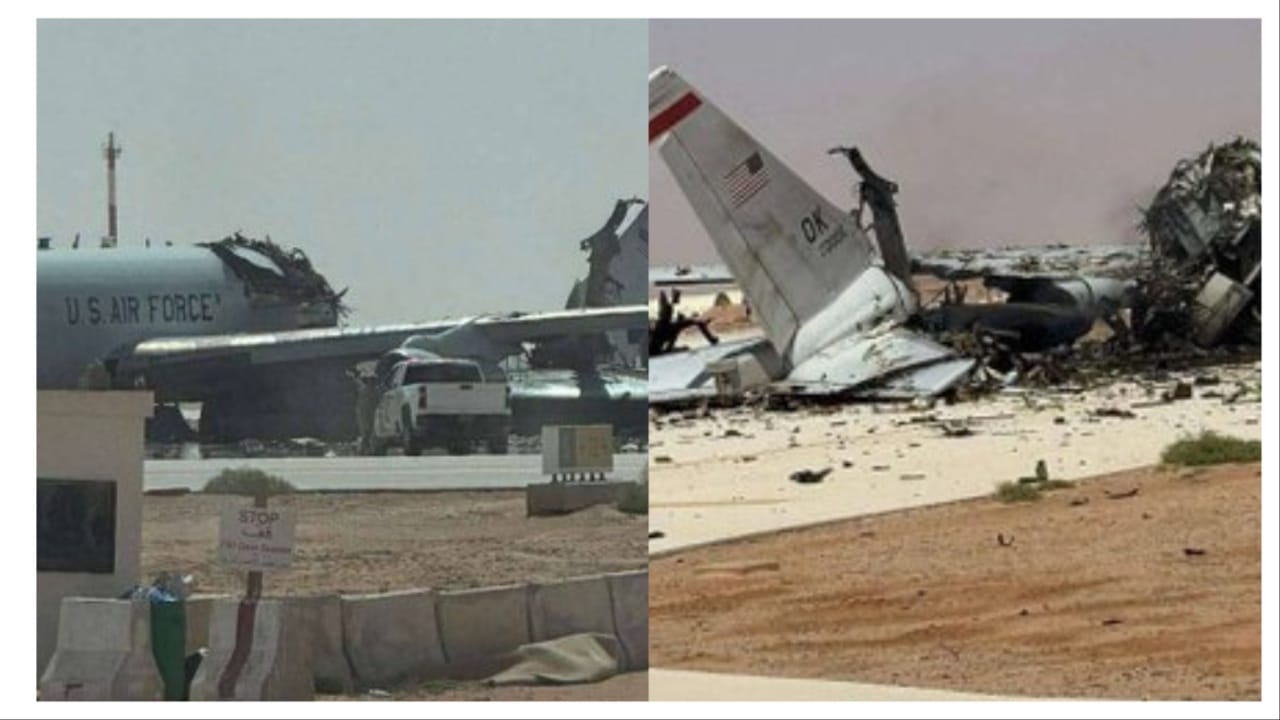
New Delhi: A key US Air Force E-3 Sentry Airborne Warning and Control System (AWACS) aircraft was damaged in a Friday (March 27) strike from Iran at Prince Sultan Air Base. The loss marks the first known combat loss for that type, as the plane costs roughly $300 million.
According to people familiar with the matter, the so-called AWACS plane left more than 10 injured and has also damaged aerial refuelling tankers stationed at the base. Since then, the unverified images of the jet showed its tail completely damaged, rendering it unflyable.
The Iranian attack on Prince Sultan Air Base in Saudi Arabia was larger than expected.
Multiple refueling aircraft and an E-3 Sentry AWACS were reportedly among the planes damaged in the strike.
At least 15 U.S. troops were wounded, including five who were seriously injured. https://t.co/PV00pVmyv3 pic.twitter.com/0qJM0z0K21
— Egypt’s Intel Observer (@EGYOSINT) March 28, 2026
As reported by Air & Space Forces Magazine, US Central Command didn’t immediately respond to a request for a comment on the loss. The US has not lost any crewed planes to enemy fire as they shot down a dozen of MQ-9 Reaper strike drones.
What does this mean?
The damage to the Boeing E-3 Sentry could directly impact the battlefield. Iran’s decision to strike at Prince Sultan Air Base was not random, as it was strategically planned. The base is the most important US military hub in the region, which makes it a clear high-value target.
A former F-16 pilot and analyst at the Mitchell Institute, Heather Penney, also described the loss as “incredibly problematic”, noting that the AWACS platforms are very crucial for the battlefield as it helps in airspace management and targeting.
In the experts’ view, in the absence of E-3, the Air Force will struggle in battlespace awareness and might even miss the opportunities to target adversary forces.
What exactly is E-3 Sentry?
The Boeing E-3 Sentry is a command and control centre. It has a strong rotating radar disc, which helps in spotting distant threats and directing other combat aircraft. It provides an advantage on the battlefield and as per open sources, US operators have more than 60 such and they can easily replace the loss, but the destruction of one is also costly.
It provides real-time images to the commanders across a massive area operating thousands of feet in the sky. It works as the eye and brain of the entire operating system.
So far, the damage is being reported on both ends. On one front, the US bombers are continuously striking targets in Iran with long-range strike cruise missiles. On the other side, Iran has launched more than 1,200 ballistic missiles at targets in the region, damaging several KC-135s on the ground at an airbase. And now with one E-3 down the next move from US ends will be crucial.