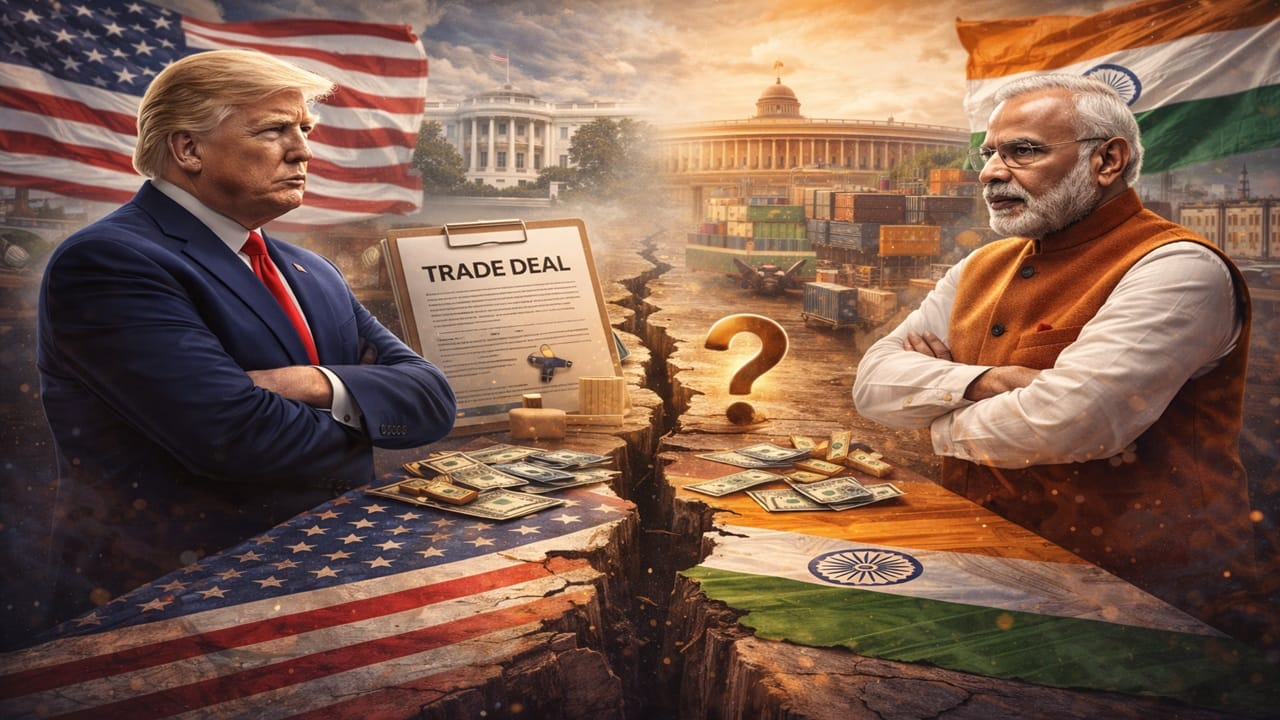
There may be an obstacle to the tariff on pulses on the trade deal between America and India.Image Credit source: ChatGPT
As the long pending bilateral trade deal between India and America reaches the final phase, an old but sensitive issue has come to the fore again. In a letter written to President Donald Trump by two influential Republican senators, India has been urged to remove tariffs on the export of American pulses. This could bring a new twist to the talks which have already dragged on for almost a year. Although this demand may seem small, it directly hurts some of India’s strict agricultural policies and ambitions to become self-reliant in pulses, thereby creating another problem for an already delicate deal.
American pulse industry’s complaint
Republican senators Steve Daines (Montana) and Kevin Cramer (North Dakota), representing America’s two largest pulse producing states, have called the pulse tariffs imposed by India as “unfair” and harmful to American farmers. In her January 16 letter to Trump, she highlighted India’s dominance as the world’s largest consumer of pulses, accounting for about 27 percent of global consumption, and argued that the high tariffs imposed by India prevent US producers from accessing this important market.
Their main concern is India’s announcement of a 30 per cent tariff on yellow peas in October last year, effective from November 1, 2025. According to the senators, such measures would cause significant harm to American exporters, regardless of the quality of American products. He urged Trump to give priority to pulses in any future trade agreement with India.
He reminded that during Trump’s first term, he had raised this issue ahead of the 2020 trade talks with India, and Trump himself handed over his letter to Prime Minister Narendra Modi, which helped American producers come to the negotiating table. The lawmakers said in the letter that as the United States tries to balance trade disparities, American farmers stand ready to help close the gap. If trade opportunities are opened up, they have immense potential to provide food and fuel to the world. In their 2020 letter, written before Trump’s visit to India that year, the senators said “unfair” Indian tariffs on pulses had significantly harmed US pulse producers.
India’s tariff policy is not limited to one country
Although the senators’ letter described these tariffs as discriminatory against the US, India’s policy on pulses is much more complex. In fact, New Delhi had not imposed any duty on the import of yellow peas till March 31, 2026. The subsequent decision to impose tariffs was driven by domestic political economy considerations rather than bilateral trade tensions. Indian farmers, facing falling prices due to a flood of cheap imports, had put pressure on the government to take action.
Importantly, this duty applies equally to all exporting countries, including Canada, which is one of the largest suppliers of pulses to India. Therefore, from India’s perspective, this measure is a safeguard measure to protect domestic farmers and stabilize prices, and not an action against the US.
A new turn in trade talks?
Statements from both sides indicate that India-US trade talks are in the final stages. The new US Ambassador to India, Sergio Gore, recently acknowledged the complexity of the talks and expressed his determination to finalize the agreement. India’s Commerce Secretary Rajesh Aggarwal had also indicated a few days ago that most of the issues have been resolved, only a few matters are under discussion.
It is in this context that the intervention of senators has become important. Raising a controversial agricultural demand at this level risks reviving debates that negotiators may have deliberately postponed to maintain momentum. Pulses and milk production are among the areas where India has drawn a Lakshman Rekha.
Agriculture and dairy production have long been the most challenging areas in India-US trade talks. India has repeatedly refused to provide open or duty-free access to US agricultural products, citing concerns over farmer livelihoods, food security and structural differences in the agricultural systems of the two countries. Pulses are at the center of these concerns.
These are not just a commodity, but a major source of protein for millions of people, especially lower income group families. Additionally, any move to weaken domestic producers could pose a political risk to the Indian government. This is widely believed to be a major reason for the trade agreement not yet being signed despite progress in other areas.
India’s strategic effort for self-reliance in pulses
Being the largest producer, consumer and importer of pulses in the world, India has made domestic capacity building its policy priority. In October last year, the government approved the Self-Reliance Mission in Pulses, a six-year initiative running from 2025-26 to 2030-31 with a budget of Rs 11,440 crore.
The mission aims to increase pulses production from about 24.2 million tonnes to 35 million tonnes, increase productivity from 880 kg per hectare to 1,130 kg per hectare and develop high-yielding, pest-resistant and climate-resilient varieties.
With production already estimated at 25.23 million tonnes in 2024-25 and a target of 27 million tonnes set for 2025-26, the policy direction is clear that the role of imports will decline over time, not increase.
Despite these ambitions, India remains a major importer of pulses, importing a record 73 lakh tonnes of pulses in 2024-25. About 15-18 per cent of domestic consumption is still met through imports, mainly from Africa, Myanmar, Canada, Russia and Australia. This dependence also creates a contradiction. While on one hand imports are necessary to control shortages and price fluctuations, on the other hand excessive dependence weakens domestic incentives and farmers’ confidence.
Therefore, tariff flexibility becomes a policy instrument that India adjusts depending on the production cycle and political pressures. Ensuring tariff-free access to US pulses through a trade agreement would limit this flexibility to a great extent, which Indian policy makers would hardly accept.
Will the issue be resolved?
The senators’ demand will not delay the India-US trade agreement, but it will definitely complicate it. For the US, domestic agricultural politics, especially in major producing states, cannot be ignored. For India, granting concessions on pulses would be contrary to both its negotiating policy and its strategic investment in agricultural self-reliance.
Due to which, like dairy and other agricultural products, pulses may also become an unresolved issue outside the final agreement. Whether the Trump administration aggressively raises the issue or quietly sidesteps it will determine whether this new issue only creates tensions or reopens rifts that were previously thought closed.