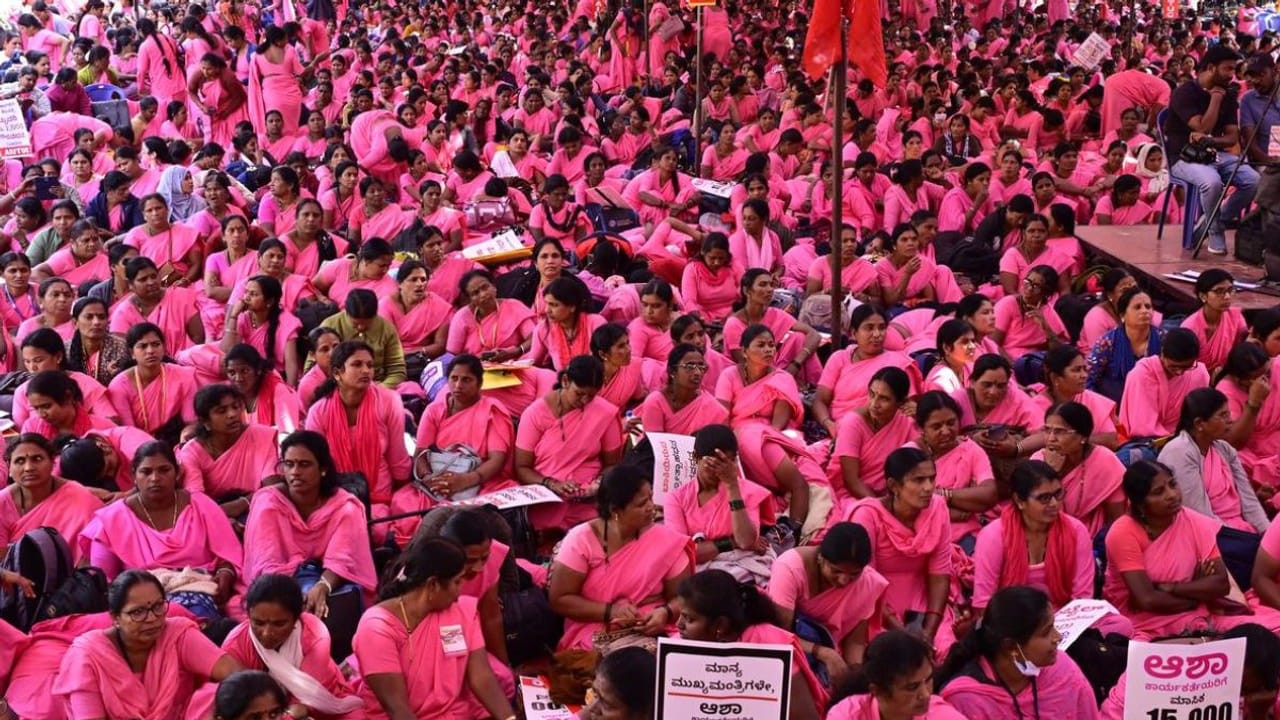
Karnataka’s ASHA workers have been protesting for better pay and benefits. Know the full form of ASHA, their roles in India’s public healthcare system, monthly honorarium and key demands.
Thousands of Accredited Social Health Activists (ASHA) workers from various districts of Karnataka have gathered at Freedom Park in Bengaluru to stage an indefinite protest, demanding better remuneration, job security and social security benefits. The protest, which has entered its seventh day, has once again brought attention to the challenges faced by these frontline healthcare workers, who have been serving communities for nearly 17 years. Their key demands include a fixed monthly honorarium of at least ₹15,000, maternity leave, mobile allowances, retirement benefits and the release of pending incentive payments.
Despite playing a crucial role in implementing government healthcare programmes and connecting people with medical services, ASHA workers continue to work without the status of permanent government employees. Their protest has raised important questions about who ASHA workers are, what responsibilities they perform, how they are paid and how their remuneration compares with that in other states.
Who Are ASHA Workers?
Accredited Social Health Activists, commonly known as ASHA workers, are community-based female health volunteers who serve as a link between the public and the healthcare system under the National Health Mission (NHM).
The ASHA programme was introduced in 2005 to strengthen community-level healthcare services, particularly in rural and underserved areas. ASHA workers are selected from within their own communities, allowing them to understand local health concerns and communicate effectively with families.
They play an important role in bringing healthcare services closer to people, especially pregnant women, newborns, children and families who may face difficulties accessing hospitals or health centres.
ASHA workers also encourage community participation in government health programmes and help ensure that information about healthcare schemes reaches households.
One ASHA Worker For Every 1,000 People In Rural Areas
Under the ASHA programme, there is generally one ASHA worker for every 1,000 people in rural areas. In urban slums and underserved areas, the population coverage may be around one ASHA worker for every 2,500 people.
An ASHA worker typically maintains regular contact with approximately 250 to 300 families, depending on the area and local population.
Their responsibilities include conducting household visits, identifying health concerns, providing basic health information and helping people access appropriate medical services.
However, ASHA workers are not permanent government employees. They receive performance-based incentives for various health-related activities, along with additional remuneration provided by state governments.
What Are The Duties Of ASHA Workers?
ASHA workers perform a wide range of responsibilities at the community level. Their work includes maternal and child healthcare, immunisation, disease prevention, health awareness and coordination with public health institutions.
Maternal And Child Healthcare
One of the most important responsibilities of ASHA workers is to monitor the health of pregnant women and newborns.
Their duties include:
- Registering pregnant women, preferably during the first 12 weeks of pregnancy.
- Ensuring that pregnant women undergo the four recommended antenatal check-ups.
- Providing information about safe pregnancy, childbirth and postnatal care.
- Encouraging women to receive the required tetanus vaccination and take iron and calcium supplements.
- Identifying high-risk pregnancies and reporting them to the concerned health authorities.
- Supporting women in accessing institutional delivery services.
- Encouraging eligible women to consider postpartum intrauterine contraceptive device (PPIUCD) insertion within 48 hours of childbirth.
- Conducting follow-up visits for low-birth-weight infants and babies discharged from Special Newborn Care Units (SNCUs).
- Monitoring breastfeeding and the health of newborns.
ASHA workers also help update information about pregnant women and children under 24 months of age on the Reproductive and Child Health (RCH) portal through the designated health authorities.
Immunisation And Child Health
ASHA workers help ensure that children receive their vaccinations on time by identifying eligible beneficiaries and encouraging families to attend immunisation sessions.
They also monitor the health of children in their assigned areas and provide follow-up support when required.
Their responsibilities include:
- Maintaining lists of children due for vaccination.
- Assisting health centres during immunisation programmes.
- Reporting infant deaths to the concerned authorities.
Household Visits And Health Records
Regular household visits form an essential part of an ASHA worker’s routine.
During these visits, they assess the health needs of families, identify people who require medical attention and provide information about available healthcare services.
They also maintain records such as:
- Village Health Registers.
- Lists of pregnant women.
- Records of children due for vaccination.
- Details of eligible couples.
- Family health information.
These records are updated through household surveys and submitted to the Medical Officer at the Primary Health Centre (PHC) every six months.
ASHA workers are also required to report information about pregnant women and children to their ASHA Facilitator within the prescribed period. This includes details of births and other important health events.
Health Awareness And Community Meetings
ASHA workers conduct health awareness activities to educate people about preventive healthcare, hygiene, nutrition and government health programmes.
They provide health information, education and communication (IEC) services and counsel women and families on various health-related issues.
They also participate in community-level health meetings, including Village Health and Nutrition Days, and support the functioning of Village Health, Sanitation and Nutrition Committees.
In addition, they attend monthly progress review meetings at Primary Health Centres and coordinate with healthcare staff to improve the delivery of services.
Disease Prevention And Healthcare Support
ASHA workers play an important role in identifying and supporting people affected by communicable and non-communicable diseases.
Their responsibilities include:
- Creating awareness about communicable diseases and preventive measures.
- Identifying people with symptoms of tuberculosis (TB) and helping them access testing and treatment.
- Identifying suspected leprosy cases and assisting patients in obtaining medical care.
- Participating in non-communicable disease prevention and screening activities.
- Supporting Universal Health Coverage (UHC) initiatives.
- Monitoring the health of adolescent girls and providing necessary guidance.
- Helping people access healthcare services through Primary Health Centres and other medical institutions.
They are also required to report deaths of women aged 15 to 49 years and infant deaths within their assigned areas to the concerned authorities.
As part of their responsibilities, they may also undertake other health-related activities assigned by the government.
What Is The Honorarium For ASHA Workers In Karnataka?
According to the ASHA Workers’ Association, ASHA workers in Karnataka receive a monthly honorarium of ₹5,000 from the state government.
In addition, they receive approximately ₹3,000 to ₹3,500 in incentives from the Central Government for various health-related activities.
They are also eligible for additional performance-based incentives for specific responsibilities, including childbirth-related services, immunisation programmes and tuberculosis control.
The total monthly remuneration may therefore vary depending on the number of activities performed and the incentives earned.
However, ASHA workers in Karnataka are demanding a fixed monthly honorarium of at least ₹15,000, arguing that their workload and responsibilities require better financial security.
How Much Do ASHA Workers Earn In Other States?
The remuneration provided to ASHA workers differs across states, depending on the contributions made by the Central and state governments and the performance-based incentives available.
According to the figures provided, the remuneration levels in some states are as follows:
- Karnataka: ₹5,000 from the state government, along with approximately ₹3,000 to ₹3,500 in Central incentives. The total is around ₹8,000 to ₹8,500, excluding any additional task-based incentives.
- Andhra Pradesh: ₹10,000 in combined contributions from the Central and state governments.
- Kerala: ₹12,000 from the state government, in addition to performance-based incentives.
- Haryana: ₹15,000 in combined contributions from the Central and state governments.
- West Bengal: ₹11,250 from the state government, along with performance-based incentives.
The figures represent the remuneration details provided for the respective states. Actual monthly earnings may vary depending on the incentive structure and the activities performed by individual ASHA workers.
Why Are Karnataka ASHA Workers Demanding ₹15,000?
ASHA workers in Karnataka are demanding a fixed monthly honorarium of at least ₹15,000, along with maternity leave, mobile allowances, retirement benefits and the release of pending incentive payments.
They argue that their responsibilities have expanded significantly over the years, requiring them to carry out regular household visits, monitor maternal and child health, support immunisation programmes and assist in disease prevention.
Despite their contribution to the healthcare system, they continue to work without the job security and social security benefits available to permanent government employees.
The workers have also pointed out that ASHA workers in some other states receive higher remuneration than those in Karnataka.
During the 2023 Karnataka Legislative Assembly elections, the Congress party had reportedly assured an increase in the honorarium for ASHA workers. The protesting workers are now demanding that the assurance be fulfilled.
ASHA Workers’ Protest Highlights Demand For Better Livelihood Security
The ongoing protest at Freedom Park in Bengaluru has once again highlighted the financial and employment-related challenges faced by ASHA workers.
While they remain an important part of India’s community healthcare system, their demands for a fixed monthly honorarium, maternity benefits, retirement security and timely incentive payments continue to remain central to their struggle.
Their protest has brought attention to the need for better financial support and working conditions for frontline healthcare workers who help deliver essential medical services to communities across the country.