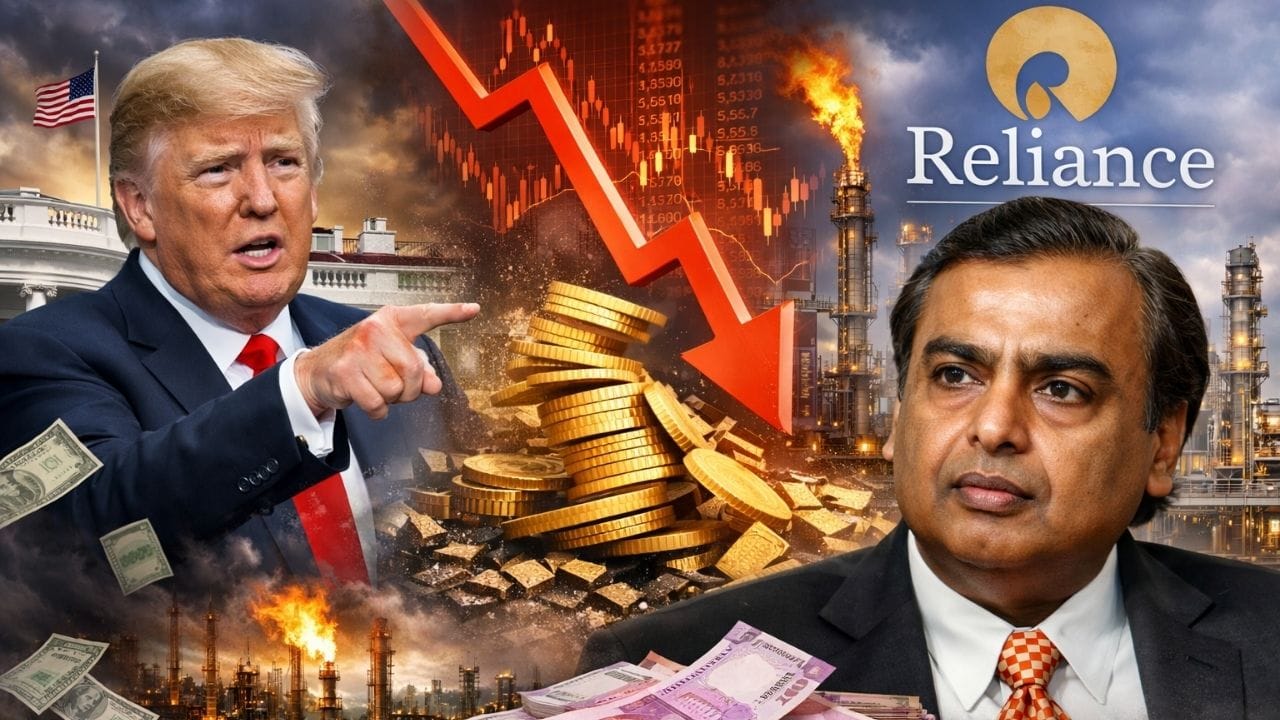
First the ban on Russian oil, then the ban on Russian companies, now the seizure of Venezuelan oil and then the proposal of 500 percent tariff on Russian oil. US President Donald Trump has taken such decisions in the last few months, whose impact has been greatly felt on India. In India too, the deepest impact of these decisions has been seen on Asia’s richest businessman Mukesh Ambani. In the year 2025, there was a good rise in the shares of Reliance Industries.
Even if there was some decline, it did not have much impact. But as the year 2026 begins, the impact of Trump’s decisions is becoming more profound. That too when the shares of Reliance Industries had reached life time high on January 5. Even after that, the company has suffered a loss of Rs 1.4 lakh crore in the current month.
If we look at the data, there has been a decline of about 7 percent in the shares of Reliance Industries in the current year. Although the company’s shares are in the green on Wednesday, but the losses and valuation have reduced so much that people have started betting on it again. However, the investors of the company are waiting for the results of Reliance Industries. From which investors have high expectations.
Experts believe that the earnings of Reliance Retail and Telecom Company may be better in the quarterly results. Also, there may be an increase in the overall profit and revenue of Reliance Industries. After which a rise can be seen in the shares of the company and the losses incurred so far can be compensated. Let us also tell you how Mukesh Ambani’s Reliance Industries has suffered losses due to Trump’s decisions.
Asia’s richest businessman billionaire Mukesh Ambani’s Reliance Industries Limited (RIL), India’s most valued listed company, has suffered a loss of about Rs 1.4 lakh crore by the beginning of 2026. Due to the dual fear of dependence on Russian crude oil and slow growth of the retail sector among competing companies, there has been a rapid change in investors’ expectations, due to which the company’s shares are down about 7 percent year-on-year.
Company shares declined
This decline in the shares of Reliance Industries has been seen when the company’s shares had seen an increase of more than 29 percent in the year 2025. The special thing is that the company’s performance was better than Nifty. But the market environment has deteriorated sharply: concerns over increased dependence on Russian crude as well as apparent weakness in discretionary spending in the organized retail sector have left investors on the fence. On the other hand, the company is preparing to release its December quarter results this Friday.
Yet brokerage firms remain largely optimistic and see 2026 as a “better year” for Reliance. The third quarter results are expected to tell a story of two businesses: strong performance in the energy sector, while ups and downs in the retail sector.
Brokerage firms’ expectations from quarterly results
Mayank Maheshwari of Morgan Stanley has said in the ET report that there will be brightness in the energy sector in the coming quarter, while there will be ups and downs in the retail sector. Income trend remains strong. The consumer retail sector may affect the performance of the stock in the near future.
Morgan Stanley expects EBITDA to grow 10 per cent year-on-year in the December quarter, driven by 16 per cent year-on-year growth in EBITDA in the Oil to Chemicals (O2C) segment due to a pick-up in refining. However, due to reduction in interest and expenses, profit growth is estimated to be only 1 percent on an annual basis. This can be seen especially in the telecom sector.
Goldman Sachs expects O2C EBITDA to see a growth of 11 percent on a quarterly basis and 16 percent on an annual basis. Strong refining income will more than offset the decline in petrochemical income. The brokerage has raised its refining estimates while cutting near-term retail growth estimates, resulting in almost no change in total income.
Gaurav Malhotra of Axis Capital has estimated EBITDA at Rs 467 billion, which is 2 percent increase on quarterly basis and 7 percent increase on annual basis. Oxygen-to-control EBITDA increased due to better refining margins, although this was partially offset by the weak performance of petrochemicals.
Obstacles in the growth of retail sector
The retail sector, which has been the main driver of growth till now, is now facing challenges. Goldman Sachs has cut Reliance Retail’s sales growth forecast for the December quarter to around 10 per cent year-on-year, lower than the earlier estimate of 12 per cent and well below the 21.3 per cent growth recorded in the September quarter.
Goldman analyst Nikhil Bhandari said in a note that in line with trends seen at other companies, we expect a slowdown in third-quarter earnings growth in the retail sector due to reduced discretionary spending, base effect and the festive season.
Morgan Stanley has estimated 9-10 per cent annual growth in the retail sector, assuming a negative impact of 150 basis points due to merger in the consumer products sector. Axis Capital expects a slowdown in retail growth due to high base, festive changes, GST reform and merger of RCPL (Reliance Consumer Products).
Are concerns over Russian crude unfounded?
Despite the recent selloff on concerns about the use of Russian crude, Goldman Sachs argues that these fears are overblown. Bhandari said that we see limited impact of these factors on the company’s medium-term income outlook. Refining fundamentals remain strong due to strong product markets through calendar year 2027, while crude oil margins in alternative grades (including Middle Eastern barrels) are improving, which should help maintain strong refining margins even in the event of further declines in Russian crude oil usage.
The brokerage firm also expressed the possibility of further increase in refining margins in the event of revival in sourcing of crude oil from Venezuela. Morgan Stanley also supported this and said that it would be beneficial due to strong GRM and ultimately the arrival of Venezuelan crude oil.
2026 will be better
Despite some challenges in the near future, brokerage firms believe that 2026 will be an important year for Reliance, with several factors leading to better performance of the shares. Maheshwari said that 2026 is a very important year for the better performance of Reliance shares and like every cycle, there will be some obstacles in this path too. Morgan Stanley has maintained its stance on Reliance with a target of Rs 1,847, with the company expecting to encash over $80 billion of investment under its fourth monetization cycle starting 2026.
Jefferies has maintained Buy rating with a target of Rs 1,830 and has estimated 13 percent growth in EBITDA due to Jio in FY 2027. The brokerage firm expects Jio to see 22 percent revenue growth on an annual basis in FY 2027 due to increase in tariffs in the mobile segment and continued growth of home broadband. The 280 basis point increase in margins is expected to lead to 28 per cent YoY growth in EBITDA, while Jio’s free cash flow is expected to grow by 65 per cent YoY.
Jefferies said investors will focus on JPL’s upcoming listing in 2026, the timing and magnitude of further tariff increases, and the expansion of its FWA offering. He described the increase in tariff and listing of Jio by mid-2026 as the main factors. Other factors include 15 per cent growth in the retail sector in FY 2027 and value discovery in FMC, new energy and data center businesses during FY 2027-28.
Valuation got support
The recent fall has also provided some support to the valuations. Axis Capital said that Reliance’s stock is trading at 10.7 times one-year forward EV/EBITDA, which is about 11 per cent lower than the average of the last five years, and the company has given it a buy rating. Morgan Stanley expects earnings CAGR of 12 per cent during FY 2025-28, mainly due to acceleration in refining cycle, global slowdown in chemicals, growth in new energy and monetization of retail and digital investments.
Brokerages are of the view that short-term volatility may persist due to retail market weakness and crude oil procurement concerns, but a number of factors ranging from Jio’s much-awaited IPO and tariff hike to upcycle benefits of refining and increase in new energy production indicate that this selloff could create an entry opportunity for patient investors who are willing to look beyond the noise.
Slight rise in company’s shares
By the way, there is a slight rise in the shares of the company on Wednesday. If we look at the data, at 2:25 pm the company’s shares are trading at Rs 1,458.15 with a rise of 0.50 percent. However, during the trading session, the company’s shares had also reached the day’s high of Rs 1,466.80. However, on January 5, the company’s shares reached a record level of Rs 1,611.20. Since then, the company’s shares have seen a decline of about 10 percent. Due to which the market cap of the company has come below Rs 20 lakh crore.