India’s eastern coastline, long considered its quieter flank, has turned into a fresh point of tension. A string of defence deals between China and Bangladesh covering fighter jets, drones, ports and airfields, along with growing Pakistani defence and intelligence links in Dhaka, have all added to the unease.
The warning signs were laid out plainly by Pakistan’s chief of defence forces, Gen. Asim Munir, who said in August 2025 that in any conflict, “We will start from the east.” Now Islamabad appears to be backing that rhetoric with real naval moves near India’s eastern seaboard.
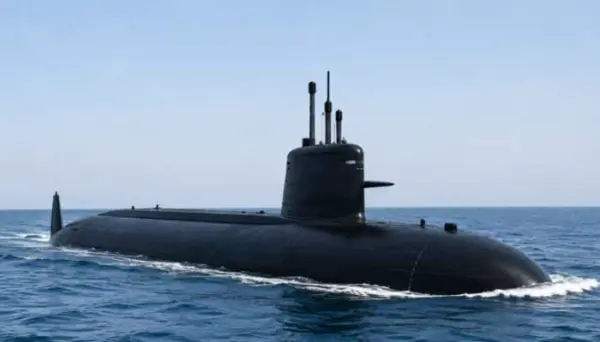
In April, Pakistan commissioned the first of eight Hangor-class diesel-electric submarines being built for its navy by China. The vessel completed its delivery run from China last month, sailing via Colombo before reaching Karachi.
According to an India Today report, speaking at a naval event in Colombo, Commodore Omer Farooq, the mission escort commander for PNS Hangor, remarked that the submarine would give Pakistan “the reach to maintain a presence in the Bay of Bengal.” That single line caught New Delhi’s attention, since a genuine Pakistani presence there would be the first since 1971, when the country lost its foothold in the eastern seas.
Stretching across roughly 2.6 million square kilometres, the Bay of Bengal is far from a peripheral concern for India. It hosts the Eastern Naval Command at Visakhapatnam alongside INS Varsha, the country’s closely guarded nuclear submarine base. Any Pakistani submarine lurking nearby could complicate surveillance around these sites, and the bay also carries major shipping routes connecting India to Southeast Asia, making unwelcome naval visitors a genuine worry, reports added.
As per reports, defence analysts point out that the Hangor-class boats, built as export versions of China’s Yuan-class submarines, could give Pakistan the means to run covert missions across the northern Indian Ocean and into the Bay of Bengal. Their air-independent propulsion systems allow them to stay submerged for up to three weeks without surfacing, a significant leap for a conventional submarine fleet.
Should Pakistan manage to push its submarines eastward, India would effectively need to guard two coastlines at once. There is a further complication: since Pakistan’s fleet is largely Chinese-built, closer coordination with the People’s Liberation Army Navy becomes more likely, raising the spectre of a combined Pakistan-China presence in waters India considers its own backyard. In a wartime scenario, submarines operating in the bay could threaten merchant shipping and disrupt naval supply lines, including those feeding the Andaman and Nicobar Islands.
History offers a precedent. Pakistani submarines have kept largely to the North Arabian Sea since 1971, the year PNS Ghazi sailed from Karachi into the Bay of Bengal and patrolled off Visakhapatnam for several days before being sunk.
Islamabad’s broader naval modernisation goes well beyond submarines. The plan includes new frigates, corvettes, long-range maritime patrol aircraft, and greater cyber and space capability, but the Hangor-class boats remain its flagship project. The lead vessel, PNS Hangor, has already entered service, with PNS/M Shushuk, PNS/M Mangro and PNS/M Ghazi expected to follow. Each is fitted with air-independent propulsion, modern sensors, heavyweight torpedoes, anti-ship missiles and the nuclear-capable Babur-3 cruise missile, giving Pakistan both extended range and a credible second-strike option.
Former Chief of the Naval Staff, Admiral Sunil Lanba (retd), believes a Bay of Bengal deployment is technically possible if the Hangor has sufficient range, though its usefulness would be limited without a port for operational turnaround. “We would need to assess how many of these submarines are operationally available and the most likely areas of their deployment. If one considers the possibility of a Hangor being deployed off a harbour on the east coast, then anti-submarine operations would need to be intensified in that area,” he says, as per the reports.
Vice Admiral A.K. Singh, a former submariner, shares that view but adds a caveat – such deployments would only work if Pakistan can secure refuelling access in Bangladesh, something he believes could take years for Pakistan’s navy to operationalise reliably for long-range missions.
Indian military experts see BNS Pekua, Bangladesh’s easternmost naval base near Cox’s Bazar, as the likeliest candidate to support any Hangor deployment. Access to Pekua would considerably extend a submarine’s time at sea, but it would come at a cost: a visible port call would make it far easier for India to track the vessel, stripping away the stealth that makes submarines valuable in the first place.
The idea of Pakistan gaining access to Pekua is not so unlikely given how quickly Dhaka-Islamabad relations have warmed since Sheikh Hasina’s government fell in 2024. Diplomatic and military exchanges between the two have picked up pace, alongside wider defence cooperation. In November 2025, the Pakistan Navy frigate PNS Saif docked at Chattogram, the first such visit by a Pakistani warship to Bangladesh since 1971. The two countries also took part together in exercise AMAN, held in the North Arabian Sea in February 2025.
None of this necessarily points to a formal alliance, but it does suggest a steady widening of defence ties, one that fits neatly with China’s “String of Pearls” strategy of extending influence around India’s periphery.
China remains Bangladesh’s chief partner in naval development. Under its Forces Goal 2030 programme, Beijing has supplied two Type 035G Ming-class diesel-electric submarines and built the BNS Pekua submarine base, opened in 2023, which can house up to six submarines and eight warships along with full maintenance facilities. Combined with Chinese-backed upgrades at Chattogram and Mongla, Pekua fits into a wider Chinese Indian Ocean strategy, one that, paired with Pakistan’s largely Chinese-origin fleet, adds fresh complexity to the region’s maritime balance.
Bangladesh is also said to be using Chinese funding to develop an air base at Lalmonirhat, along with a nearby hangar just 16 kilometres from the Siliguri Corridor, the narrow 22 kilometre strip of land connecting India’s mainland to its north-eastern states, a project that has done little to ease New Delhi’s concerns.
Rear Admiral Anil Chawla, former chief of the Southern Naval Command, draws a line between such peacetime manoeuvring and what might happen in an actual conflict, when Bangladesh could be drawn into a war it likely wants no part of. Maintaining strong ties with Dhaka, he argues, matters precisely because of this risk. “We will have to divide attention between both coasts, which will mean more resources,” he says. “Even AIP-equipped subs have limited endurance, and the Bay of Bengal is a long way off from Pakistan. It is unlikely they will get support facilities in wartime. That is what we need to prevent.”
India’s underwater strength
India’s submarine capability remains one of the sturdiest pillars of its maritime defence. The navy runs an expanding mix of conventional and nuclear-powered submarines, backed by advanced surveillance systems, maritime patrol aircraft and well-placed bases. The Eastern Naval Command at Visakhapatnam lets India keep watch over vital sea lanes, protect sensitive installations and sustain a credible underwater presence across the Bay of Bengal.
Further support comes from the Andaman and Nicobar Command, India’s only tri-service command, positioned near the Strait of Malacca chokepoint to track naval activity across the eastern Indian Ocean. Paired with satellite surveillance, long-range patrol aircraft, surface warships and anti-submarine warfare units, this gives India a layered defensive network beneath the waves.
At the heart of this deterrence sit the three Arihant-class nuclear-powered ballistic missile submarines, the maritime leg of India’s nuclear triad. Plans are also under way to grow the conventional fleet with additions such as the French-origin Kalvari-class, while a joint project with German shipbuilder ThyssenKrupp Marine Systems to build six AIP-equipped diesel-electric submarines continues to move forward.
For now, Pakistan’s push into the east remains more a statement of intent than an operational reality. Still, the combination of new submarines, thawing ties with Bangladesh and closer alignment with Chinese interests marks a real shift in Islamabad’s maritime outlook, one that will test how India balances diplomacy, surveillance and naval strength across its eastern waters in the years ahead.