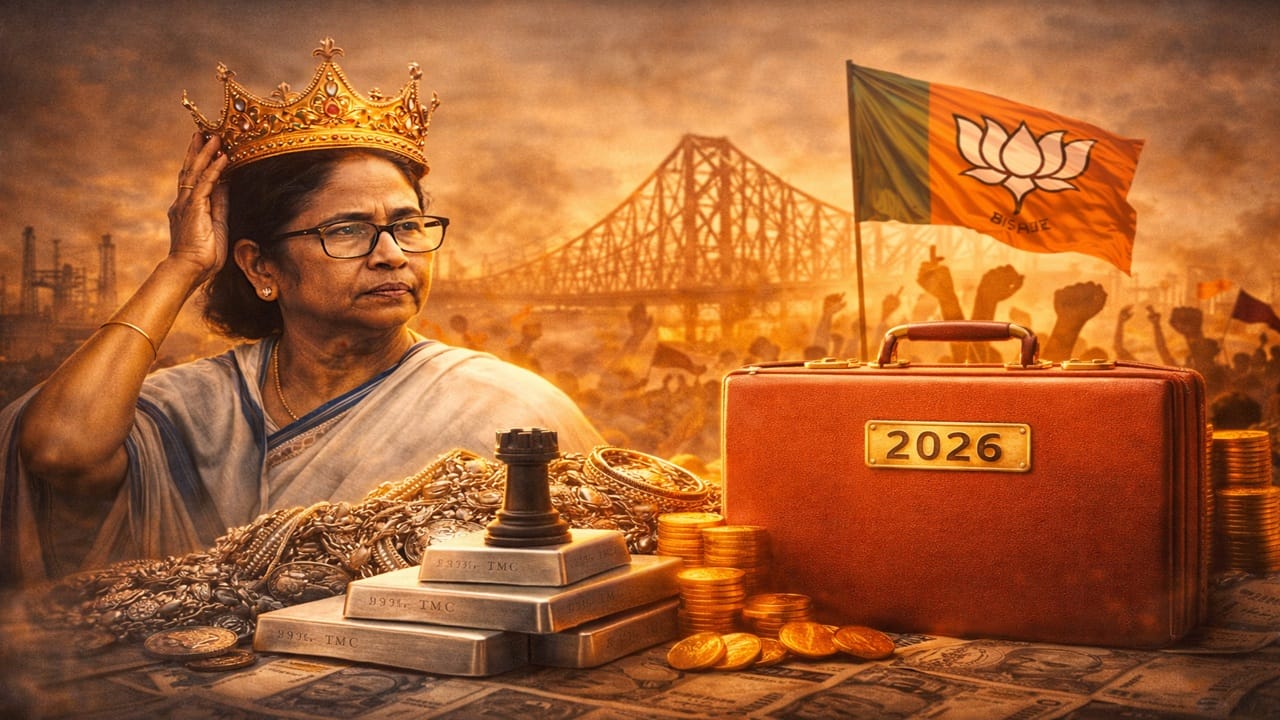
As New Delhi prepares to present the Union Budget 2026, in West Bengal which is preparing for elections, this document is being seen not only as an economic statement but also as a political statement. Time is very important for Bharatiya Janata Party. West Bengal remains one of the toughest electoral challenges for the party. Because of which Budget 2026 has also become very important before the Bengal elections. If experts are to be believed, the current central government can take the help of the budget to demolish Mamata’s impregnable fort. In which she can make such announcements for Bengal, which have never been made before. Let us try to understand in detail how Bengal elections and Budget 2026 are complementing each other.
Budget 2026 and its importance
In recent years, the central government has been accused of using budgetary signals to influence the electoral environment in key states. The most prominent example of this came from Bihar, where many important announcements were made in the last budget. The July 2024 budget outlined over Rs 60,000 crore of infra and development projects for the state, along with commitments such as Rs 11,500 crore specifically for flood control. These moves were widely seen as strengthening the political message in the ally state which is preparing for elections.
The political class in West Bengal is now raising the question whether a similar approach will be adopted in Budget 2026 – not through direct “special packages” – but through subtle fiscal options that can reshape the electoral discourse. Further strengthening these expectations, Prime Minister Modi recently flagged off India’s first Vande Bharat Sleeper train connecting Howrah and Guwahati (Kamakhya) from Malda Town Railway Station.
Later on the same day, he also virtually inaugurated the Guwahati-Howrah return Vande Bharat Sleeper train. This initiative strengthens rail connectivity in election-bound West Bengal and also reflects the development vision of the Central Government. During his two-day visit to eastern India, Prime Minister Modi inaugurated several rail and road projects and laid the foundation stone of projects worth Rs 3,250 crore.
Before flagging off the train, Union Railway Minister Ashwini Vaishnav highlighted the wide scope of the ongoing railway development. Vaishnav said that under the Amrit Bharat Station Scheme, 101 stations in West Bengal are being redeveloped. Prime Minister Modi has allocated Rs 13,000 crore for railway development in the state.
Pressure on federal structure
The question of fiscal federalism has arisen at the center of this debate. Leaders of both the ruling Trinamool Congress and the opposition CPI(M) argue that the nature of Centre-state relations has fundamentally changed since 2014. According to CPI(M) general secretary Mohammed Saleem, India “has moved from cooperative federalism to repressive federalism, where financial transfers depend on political alliances.” TMC spokesperson Dr Pradipta Mukherjee was even more blunt, calling the approach to the Union Budget “vote bank politics” rather than cooperative governance.
He said in the ET report that the central government gives priority to allocation on the basis of electoral gains rather than the actual needs of the states. He pointed out the glaring contradiction between the high-level attention given to Bihar elections by the Center and its continued neglect of West Bengal.
Meanwhile, Kolkata-based political analyst Tanya Bagchi said in an ET report that the central government is talking about cooperative federalism, but the budget has not given enough scope to the states to plan according to their priorities. For a large and diverse state like Bengal, greater certainty in fund flow and decision making is extremely important. However, the BJP-led central government has repeatedly rejected allegations of political vendetta and insisted that the release of funds is controlled by accountability and compliance standards.
MNREGA is an important issue
No program reflects this conflict more clearly than MNREGA – which is now being replaced by the Devolved India-Employment and Livelihood Mission (Rural) Act, 2025 (commonly called VB-GRAMG) after passage by Parliament and assent by the President in December 2025. The new law retains rural employment support while amending the structure, funding and statutory guarantees of the old scheme. However, the scheme remains a financial lifeline in rural Bengal, where guaranteed employment is extremely important due to seasonal migration and agricultural distress.
The central government stopped the release of MGNREGA funds to West Bengal in March 2022 under Section 27 of the Act, citing non-compliance with rules and alleged irregularities. Union Rural Development Minister Giriraj Singh later said the funds would be released only when the Center is satisfied with transparency and accountability. This dispute reached the courts.
In June 2025, the Calcutta High Court ordered the Center to restart MNREGA in West Bengal from August 1, 2025, ending the three-year ban. By November 2025, the High Court was pressurizing both the parties for the dues, while the Center continued to allege misappropriation and the petitioners continued to demand payment of wages. For TMC, this ban became political evidence of punishment.
Dr Mukherjee said that because the ruling party at the Center failed to win the state elections in Bengal, they are now ‘punishing’ the state by withholding financial resources. Meanwhile, the CPI(M) leader put the issue in even sharper terms, calling MNREGA the “biggest victim” of fiscal pressure, while the national allocation remains at Rs 86,000 crore.
Mohammad Salim said in the ET report that we are seeing a dangerous example where the central government is using standards to bypass statutory obligations. Its biggest victims are the poor people of West Bengal. While the national allocation of Rs 86,000 crore has been retained in the Budget 2025-26, West Bengal has been kept out of it since the end of 2021.
Housing and Education
MNREGA is just a front. Funds for Pradhan Mantri Awas Yojana (PMAY) and overall education have also become politically sensitive issues. In March 2025, a parliamentary committee had urged the Education Ministry to resolve the PM-Shri and Samagra Shiksha disputes and release pending funds to West Bengal and other states, while warning that students should not suffer due to administrative conflicts. Dr. Mukherjee said in media reports that despite the Centre’s neglect, the Bengal government has supported the public through state-funded alternative schemes.
ET reported that the TMC spokesperson argued that the state has had to compensate for this through its schemes like Banglar Bari for housing, Karmashree for employment and Krishak Bandhu for farmers, which reinforces his claim that Bengal exists not because of central cooperation, but in spite of it.
Example of Bihar and question of Bengal
However, what may trouble the Bengal leadership is the comparison with Bihar. In successive budgets, Bihar has been the focus of fiscal messages, with announcements on flood control, tourism circuits and corridors coinciding with the state’s election calendar. Also, the Center has promoted its vision of development of Eastern India through the Purvodaya initiative covering West Bengal, Bihar, Jharkhand, Odisha and Andhra Pradesh.
Although it is being presented as a regional development strategy, political leaders in Bengal say its actual impact will depend on the allocation of projects and their implementation at the ground level. However, Bagchi said Nirmala Sitharaman’s upcoming speech is unlikely to bring any major “fiscal stimulus” for the eastern state due to strained relations between the BJP ruling party in Bengal and New Delhi.
He said that earlier, election-bound states like Bihar have seen an increase in financial announcements before the elections. West Bengal Assembly elections are going to be held in 2026, so there may be some announcements or assurances. However, given the political relationship between the central and state governments, any major fiscal stimulus is unlikely without a change in approach.
What changes can come from Budget 2026
- Budget 2026 gives the central government several options if it wants to improve its image in Bengal without abandoning its compliance framework. But opposition parties in the state argue that any real reform will have to go beyond lip service and address the deep structural distortions present in fiscal federalism.
- The most immediate measures will be administrative: immediate release of verified MNREGA wages, settlement of pending payments of PMAY and resolution of the long-standing impasse of the overall education fund by strengthening the audit mechanism.
- From the TMC’s point of view, there should be an unconditional release of all pending dues, including funds for rural employment, housing and basic amenities like roads and drinking water, and the allocation should be determined based on the needs of the people of Bengal rather than electoral considerations.
- Apart from the immediate dues, the CPI(M) is pushing for a comprehensive restructuring of fiscal relations. The party, once in power, has sought a return to genuine cooperative federalism, including a more equitable distribution of GST revenues, greater devolution of central taxes to states and an end to practices such as “coercion” through conditional grants.
- Mohammad Salim said in the ET report that we demand immediate payment of dues of Rs 1.6 lakh crore of the people of Bengal. Transfers to the states should be unconditional and based on the principle of cooperative federalism.
- Second, infrastructure-focused Capex announcements under the Eastern India Development Plan can clearly put Bengal on the national development map. In pre-budget consultations, states have demanded increased capex support and GST loss compensation.
- The role of Bengal in these allocations will be closely monitored, especially in those districts which have been suffering from agricultural crisis and industrial stagnation for a long time. The CPI(M) has urged that any such expansion should also be accompanied by targeted support for farmers, including implementation of MSP as per the Swaminathan Commission formula (C2+50%) for jute, paddy and potato growers of Bengal and renewed input subsidies to curb rural indebtedness.
- Repeated floods in North Bengal have led to several standoffs between the state and the Centre, with Chief Minister Mamata Banerjee accusing New Delhi of inadequate assistance. Both TMC and CPI(M) argue that the 2026 budget should go further by declaring the erosion of the Ganga in Malda and Murshidabad as a national disaster, holding the Farakka Barrage Authority accountable for silt management and setting up a permanent, centrally funded rehabilitation program for displaced families.
Three narratives and one budget
TMC believes that the voters will not be impressed by the sudden generosity shown in the election season after years of neglect. The BJP argues that only a “twin-engine” government can ensure honest delivery of welfare schemes. CPI (M) says that both the governments are centralizing power while the common citizens are paying the price for it.
In this sense, Budget 2026 is unlikely to change the political landscape of Bengal overnight. But in a state where the language of “dues”, “funds” and “rights” dominates everyday political discourse, fiscal policy is not just economic, it is the electoral arena itself. Whether the central government chooses to realign its approach in the region could determine whether the BJP finally begins to loosen its political grip on West Bengal or whether the state once again proves unaffected by the power of New Delhi’s money.