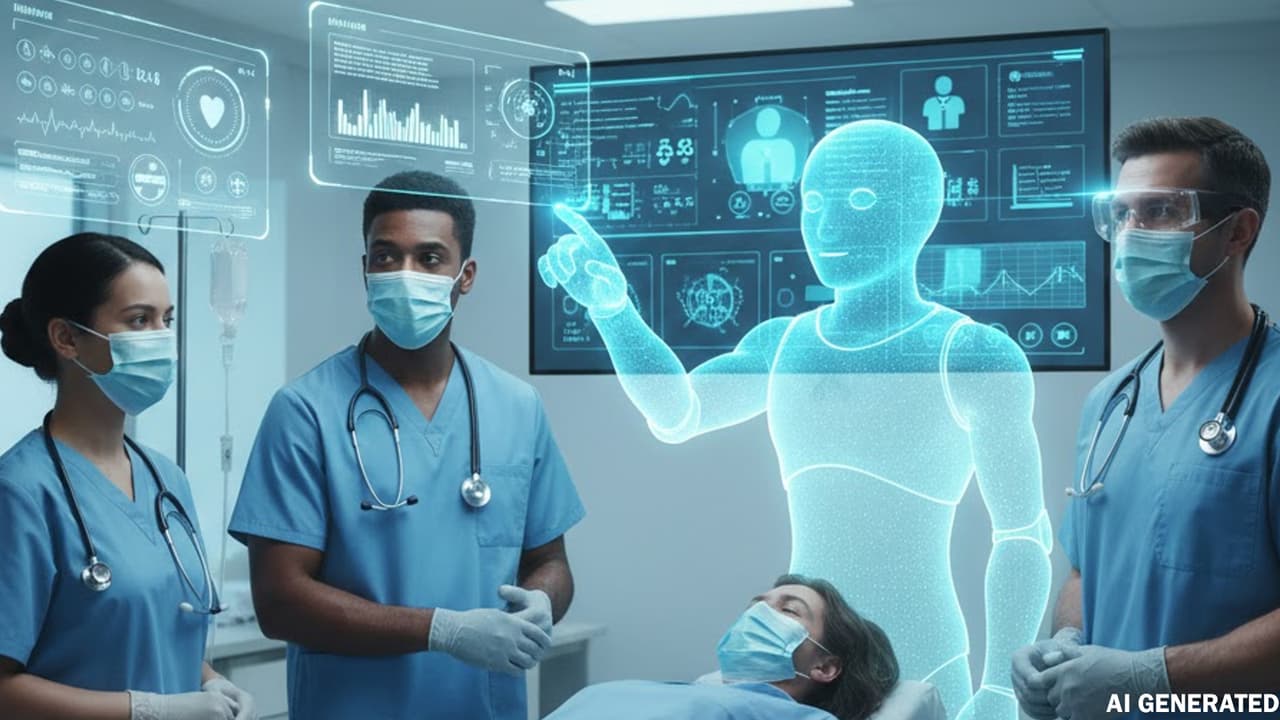
On the second day of the UP AI and Health Innovation Conference, experts said that with proper use, AI can strengthen health services. Empowering frontline health workers, data security and departmental coordination are the keys to AI success.
Lucknow. Experts shared their views on the role of Artificial Intelligence (AI) in the health sector on the second day of the two-day Uttar Pradesh AI and Health Innovation Conference held at Hotel The Centrum on Tuesday. AI experts said that if the technology is used properly and responsibly, it can further strengthen the health services of the country.
Urban-rural health gap can be reduced with AI
Experts said that the biggest benefit of AI is that through it the gap in health services between urban and rural areas can be reduced to a great extent. Early detection of the disease and timely treatment can provide better health facilities to millions of people.
AI will be effective only if frontline health workers are empowered.
Medical Health and Family Welfare Secretary Dr. Pinky Jowell said that the real benefits of AI will be realized when it empowers frontline health workers. Asha workers, Anganwadi workers, ANMs and doctors provide health services to every village. If AI-based tools make their work easier, then treatment can be timely and effective.
Emphasis on telemedicine and remote care
Dr. Pinky Jowell said that by promoting telemedicine and remote care, advice from specialist doctors can be easily made available to people living in remote areas. He said that about 1.80 lakh Asha workers, Anganwadi workers, ANMs and Chief Health Officers are the backbone of the health system in the state. AI based solutions should be such that they simplify their daily work and not add additional burden.
Better health services through AI in Ayushman Arogya temples
He said that by properly using AI in primary health centers like Ayushman Arogya Mandir, better and timely health services can be provided even in remote areas. With this, identification of serious diseases will be possible at the primary level itself.
Departmental coordination is necessary to make AI successful
Experts in various sessions said that to make AI effective in the health sector, strong coordination between departments is necessary. Not only the health department, but other government departments will also have to work together. There will be coordination from policy formulation to implementation, only then the real benefits of AI will reach from villages to big hospitals.
Patient consent and data security paramount
AI experts included in the panel said that when a large population of the country is women and children, then the security of their health data is very important. AI-based data should not be used without the explicit consent of the patient. Transparency and trust are the foundation of any strong health system.
AI plays a big role in reducing maternal and child mortality rates
Experts said that maternal mortality rate can be reduced with the help of AI. AI based system can identify risk signs in pregnant women in advance. With this, ASHA workers can take the woman to the hospital in time and with proper referral at the village level, the life of both mother and child can be saved.
Experts from leading institutions of the country were present.
- Arvind Kumar (Director General, Software Technology Parks of India)
- Pro. R.K. Singh (SGPGI)
- Dr. Sanjay Sood (C-DAC, Mohali)
- Pro. Shri Ram Ganpati
- Colonel Sameer Kanwar (DG, PATH)