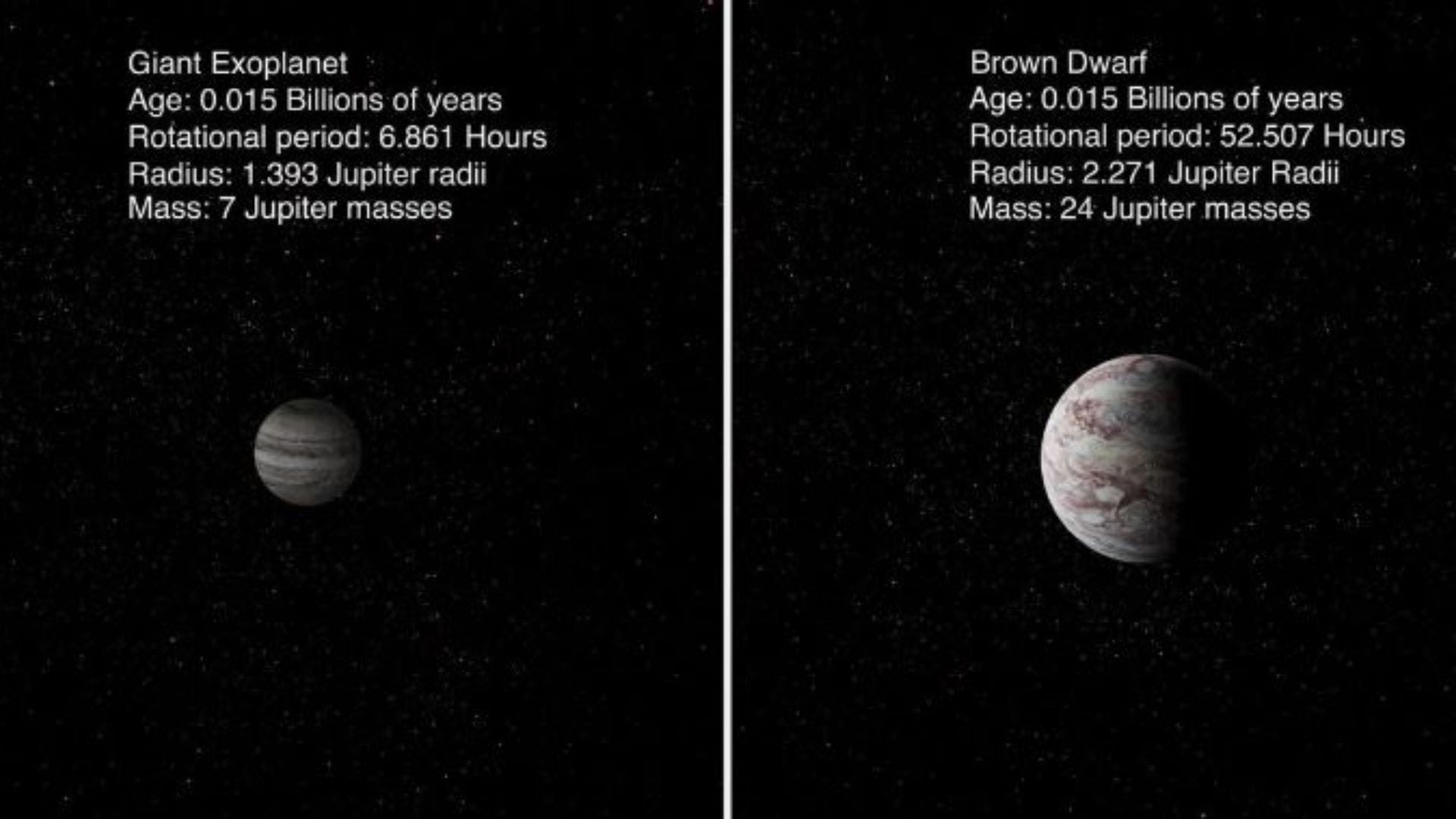
New Delhi: Astronomers have confirmed a long-predicted relationship between planetary mass and rotation using the WM Keck Observatory on Maunakea in Hawai’i. The scientists carried out the largest ever survey of exoplanet spins, measuring the rotation rates of a large sample of directly imaged exoplanets, as well as brown dwarfs. The scientists discovered that the gas giants spin faster than their more massive counterparts, after accounting for mass, size and age. The results confirm a long-standing theoretical prediction. The spin of a planet preserves information on the conditions in which it was assembled from the material leftover from star birth.
By measuring the rate at which a world is rotating, scientists can understand the physical processes that led to their formation when they were formed, tens or hundreds of millions of years ago. The researchers isolated light from faint exoplanets orbiting their host stars, to track fine features in the atmospheres, that allowed them to determine how quickly a planet is spinning. Because of the technique used, the research could only be conducted on nearby exoplanets. Many of the studied planets are at distant orbits from their host stars, often tens of times farther than the Earth is to the Sun. Scientists still do not fully understand how such far-flung worlds are formed.
How planets are assembled
Some planets may grow gradually from the swirling disk of gas and dust surrounding a newborn star. Others may form in a manner similar to stars. Brown Dwarfs are believed to form through gravitational collapse of dense knots in clouds of gas and dust, just like stars, but do not reach the mass necessary to sustain nuclear fusion. The newly identified spin trend helps scientists better understand the process of planet formation. The spin of a planet can be slowed down by the interaction of its magnetic field with the circumstellar disk. A more massive object will be slowed down more because of a stronger magnetic field. A paper describing the research has been published in The Astronomical Journal.