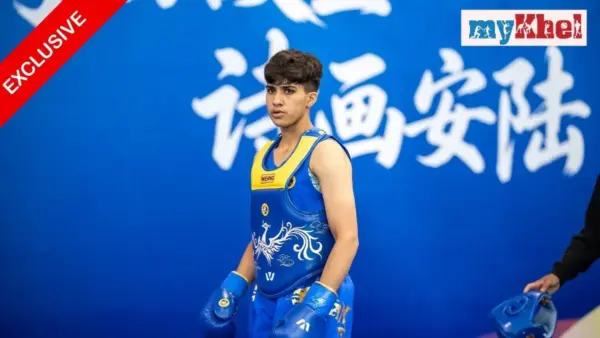
Divyanshi Choudhary won her spot on India’s Asian Games wushu squad in the ring. She lost it in a hospital report. Between those two facts sits a story her family and coach say has been reduced to a simple medical footnote when it was, in their telling, anything but simple.
The bare outline is not in dispute. Divyanshi topped the final selection trial in the women’s 60kg Wushu Sanda category, beating two-time Asian Games medallist Naorem Roshibina Devi. A subsequent medical assessment at the national camp found a partial to high-grade ACL tear and recommended rehab, regular follow-up, and a break from full training. The Wushu Association of India pulled her from the squad on that basis.
Divyanshi initially objected publicly, visibly distressed in her social media post on the issue. A day later, she accepted the federation’s reasoning once officials explained her health came first.
That should have been the end of it. It wasn’t.
A Trial Result That Was Already Being Contested
What’s emerged since, through conversations with Divyanshi’s mother, Head Constable Shashiprabha, her personal coach Ashok Kumar Gautam, and an apparent application filed by Roshibina herself, is that the selection dispute didn’t start with the injury. It started weeks earlier.
It should be noted that Roshibina’s application, obtained by myKhel, remains unverified. Dated June 24, 2026 and addressed to the Director of the Sports Authority of India through SAI’s Imphal regional office, the application claims she won the first two ranking tournaments but lost the decisive trial to Divyanshi because of a “technical anomaly”, erroneous scoring, in her words. She also demanded a special rerun trial against Divyanshi to settle the matter fairly.
WAI rejected the complaint and confirmed Divyanshi’s result stood. But the request itself establishes something the injury narrative alone doesn’t capture: there was already an unresolved fight over who deserved the spot, months before medical reports entered the picture.
The Family’s Harder Allegation
Shashiprabha doesn’t dispute that her daughter was injured. What she disputes is the idea that the injury explains everything that followed. Her account traces back to a 10-day camp in Srinagar in June, around the time of the trials Divyanshi won, where she alleges Roshibina deliberately injured her daughter’s shoulder – separate from the ACL issue that later ended her Games campaign.
“During that time, she had intentionally injured Divyanshi’s shoulder. That is the reality,” Shashiprabha claimed in conversation with myKhel. “She had done it intentionally. That is clear. That is right.
“My daughter has also said the same. That Roshibina has mentally harassed her. She has physically harassed her.”
From there, she describes months of pressure: near-daily calls from Divyanshi describing new incidents of distress, appeals she says Roshibina pursued up to the Sports Ministry and reportedly involving the Lok Sabha Speaker’s office, all after having already lost the selection contest.
“These things are harassment. That player has done a lot of injustice to my daughter. She has tortured my daughter a lot,” Shashiprabha said, adding that the strain left Divyanshi in what she described as depression at points before the family and federation helped her through it.
None of this – the shoulder injury allegation, the harassment claims, the political appeals – appears in any medical or federation document reviewed for this story. It is the family’s account, not a verified record, and it hasn’t been independently established.
Gautam’s Comparison – and Its Limits
Coach Ashok Kumar Gautam backs the family’s framing of three months of what he calls mental disturbance, driven by repeated appeals to officials after Divyanshi’s Srinagar win. But he goes further, questioning the medical logic of her removal altogether.
His argument rests on a comparison: he says Roshibina competed at the 2023 Asian Games – and won a medal – despite her own ACL and meniscus damage, managed with taping rather than withdrawal. “You can play by taping. It’s not a big deal. Many players play… Take a look at the 2023 record. She was taping her whole leg. She played. She won a medal,” he said.
It’s a pointed argument, and it’s worth taking seriously on its own terms – but it’s also thinner than it sounds. Gautam is describing a different athlete, a different Games cycle, and there’s no medical record in front of us confirming the grade or nature of Roshibina’s 2023 injury at the time she competed.
Divyanshi’s own documentation – physio notes, an MRI, an orthopedic consult – specifies a partial to high-grade tear with an explicit recommendation against competitive training. Whether two ACL injuries are comparable depends entirely on severity and clinical judgment, not just the label “ACL.” Gautam’s comparison is an argument, not evidence that the standard was applied unevenly.
Tellingly, when asked if he’d ever formally complained about any of this, Gautam said no: “We never complained… Complaining is not the solution. You prepare well.”
What Actually Has Paperwork Behind It
Strip away the competing narratives and one thing is verifiable: Divyanshi’s ACL tear is real, consistently documented, and the federation’s decision to withdraw her tracks the medical advice on record. That part isn’t contested by anyone, including her own camp.
What isn’t resolved – and can’t be, on the material available – is whether a months-long pattern of pressure shaped the circumstances around that injury or Divyanshi’s mental state heading into it. That’s a serious allegation from people close to her. It’s also, right now, just an allegation.
A Bigger Ask, Beyond This Case
Whatever gets resolved about the specifics, Shashiprabha used the conversation to push a broader point: what happens to athletes who do everything right and still miss the Games at the last step because of injury. She pointed to Neeraj Chopra’s government job as a model, arguing her daughter – an 18-year-old who beat a two-time Asian Games medallist only to be sidelined by injury before the event – has earned some form of recognition or employment given the sacrifices involved, including cutting 14 kilos to make weight.
“She has been working so hard for this day since she was five years old,” she said. “The players who are one step away, who have been injured, that player should get a job from the government.”
For now, Gautam is framing this as a pause, not an ending. “She is a star player, and we’ll definitely see a gold medal from her in the 2030 Asian Games,” he said, adding that any reckoning with Roshibina will happen “in the ring” rather than through further appeals. “We will stay quiet. We will prepare.”
The medical record answers one question. It doesn’t the other one – how much of what happened to Divyanshi Choudhary in the three months before that diagnosis was injury, and how much was everything around it.