German Foreign Minister Johann Wadephul welcomed the EU-India FTA, calling it a strong sign for global trade and their partnership. He noted it offers huge opportunities and will benefit nearly 2 billion people through growth and prosperity.
German Foreign Minister Johann Wadephul welcomed the EU-India Free Trade Agreement (FTA), calling it a significant step toward strengthening bilateral ties and supporting global commerce. In a post on X, Wadephul wrote, “The #FreeTradeAgreement between the EU & #India is a strong sign of our close EU-India partnership & for #GlobalTrade. The agreement offers huge opportunities – including for diversification. Nearly 2 billion people will benefit from #Growth & #Prosperity.” https://x.com/AussenMinDE/status/2016123796432826813?s=20
The message was subsequently reshared by the Embassy of India in Berlin, highlighting the agreement’s potential to open new opportunities and benefit nearly two billion people through growth and prosperity. https://x.com/eoiberlin/status/2016203972701266130?s=20
Decades in the Making: India, EU Finalise ‘Mother of All Deals’
Wadephul’s remarks followed the announcement by India and the European Union that negotiations on a comprehensive Free Trade Agreement had been successfully concluded, ending discussions that began almost twenty years ago. The development comes at a time of strain on global trade, marked by elevated US tariffs, vulnerable supply chains and ongoing geopolitical tensions, including the Russia-Ukraine conflict. India is currently facing high duties imposed by Washington, while the EU is also confronting the prospect of increased American tariffs.
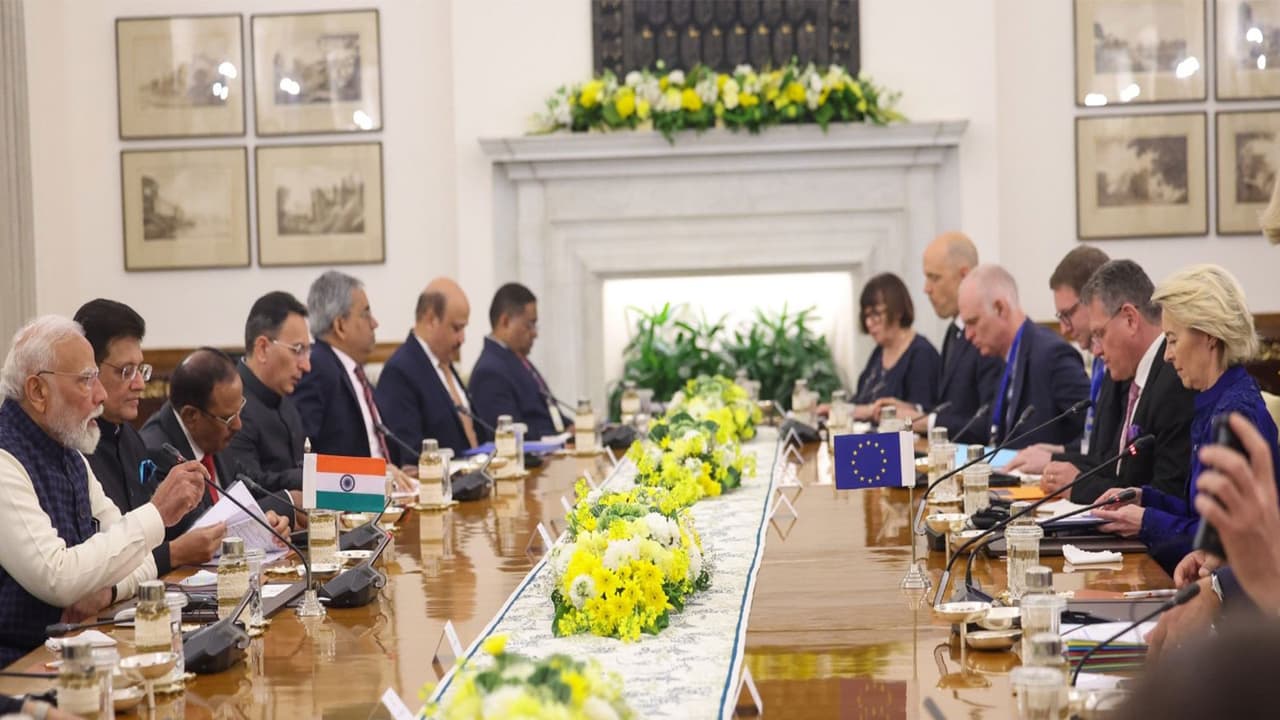
During the EU leadership’s state visit to India, Prime Minister Narendra Modi held bilateral meetings in New Delhi with European Council President Antonio Luis Santos da Costa and European Commission President Ursula von der Leyen. The discussions at Hyderabad House were also attended by EU High Representative for Foreign Affairs and Security Policy Kaja Kallas.
Earlier, Prime Minister Modi announced the India-EU Free Trade Agreement, describing it as a move with the potential to reshape global trade patterns. Von der Leyen later said Europe and India were making history by concluding the “mother of all deals”. “We have created a free trade zone of two billion people, with both sides set to benefit. This is only the beginning. We will grow our strategic relationship to be even stronger,” she said in a post on X.
Officials said the formal signing of the agreement is expected within six months. The pact is aimed at expanding cooperation in areas including trade, security and defence, clean transition efforts and people-to-people exchanges.
After nearly two decades of talks, the two sides finalised the wide-ranging agreement, which von der Leyen described as the “mother of all trade deals”, at a moment when US President Donald Trump continues to challenge established global partnerships. The Ministry of External Affairs noted that India-EU ties have grown steadily since diplomatic relations were established in 1962, driven by shared priorities in trade, investment and sustainable development.
US Voices Criticism Over Deal’s Timing
The agreement’s timing is notable amid rising geopolitical uncertainty and market volatility linked to US tariff policies and a Russia-Ukraine war that shows no signs of easing. The United States has voiced reservations over the deal. US Treasury Secretary Scott Bessent criticised the EU for moving ahead with a trade pact with India while talks between New Delhi and Washington are still ongoing.
Speaking to ABC News, Bessent said the US had borne a greater share of responsibility in efforts to resolve the Russia-Ukraine conflict. “We have put 25% tariffs on India for buying Russian oil. Guess what happened last week? The Europeans signed a trade deal with India,” he said. “The Russian oil goes into India, the refined products come out, and the Europeans buy the refined products. They are financing the war against themselves,” he added.
Economic Impact and Key Provisions
The European Union remains India’s largest goods trading partner, with bilateral trade valued at about USD 136 billion in 2024-25. The bloc also ranks among India’s top partners when goods and services are combined.
Once operational, the FTA is expected to provide a major boost to trade between India and EU member states, as countries increasingly seek to diversify supply chains amid growing disruptions under the Trump administration’s policies.
Under the agreement, tariffs on more than 90 per cent of EU goods exports will be cut or removed, delivering savings of up to 4 billion euros annually on European products. The pact also gives EU exporters a competitive advantage, representing the most extensive trade opening India has offered any partner. India will extend tariff concessions to the EU that exceed those granted to other trading partners, significantly enhancing access for European exports. The agreement is also expected to simplify customs procedures, speed up exports and ensure protection of EU intellectual property, including trademarks. (ANI)
(Except for the headline, this story has not been edited by Asianet Newsable English staff and is published from a syndicated feed.)