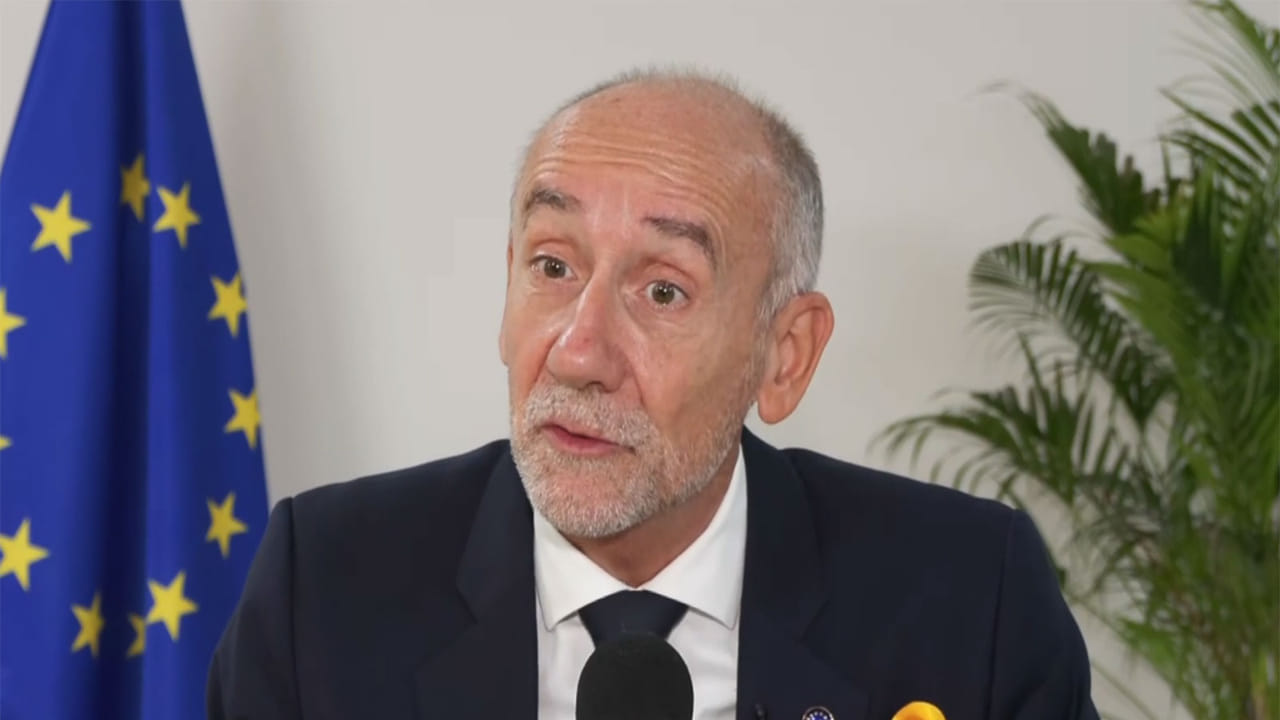
EU Ambassador Jean-Eric Paquet rejects US tariff justifications, highlighting the upcoming India-EU FTA as a commitment to rules-based trade and announcing deeper cooperation in defence, research, and educational student mobility.
New Delhi [India], November 27 (ANI): European Union Ambassador to India Jean-Eric Paquet dismissed Washington’s rationale of European industrial overcapacity for newly proposed US tariffs, arguing instead that the upcoming India-EU Free Trade Agreement (FTA) sends a crucial global signal that a stable, rules-based trading order matters. Speaking with ANI following Washington’s proposal of fresh Section 301 tariffs targeting 14 economies, including India and the European Union, Paquet said officials in Brussels find the US justification unconvincing, noting that Europe faces similar external overcapacity pressures as the United States. “What the teams in Brussels are noting is that the basis for the tariffs, an alleged overcapacity in Europe, is not very convincing. We are, on the contrary, suffering from overcapacity of exporters towards Europe, similarly to the US in reality. The tariffs are of course similar to the ones which had been agreed between the US and Europe a couple of years ago,” Paquet said.
Addressing whether rising US protectionism is driving Brussels and New Delhi closer, the envoy emphasised that India-EU cooperation is anchored in a long-term strategic framework rather than short-term reactions to third-country trade measures. “We are establishing that strategic framework anchored in this Free Trade Agreement, and that’s an agreement for the years and maybe decades to come. So it’s a long-term framework, a rules-based, long-term framework which is stable, reliable, and which allows in India and Europe operators and also people in Europe and India to really work within that stable and reliable framework,” he said. “I think it’s a signal, or rather an illustration in that relationship, that rules matter, that they are necessary, and that everybody benefits from them. So that’s the signal which India and Europe are giving.”
Beyond trade, Paquet highlighted deepening defence and security ties, noting that senior-level foreign policy and security consultations were underway in New Delhi between the Ministry of External Affairs and the European External Action Service. He added that Brussels and New Delhi plan to launch a dedicated forum for defence industries to explore supply chain cooperation and technological development. “Europe’s investment in defence is massive. We have capability gaps to plug. We need to ensure that we can stand on our feet, confront also the hybrid threats of Russia. There is a war, of course, taking place in Europe with the Russian war of aggression against Ukraine, so we are investing massively in our defence. Our defence industries are under pressure to build up, and there I think this really opens opportunity for supply chain discussions,” Paquet explained.
Asked whether Europe views India as a defence manufacturing and co-development partner rather than just an export market, Paquet said current geopolitical realities are opening major avenues for joint production. “As I said earlier on, our defence industries are now ramping up their production immediately and in the medium term. This is a strategic necessity, and that creates opportunities, indeed, to work on supply chains, to co-develop. India is certainly also a market for Europe’s defence industry, has been traditionally, with many cooperations and also production then taking place here in India. The circumstances today create absolutely major new opportunities,” he noted, adding that the upcoming defence industry forum will help advance those discussions.
Turning to innovation and research, Paquet pointed to India’s association with Horizon Europe—the EU’s flagship research and innovation program—as a major catalyst for startups and scale-ups across Indian states. “India has joined Europe’s research program, Horizon Europe, meaning that Indian participants are on par with European participants. They are treated exactly the same. They have the same access. They are supported by the program. This will provide momentum and space for more collaborative research between India and Europe,” he said.
On people-to-people mobility, the ambassador encouraged more Indian students to consider European universities, noting that roughly 100,000 Indian students are currently studying across the bloc and highlighting the wide availability of English-taught programs. “Indian students are great students and would no doubt enhance the academic setup in Europe. So I can only encourage Indian kids to look at Europe. Wherever you study in Europe, you can do it in English. That’s not always well understood. And of course, being in a city in Europe, you will certainly also pick up a bit of the language there, but English allows you to go. You can study in English, and most Europeans do speak rather good English as well,” Paquet said.
His remarks come as the United States Trade Representative (USTR) on Wednesday proposed tariffs of up to 25 per cent on Indian goods, with certain exemptions, while indicating that the rate could be lowered to 17 per cent if India reaches an Agreement on Reciprocal Trade with Washington that addresses the findings of its investigation into structural excess capacity and production in manufacturing sectors. The USTR further proposed considering adjustments to the additional duties to account for tariffs imposed under existing Section 301 and Section 232 actions, or a tariff rate of 17 per cent if India reaches a reciprocal trade agreement addressing the findings of the investigation. The announcement comes after US Trade Representative Jamieson Greer determined that the acts, policies and practices of 14 economies, including India, relating to structural excess capacity and production in manufacturing sectors are unreasonable and burden or restrict US commerce. The USTR has invited public comments on the proposed tariff measures, with written submissions and requests to appear at the hearings due by January 5, 2027. The hearings are scheduled to commence on January 25, 2027. (ANI)