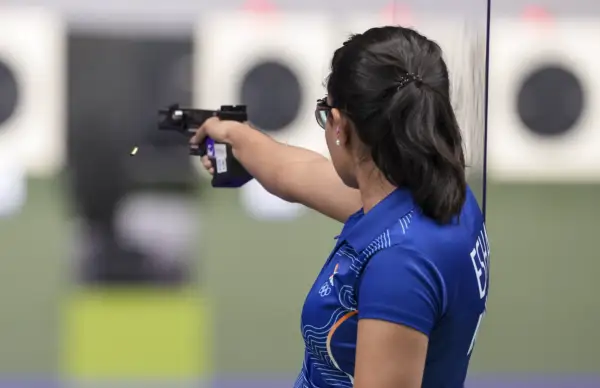
Nagoya, Sep 28 (PTI) Esha Singh fought through pain, exhaustion, and five nerve-wracking shoot-offs in a gruelling test of skill and temperament before settling for silver in the women’s 25m pistol at the Asian Games here on Monday.
It was a performance that demanded every ounce of her resilience and perhaps meant more to her than a gold medal.
The world No. 1 in the event, the 21-year-old Indian endured an aching arm and shoulder, survived a series of heart-stopping eliminations and pushed herself to the very limits in one of the most dramatic finals of the Games.
Even as the gold slipped through her grasp in a nerve-shredding shoot-off against China’s Tokyo Olympics bronze medallist Jiaruixuan Xiao, Esha had already demonstrated the fighting spirit that has made her one of the most formidable young shooters on the international circuit.
Her silver was India’s only individual medal from the shooting ranges on Monday, but the manner in which she earned it made it a performance to savour.
In a final that swung between drama, exhilaration and heartbreak, Esha first survived three shoot-offs against North Korea’s Kim Hyon Suk before engaging in two more against Xiao in the battle for gold. The Indian eventually bowed out after the two shooters were locked at 38 hits, equalling the Games record.
“It was amazing and I have never had an experience like this before. Definitely going into my bucket of amazing experiences and I am grateful for every moment. Though it was nerve-wracking, it was amazing, yeah,” said Esha, still absorbing the enormity of a final that had tested her in ways she had never experienced before.
The silver added another significant chapter to Esha’s growing Asian Games collection. At the 2023 Hangzhou edition, she had won four medals, including silver in the individual 25m sports pistol, gold in the team 25m pistol, and silver medals in the individual and team 10m air pistol events.
Monday’s medal, however, carried a different significance, coming after an exhausting battle in which she had to summon extraordinary reserves of physical endurance and mental composure.
What made her achievement even more remarkable was the precarious position from which she entered the final.
Esha had struggled in qualification, shooting 290 in the precision stage on Sunday to lie sixth before slipping to eighth after the rapid stage on Monday. Her aggregate of 580 was just enough to secure the last available spot in the eight-shooter final, with the Indian edging out a Chinese Taipei shooter on the basis of inner 10s, the shots closest to the bullseye. Esha had 22 inner 10s against her rival’s 20.
From being the last qualifier to becoming the last Indian standing in the medal race, Esha transformed a difficult start into an extraordinary demonstration of resolve. She refused to allow her qualification struggles to dictate her performance in the final, where every series brought fresh pressure and every shoot-off threatened to end her campaign.
The physical toll was considerable, with the prolonged competition aggravating the pain in her arm and shoulder. Yet, Esha continued to hold her nerve through repeated eliminations, keeping herself in contention even as the final stretched into an almost relentless test of concentration and stamina.
Her ability to withstand that pressure stood in stark contrast to the disappointment elsewhere in the Indian camp. Double Olympic bronze medallist Manu Bhaker, who had arrived with considerable expectations in both the 10m air pistol and 25m pistol, failed to make the final after finishing 11th in qualification with a score of 579.
Veteran Rahi Sarnobat, the 2018 Asian Games champion in the event, endured an even more difficult outing, finishing 30th with 568.
For Manu, who had been expected to fight for multiple medals, the Games ended without a podium finish, a disappointing outcome for one of India’s most accomplished pistol shooters.
Sarnobat, meanwhile, was left devastated by an extraordinary mishap that saw one of her shots register zero after it went into the frame on day two of qualification. The error proved particularly costly for India’s team medal prospects, as the trio of Esha, Manu and Sarnobat slipped from third place to fifth in the team standings, with an aggregate of 1727.
China claimed the team gold with 1743, South Korea took silver with 1735, while Chinese Taipei secured bronze with 1734. India’s deficit was particularly painful given that a 10 from Sarnobat in place of the zero would have lifted the team’s tally to 1737, enough for silver.
For Sarnobat, who missed the Hangzhou Asian Games due to illness and has battled her way back into the national team despite a debilitating health setback, the incident was difficult to comprehend.
The 35-year-old said she had never experienced anything similar in her career, not even during training, and was struggling to process the consequences of the mistake.
“When it affects your fellow shooters as well, then it gets difficult even further to process. But, yeah, I think we see such things in lots of sports, that sometimes the rules are so weird that you cannot really do anything beyond that,” she said.
“I think accepting this and, more than accepting, I need some time to process first of all because this has never happened with me before. So, I do not know how it feels and I do not know how to think about it. So, that is my first reaction, I would say.”