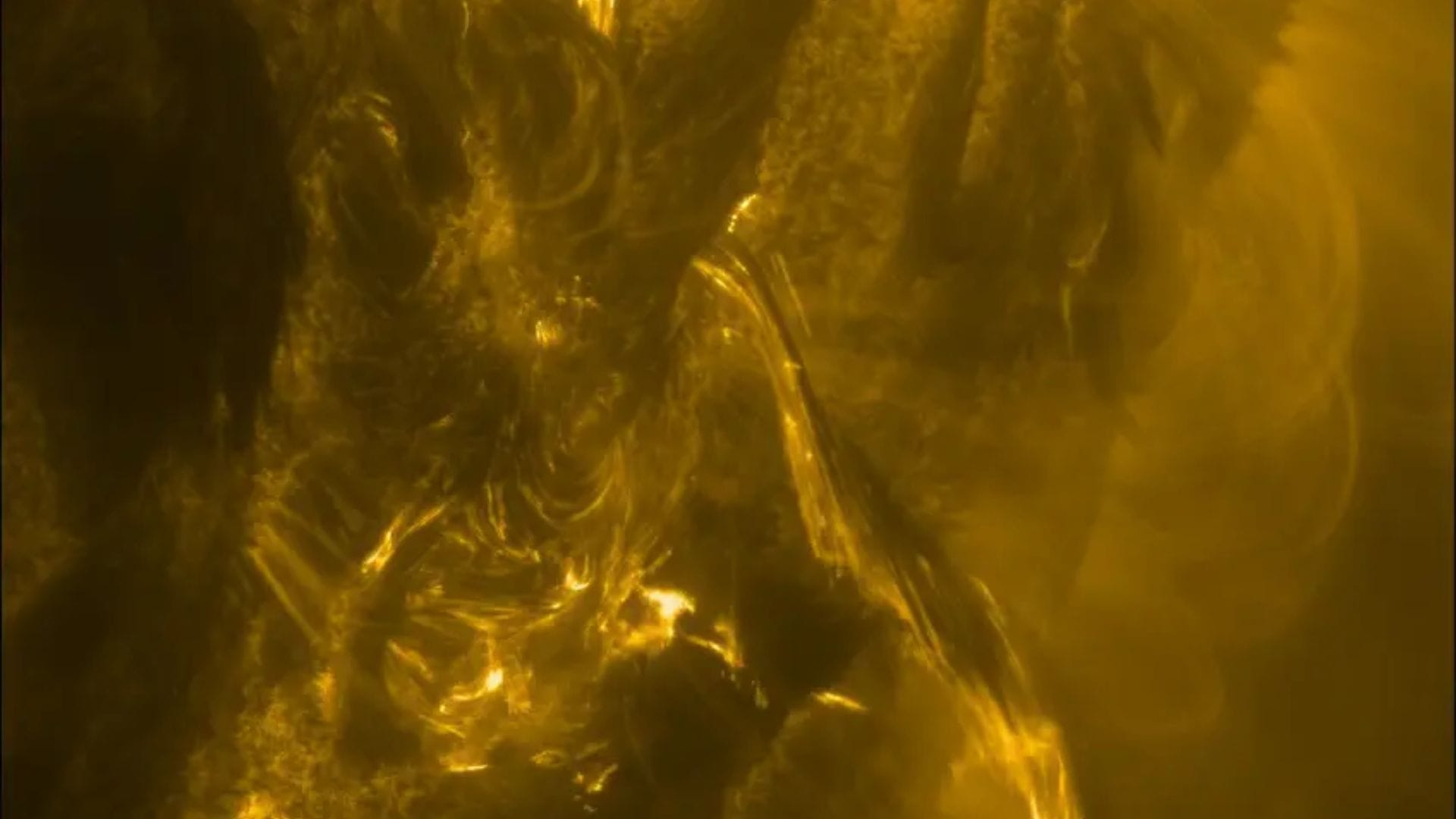
New Delhi: The Solar Orbiter of the European Space Agency captured detailed images of an M-class flare erupting on the edge of the Sun on 30 September, 2024. This is the second-strongest category of solar flare. The observations were conducted from a distance of 45 million kilometres, about one-third of the distance between the Earth and the Sun. The M7.7 flare erupted serendipitously at the closest point in the orbit, providing an ideal, side-on view. The flare hurled energetic radiation and particles outwards into space. Analysis revealed that the eruption started with small disturbances in the magnetic field of the Sun, triggering a chain reaction of reconnections, building up like an avalanche to release stored energy.
Such events are sporadic even during periods of high solar activity, but have the capabilities of disrupting satellite operations and energy distribution infrastructure on the planet. The build up of the flare involved twisted magnetic field lines holding a dark loop of relatively cool plasma in the corona or outer atmosphere of the Sun, that is mysteriously hotter than the surface. About 40 minutes before the flare peaked, the structure destabilised, with initial reconnections causing bright flashes and rapid rearrangements. The Extreme Ultraviolet Imager payload captured high-resolution sequences every two seconds, revealing fast movements at a spatial resolution of 210 kilometres.
The core mechanism of a solar flare
The eruption accelerated particles to between 40 and 50 per cent the speed of light, with some of the plasma raining back on the Sun. The observations exposed the core mechanism of a solar flare, an avalanche of small magnetic reconnections spreading quickly in space and time, driving the larger explosion. The outburst emphasised how minor events can cascade into major ones. Experts were surprised on the role that the base of the flare played. The findings indicate that the process may occur on all solar flares, and possibly even on other stars. The research improves predictions on space weather, that can protect human technologies from widespread disruptions. A paper describing the findings has been published in Astronomy & Astrophysics.