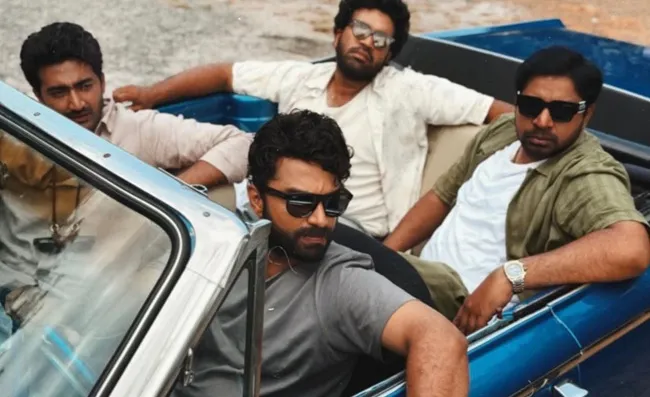
The reunion of the crazy gang from Ee Nagaraniki Emaindi has generated considerable buzz. Director Tharun Bhascker’s return to filmmaking after a considerable gap has added to the curiosity surrounding the film.
With the original enjoying a cult following over the years, expectations are naturally high. Has the sequel delivered the fun quotient it promised? Let’s find out.
Story
Vivek (Vishwak Sen) and his friends (Abhinav Gomatam, Srinath Maganti and Venkatesh Kakumanu) are struggling to find their footing in life after their film fails to achieve success.
Meanwhile, Keerthana (Shivathmika Rajasekhar) joins a film crew as an assistant to a cameraman without informing her father (Priyadarshini Ram), who despises the film industry and believes that professions such as medicine are the only ones that genuinely serve society.
When Vivek and his friends beat up Keerthana’s fiancé (Srirama Chandra) at a party, her furious father throws down a challenge.
Vivek and his gang decide to shoot a survival thriller at the location where Keerthana’s destination wedding is planned, hoping to prove themselves and win the challenge.
Will they succeed in their unusual mission?
Performances
Abhinav Gomatam takes centre stage, particularly in the second half, and virtually steals the show. Much of the film’s entertainment value comes from his characterisation and hilarious performance. He dominates several stretches and emerges as the film’s biggest strength.
Vishwak Sen plays a film director and is technically the lead actor, but he has relatively little to do for most of the runtime. He gets a few notable moments, particularly around the interval, but largely allows the other characters to take centre stage.
Srinath Maganti, who plays the cameraman and the man in love with Shivathmika’s character, is just adequate. Venkatesh Kakumanu, as Uppi, gets some of the film’s best moments and makes good use of them.
Priyadarshini Ram is effective in his role, particularly in the portions leading up to the interval. Shivathmika Rajasekhar performs her part neatly, although her character could have been written better.
Karunakumar, as Priyadarshini Ram’s brother, does an adequate job. Anisha Ambrose, who played the female lead in the original film, makes a cameo appearance.
Technical Aspects
Vivek Sagar’s music is in sync with the film’s mood and setting. However, the songs are very weak, with none having a particularly engaging or memorable appeal.
The cinematography is good, with the single-shot sequence in one of the key Thailand episodes standing out.
The editing is particularly innovative in the opening portions, but the second half suffers from pacing issues and excessive length.
The production design and overall technical values are decent.
Highlights
Abhinav Gomatam
The climax sequence
Dialogue writing
Filmmaking-related satire
Drawbacks
Long scenes
The first 20 minutes
Lengthy runtime
Uneven humour
Analysis
Ee Nagaraniki Emaindi was released in 2018. Although it did not emerge as a major theatrical success upon its initial release, the film gradually developed a cult following. Its popularity was evident during subsequent re-releases as well.
Considering the affection audiences have developed for the original, director Tharun Bhascker has now returned with ENE Repeat. However, this is not a conventional sequel but rather a film set in the same universe.
The story and treatment are considerably different this time. Tharun Bhascker has attempted a mix of satire, philosophical observations and motivational themes, all set against the backdrop of filmmaking.
As a result, the film feels quite different from its predecessor. The opening portions do not immediately establish the familiar camaraderie or humour associated with the original. In fact, it takes nearly 20 minutes to half an hour for the film to find its rhythm.
Once the narrative moves to the bachelor party involving Shivathmika’s character and her fiancé, the proceedings begin to fall into place. The pub fight, the subsequent developments and the interval bang unfold at a brisk pace, setting up an entertaining second half.
However, the momentum does not continue consistently after the interval. The jokes during the plane journey fail to generate much laughter, while the initial Thailand episodes also feel rather flat. The film once again tests the audience’s patience before finding its groove.
The introduction of a lookalike character for Abhinav Gomatam changes the mood considerably. The comedy picks up from there, particularly during the stretch in which Abhinav ventures into the forest to shoot the survival drama. This entire episode is among the film’s most entertaining portions.
Both halves have their share of genuinely funny scenes, interesting episodes and rather ordinary stretches. The result is an uneven viewing experience, with the film repeatedly shifting between engaging comedy and ordinary sequences.
The original was a straightforward buddy comedy, somewhat along the lines of Zindagi Na Milegi Dobara. For this film, Tharun Bhascker has chosen to experiment with both the writing and the treatment.
While the ambition to move beyond the familiar template is appreciable, experimentation does not always translate into effective storytelling. Some ideas work wonderfully, while others fail to connect immediately. That unevenness is the film’s biggest problem.
The dialogue writing remains one of its strengths. Lines such as the observation that some people die mentally in their twenties but continue living physically until they are eighty offer a philosophical perspective.
Similarly, the dialogue suggesting that doctors can only prolong life but cannot prevent death carries the distinctive Tharun Bhascker touch. These moments give the film a certain depth beyond its comedy.
Unfortunately, the same depth is missing in the writing of a few important characters, particularly those played by Shivathmika Rajasekhar and Priyadarshini Ram.
Before the interval, Priyadarshini Ram’s character appears to have considerable emotional depth and ideological conviction. However, once the story shifts to Thailand, he gradually turns into a rather conventional and predictable character.
The conflict that initially appeared interesting does not receive the treatment it deserved.
Despite these shortcomings, the film has several amusing observations about contemporary filmmaking trends. The joke surrounding The Revenge of Snakes is particularly funny.
The cameos by Sujeeth, Sandeep Reddy Vanga, Nandini Reddy and Anil Ravipudi are effective and add to the film’s satirical flavour. The post-credit sequences are also enjoyable.
The biggest issue, however, remains the runtime. Several stretches could have been trimmed considerably to make the narrative tighter and more engaging. Sharper editing would have helped the film retain its comic momentum.
Overall, ENE Repeat offers some genuinely funny moments and flashes of clever, fresh writing. While paying tribute to filmmaking, it also takes amusing digs at the industry’s changing trends.
However, the experimental approach does not work consistently, and the film suffers from considerable ups and downs.
The opening sequences do not work, and even the early post-interval scenes are boring. With some portions working effectively and others stretching on for far too long, it ultimately turns out to be a mixed bag of comedy and drama.