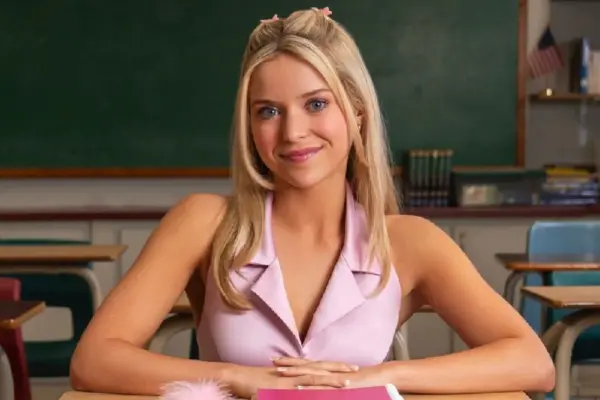
More than two decades after Reese Witherspoon’s unforgettable performance as Elle Woods, the pink-loving law student from remains a feminist pop culture icon.
That legacy inevitably raises the stakes for , Prime Video’s prequel series that explores the teenage years of the beloved character.
Created by Laura Kittrell and Caroline Dries and backed by Witherspoon’s Hello Sunshine banner, shifts the timeline to 1995, years before Harvard Law. Instead of following Elle as she fights stereotypes in college, the eight-episode series imagines her navigating high school after an unexpected move from glamorous Beverly Hills to gloomy Seattle.
Despite the promising premise, the series rarely captures the charm that made such a classic.
The story begins on Elle Woods’ 16th birthday. Her carefully planned future – complete with popularity, perfect friendships and dreams of an ideal first kiss – is abruptly disrupted when her plastic surgeon father botches a celebrity nose job. Forced to leave Los Angeles, the Woods family relocates to rain-soaked Seattle, where Elle suddenly finds herself surrounded by flannel shirts, grunge culture and classmates who dismiss her obsession with pink and fashion.
The culture clash initially provides some entertaining moments. Watching Elle attempt to fit into a school where everyone seems determined to reject California sunshine creates an amusing fish-out-of-water setup.
Lexi Minetree proves to be a solid casting, successfully capturing much of Witherspoon’s warmth and optimism without descending into imitation. She understands Elle’s cheerful sincerity and bubbly personality. Rather than copying Witherspoon’s every mannerism, she crafts a younger version that feels distinct while remaining familiar.
The supporting cast also contributes several bright spots. June Diane Raphael delivers one of the series’ strongest performances as Eva Woods, Elle’s mother, whose own struggles adapting to life in Seattle provide unexpected emotional depth. Tom Everett Scott adds some comic timing as Elle’s father, while Jessica Belkin makes an impression as Elle’s fashionable best friend back in Los Angeles.
Perhaps the show’s most compelling relationship isn’t a romance but the evolving mother-daughter dynamic between Elle and Eva. As both women wrestle with the challenge of rebuilding their lives, the series occasionally finds the emotional sincerity that much of the broader narrative lacks.
Unfortunately, these performances can only do so much against a script that repeatedly misunderstands what made Elle Woods such a beloved character.
The central issue with is that it fundamentally rewrites the heroine’s defining journey. In, Elle’s decision to leave her privileged California life for Harvard represented a bold leap into unfamiliar territory. She entered an environment that dismissed her because of her appearance and gradually proved everyone wrong without sacrificing her personality.
The prequel repeats that exact narrative years earlier.
By sending teenage Elle to Seattle – another place where she stands out because of her bright personality and fashion choices – the series inadvertently diminishes the originality of her later Harvard experience. Viewers are left wondering why Elle appears to relearn many of the same life lessons she supposedly mastered during high school.
Throughout the season, the writers sprinkle numerous callbacks to , from arriving embarrassingly underdressed at an important social event to solving mysteries through fashion observations. Every episode even borrows its title from one of the original film’s memorable quotes.
Rather than feeling like affectionate tributes, however, many of these references come across as forced recreations designed to trigger nostalgia. Instead of enriching the character, they often invite uncomfortable comparisons with scenes the film executed far more effectively.
The writing also leans heavily on familiar teen drama clichés. Mean girls, love triangles, locker insults, awkward parties, friendship conflicts and predictable romantic misunderstandings dominate much of the season. While there’s nothing inherently wrong with these staples, rarely offers fresh twists or memorable dialogue to elevate them beyond formula.
More disappointing is how the series occasionally asks Elle to compromise aspects of her personality simply to gain acceptance. That’s a significant departure from the original character, whose greatest strength was her unwavering belief in herself. celebrated the idea that Elle never needed to become someone else to earn respect. Here, that confidence often feels diluted.