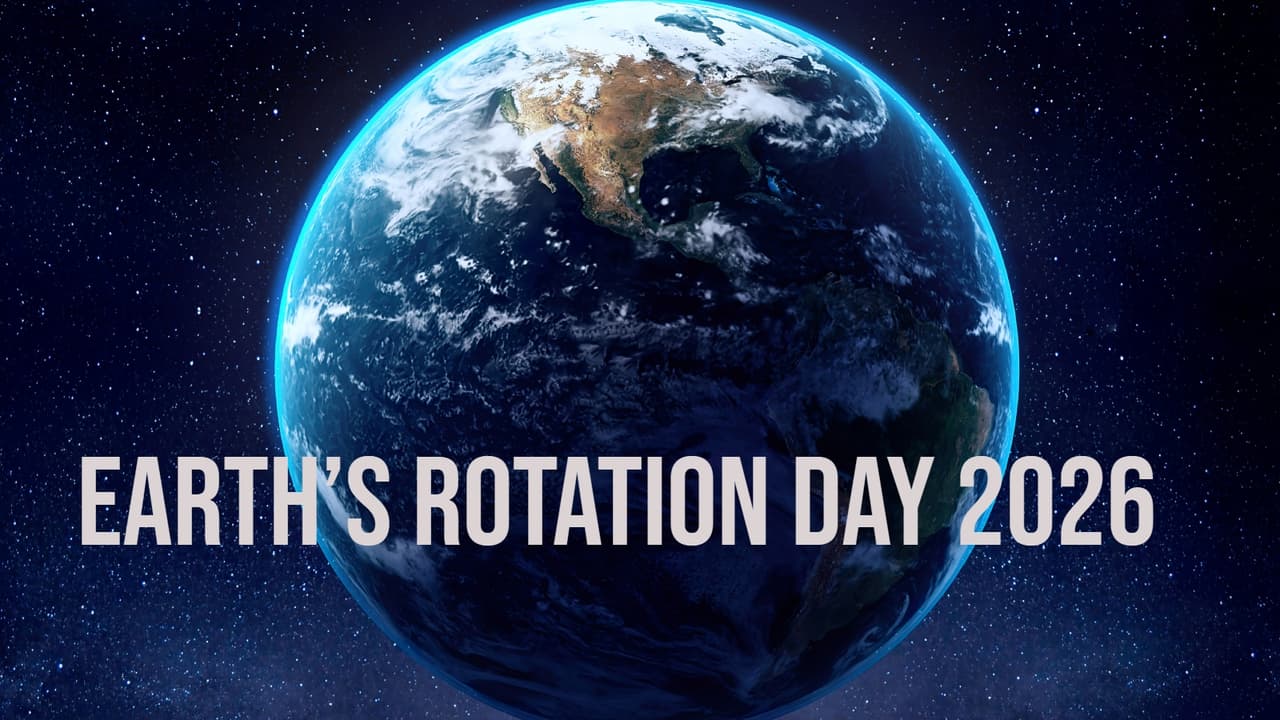
Earth’s Rotation Day 2026, observed on January 8, highlights how Earth’s constant rotation shapes day and night, climate, weather, and life itself, celebrating science, discovery, and human curiosity.
Earth’s Rotation Day 2026: We see the sun rise and set every day, journeying from day to night and back again. All this seems so normal that we rarely stop to think about the real reason behind it. Earth’s Rotation Day, celebrated every year on January 8, reminds us of this seemingly ordinary yet extraordinary truth. This day gives us a chance to understand that the Earth’s rotation on its axis is not just a scientific fact, but the foundation of our entire lifestyle.
When Earth’s Rotation Was Questioned
Today, science has made it clear that the Earth is constantly rotating on its axis, but there was a time when people were not ready to believe it. For centuries, the prevailing belief was that the Earth was stationary and the sun and moon revolved around it. Greek philosophers were the first to propose the idea that the Earth itself is in motion. However, they lacked the technology to prove it. This idea remained limited to thoughts for a long time, until science presented solid evidence in the 19th century.
A Pendulum That Changed the World’s Thinking
On January 8, 1851, French scientist Léon Foucault conducted an experiment that visually demonstrated the Earth’s rotation. He proved that the Earth rotates on its axis using a giant pendulum. This experiment was so impactful that it was later installed in public places so that ordinary people could see and understand it. Foucault’s experiment became a milestone in the history of science.
Earth’s Rotation: More Than Just Day and Night
The Earth’s rotation is not limited to just creating day and night. It is a crucial part of our climate, weather, and natural balance. The Earth completes one rotation every 24 hours. This rotation determines the direction of winds. Ocean currents flow on different paths because of it. The Coriolis effect, generated by the Earth’s rotation, determines the direction in which cyclones will spin and winds will turn.
What If the Earth Stopped Rotating?
On Earth’s Rotation Day 2026, it’s important to ask ourselves this question: what would happen if the Earth stopped rotating? According to scientists, in such a situation, one side would have continuous day and the other would have perpetual night. A massive temperature imbalance would occur, and the balance of life could be disrupted. This means the Earth’s rotation is as essential for life as air and water.
Significance of Earth’s Rotation Day 2026
This day reminds us of the power of science and human curiosity. For children and young people, it is an opportunity to understand how asking questions and reasoning can open the way for new discoveries. Earth’s Rotation Day 2026 is not just a celebration of an astronomical event, but a tribute to the thinking that gave humanity the ability to understand the universe.
Some Shocking Facts About Earth’s Speed
- The Earth’s rotation speed is slowing down over time, so the length of a day is very gradually increasing.
- The Earth’s magnetic field, which protects us from solar radiation, is linked to internal rotation and core activities.
- About 70 percent of the Earth’s surface is covered with water, and this balance is also linked to the planet’s rotation.
- According to scientists, the Earth is about 4.5 billion years old, and its rotation has never stopped during this time.
Earth’s Rotation Day 2026 reminds us that the Earth we stand on is in motion every moment. Perhaps this motion is life’s greatest strength, inspiring us to keep moving forward.