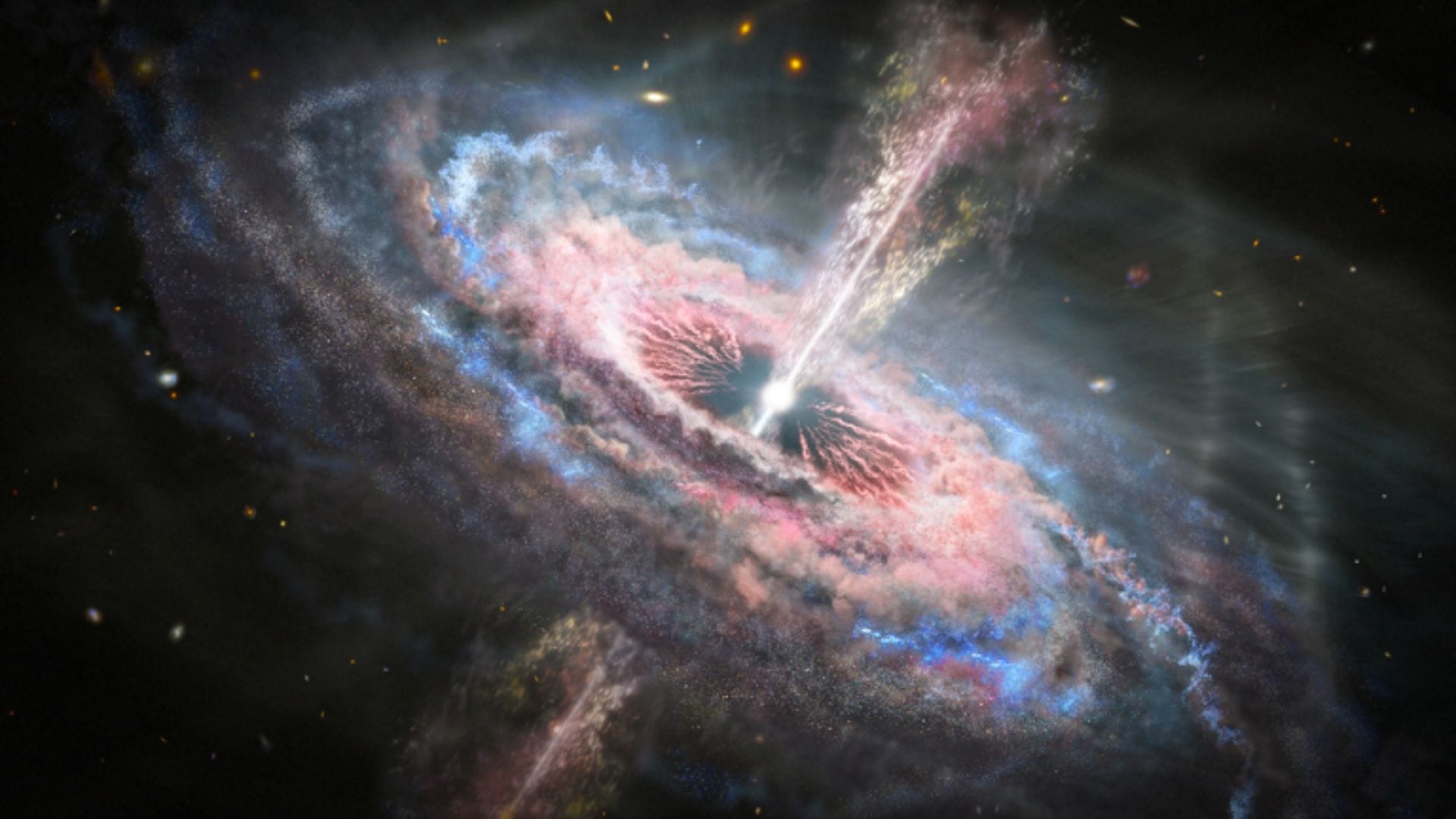
New Delhi: Scientists using the Subaru Telescope have identified a quasar in the early universe, dating to about 12 billion years ago. This active galactic core hosts a supermassive black hole that is growing at an extreme rate. The black hole is gobbling up gas and dust at approximately 13 times the Eddington limit, far exceeding the theoretical upper bound where the radiation pressure from the glow of the tortured material balances out the gravitational influence of the black hole, preventing any more matter from falling in. The quasar is designated as eFEDS J084222.9+001000 and displays an unusual combination of properties.
The black hole produeces bright X-ray emissions from a corona of hot plasma, and strong radio emissions from a powerful jet, while in the extreme accretion phase. Many theoretical models predict that during super-Eddington accretion, the inner flow structure changes in ways that diminish the X-ray output, while weakening or supressing jet formation. The coexistence of intense X-rays, a prominent jet and high accretion rates challenge theoretical predictions.
An intermediate stage
Scientists have suggested that the extreme object was captured in a brief transitional phase following a sudden burst in infalling gas. This surge pushed the system into super-Eddington conditions, temporarily maintaining an active corona and energising a strong jet before the quasar likely settles into a more conventional state. A powerful radio jet implies that the black hole is sufficiently energetic to influence the environment of the host galaxy, with the feedback from the black hole regulating star formation. Galaxies co-evolve with their central black holes.
The discovery is providing scientists with a rare observational example of extreme black hole growth in the early universe, and serves as a benchmark for refining models of accretion and black hole jets under such conditions. The findings also reveal potential mechanisms that allow black holes to consume matter rapidly, not covered by current theories, and suggests that similar objects may exist undetected in survey data. A paper describing the research has been published in the Astrophysical Journal.