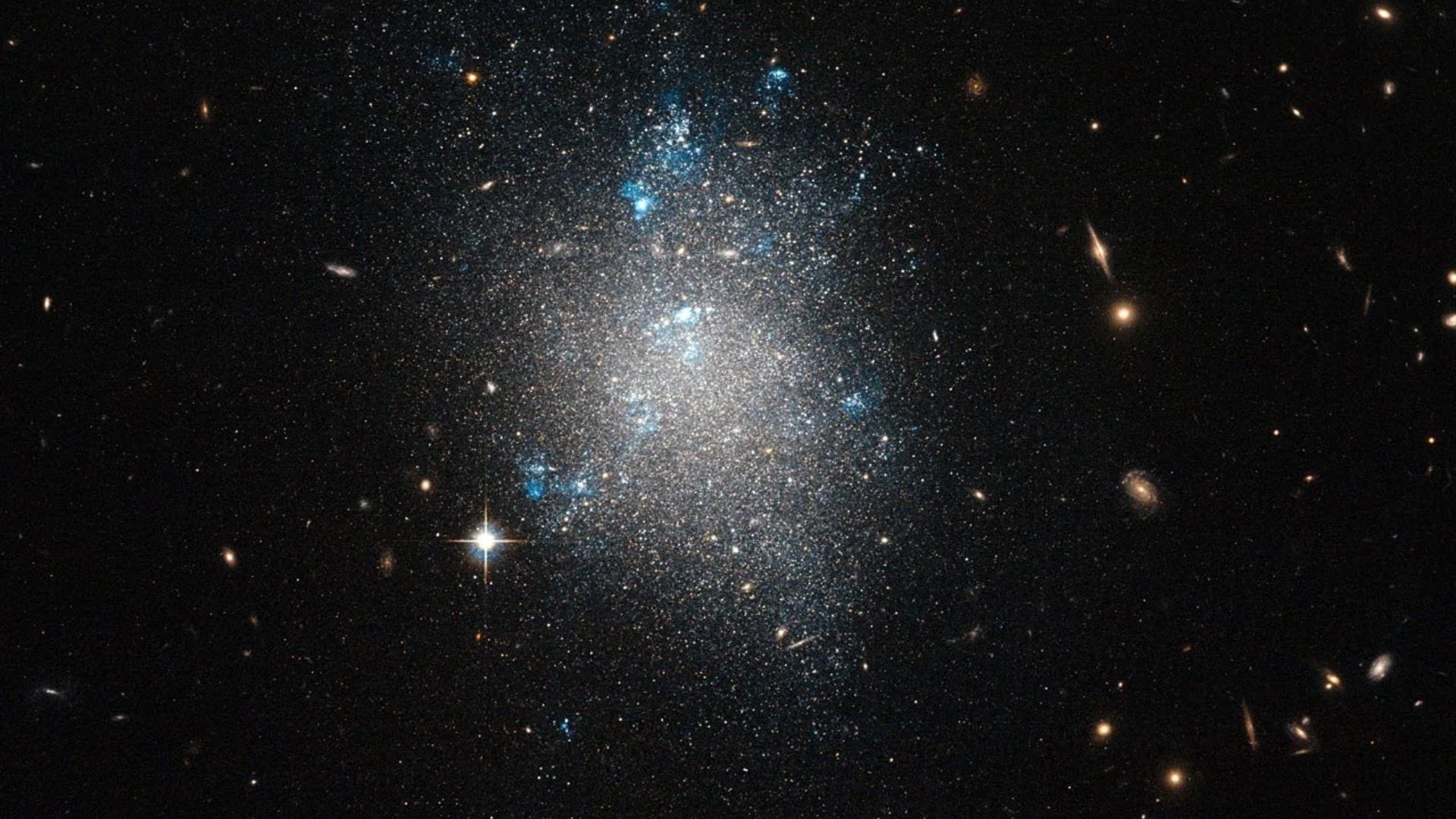
New Delhi: The smallest galaxies in the universe are emerging as one of the greatest challenge for modern astrophysics. Scientists are studying these dwarf galaxies to understand why they do not always match the predictions of the standard cosmological model, or the scientific understanding of how the universe works. Researchers have embarked on the INGENIO project that uses advanced cosmological simulations to reconstruct the galactic environment closest to the Milky Way, and examine the physical processes that remain incompletely understood. Dwarf galaxies are the most abundant type of galaxy in the Universe, and are heavily dominated by dark matter, hinting at some key mechanism in galaxy formation that has eluded scientists.
The research focuses on the Local Group, or the galactic neighbourhood of the Milky Way, that consists of our Galaxy, Andromeda, Triangulum and a number of smaller dwarf galaxies. High-resolution simulations using constrained initial conditions to recreate scenarios that closely resemble the observed Universe, allowing for direct comparison between the theoretical understanding and astronomical data. The team is not just simulating a generic universe, but one that faithfully reflects our environment. While the cosmological model describes large-scale structures accurately, it shows systematic deviations for the smaller dwarf galaxies. The discrepancies indicate something is missing in the model.
Central Black Holes may be key
Galaxies co-evolve with the central supermassive black holes. A central innovation of the INGENIO project is the analysis of black holes in very low-mass galaxies. These are traditionally not expected to host active galactic nuclei because of their small size, but simulations reveal that even in isolated dwarf galaxies, central black holes significantly influence evolution through stellar feedback, regulating the formation of new stars and galaxy growth. The project tackles key questions on the role of AGNs in dwarf galaxies, the mismatch in predictions and observations, ultra-diffuse galaxies and models of dark matter. This research is computationally intensive, and uses supercomputers for the sophisticated simulations.