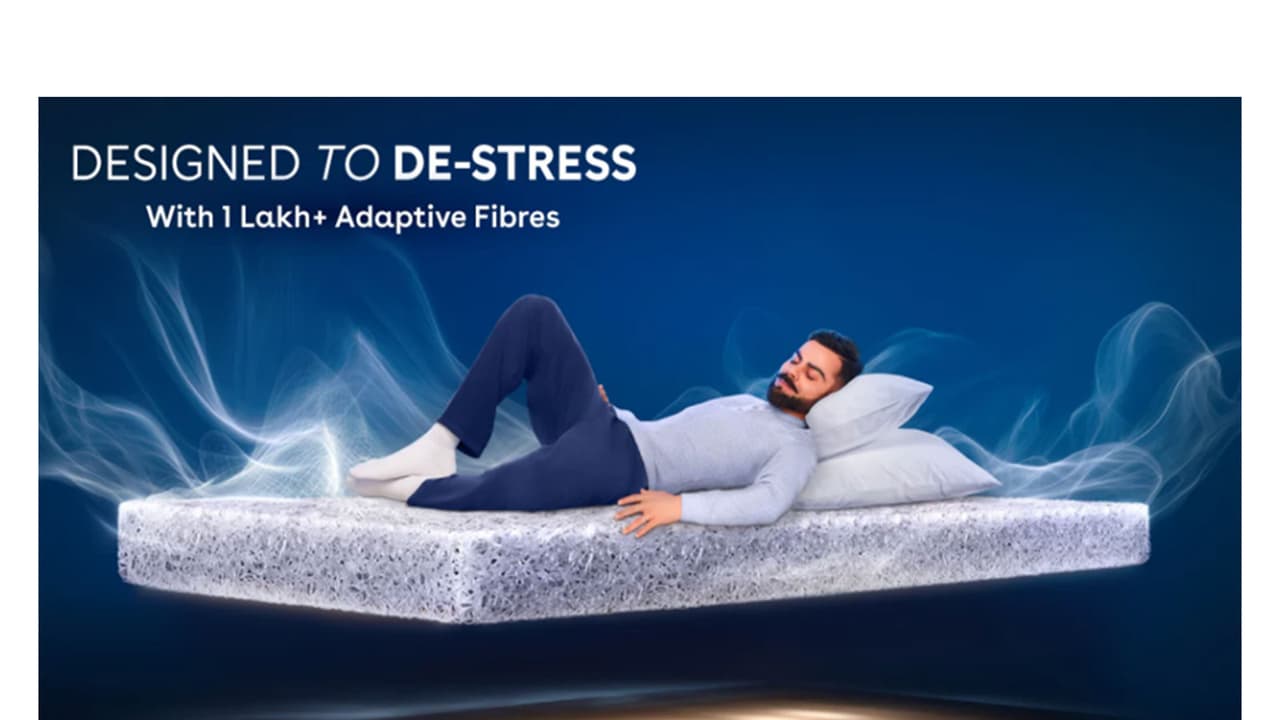
A review of the Duroflex Airboost mattress, which uses over 1 lakh micro-support points to prevent sinking. It offers firm spinal alignment, better airflow for cooler sleep, and is approved by the National Health Academy for back pain reduction.
For years, I found myself in a constant battle with my bed. My previous ‘back-support’ mattress, filled with materials like jute, had a frustrating habit of failing where I needed it most. Within weeks, it would sink in high-pressure areas, forcing me into a fortnightly ritual of flipping and rotating it just to get a level surface. After switching to the Duroflex Airboost, that cycle has finally ended. Here is a deep dive into why this tech actually stands up to the hype.
No More Sinking Feeling
The biggest flaw in many traditional mattresses, especially those using coir or low-density foam, is their inability to maintain structural integrity under weight. You end up sleeping in a ‘crater’, which is a recipe for the rigid joints and morning fatigue I used to experience. The Airboost replaces that dated approach with 1 lakh+ independent micro-support points. Instead of a single slab of material giving way, these adaptive fibres contour hyper-locally to your body shape. The result? The mattress doesn’t ‘give’ or sag, and my back feels supported all day long, not just for the first hour of the night.
Firmware Over Hotel Fluff
There’s a common misconception that ‘luxury’ means ‘ultra-soft’. If you’ve ever stayed in a high-end hotel and woken up with a backache because the mattress felt like a marshmallow, you’ll understand my struggle. The Airboost strikes that rare balance: it isn’t rock-hard, but it provides a sophisticated firmness that supports spinal alignment without the ‘stuck’ feeling of traditional memory foam.
Zero-Disturbance
Motion isolation is often the ‘make or break’ for couples. In my experience, the Airboost passes the test with flying colors. Because of the open-matrix fibre structure, vibrations don’t travel across the surface. Unless you’re jumping on the bed like crazy, your partner isn’t going to feel you tossing, turning, or getting up for an early start.
Image courtesy: Duroflex
Beating the Humidity
One of the most immediate changes I noticed was the temperature regulation. In India’s climate, waking up stuffy or sweaty is a common sleep-interrupter. The Airboost is engineered for 3 times more continuous airflow compared to standard mattresses. Its 3D structured design allows heat to dissipate away from the body rather than trapping it against you, which is critical for reaching N3 (Deep Sleep), the stage where physical recovery actually happens.
The Learning Curve
It is important to note that switching to a high-tech surface like the Airboost isn’t an overnight adjustment. Unlike traditional mattresses where you ‘sink in’ and the material hugs your frame, the Airboost stays remarkably flat and responsive. Because of this localized bounce and firm structural integrity, I initially felt like I might actually roll or fall off the side. It’s a fundamentally different sensation than the ‘hotel-soft’ beds that many of us struggle to sleep on; it requires a bit of patience to let your body unlearn the habit of sleeping in a ‘crater’.
Additionally, don’t expect to move this thing solo, it is incredibly heavy and dense. If you’re planning on repositioning it or moving house, forget doing it alone as it’s a two-person job at the very least.
Clinical Validation
What elevates the Airboost beyond standard consumer tech is its formal recognition from India’s leading health authorities. It’s exclusively approved by the National Health Academy (NHA) for its ability to provide effective spinal support and measurable back pain reduction.
Even Indian Society for Sleep Research (ISSR) recommends the Airboost for enhancing Slow Wave Sleep (N3). Those who don’t know, this is the critical ‘deep sleep’ stage focused on physical recovery, tissue repair, and immune strengthening.
Image courtesy: Duroflex
Pricing and Customization
One of the best parts about this series is that it isn’t ‘one size fits all’. The price point is quite accessible for the level of tech you’re getting, with the range starting at Rs 24,000 and going up to Rs 73,000 depending on the thickness or firmness. This might look a bit expensive but the technology it offers, it can be a good investment for a great health.
In The End
It’s rare to find a product that is both ‘Make-in-India’ tech and backed by the National Health Academy and the Indian Society of Sleep Research. If you are tired of mattresses that lose their shape or leave you feeling overheated and stiff, the Airboost is a genuine material innovation that delivers on its promises.
My Rating: 4/5
(Disclaimer: The author is an expert in the fields of consumer technology, lifestyle and auto. Views shared here are personal)
(ANI)
(Except for the headline, this story has not been edited by Asianet Newsable English staff and is published from a syndicated feed.)