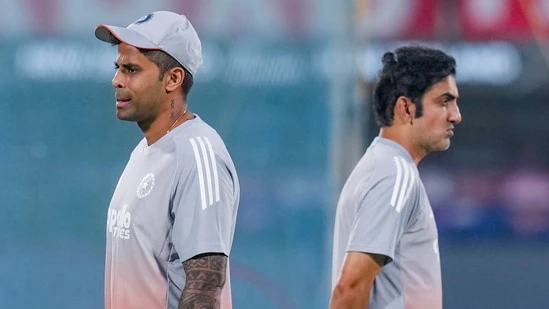
Gautam Gambhir didn’t arrive as a caretaker after Rahul Dravid gave up his role as the head coach of India after the T20 World Cup 2024. He arrived like a coach with a whiteboard and a scalpel, cutting away fixed roles to see what still functions under pressure.
The BCCI announcement set the tone: he would take charge from the Sri Lanka tour and help build excellence while nurturing young talent.
The core theory: Team India as a controlled experiment
Since he has started, Gambhir has apparently been a scientist and the India team is a laboratory of experiments. The “Dr Gautam Gambhir” idea works because the method is visible: treat batting slots, match roles and even leadership lanes as variables, so the team becomes harder to read and quicker to adapt. It is not experimentation for novelty; its experimentation to manufacture optionality.
Gautam Gambhir has also framed the philosophy publicly. In the T20 context, he has called batting orders “overrated” beyond the openers, arguing that it is not the amount of runs that matters, it is the impact. If you believe that, you don’t build a rigid 1 to 11 ladder. You build a toolkit.
ODIs: where the batting order stops being sacred
ODIs are where this approach becomes most controversial, because the format historically rewards clarity: who anchors, who accelerates, who finishes. Yet early in Gambhir’s tenure the order looked intentionally fluid.
In India’s first four ODIs after Gambhir took over, there was no fixed top six, with repeated reshuffles tied to left-right pairing logic. The Sri Lanka ODIs provide a clean snapshot: Washington Sundar pushed up at no.4 in the first ODI, in the next, Shivam Dube was moved to number 4 and Axar Patel at number five, while Sundar slid down the order.
India did pay heavily in the series and gradually, the experimentation has dipped in the format. But with the World Cup 2027 approaching, Gambhir might stress test other players in different roles.
Tests: where the price of experimentation has been heavy
In Test cricket, the experimentation arrived wearing a different costume: succession planning. In January 2025, Rohit Sharma was dropped from the playing XI despite being the captain because of his poor form.
Then came the structural reset. Rohit retired from the format on May 7, 20265 and Virat Kohli followed his mate on May 12, 2025 announcing retirement from test cricket.
That left India with the opportunity to rebuild the red-ball spine. Shubman Gill was appointed the captain and was given the number four spot in the batting line-up after discussion with Gambhir. After that India had tried many combinations in both the batting and bowling department and most of them have not paid off. The home Test series defeat against South Africa stands as an example of how this lab assignment has really flopped in the toughest format.
Leadership lanes
The idea of testing isn’t limited to batting positions or team combinations. On October 4, Gill was also named the ODI captain for the Australia tour, replacing Rohit Sharma, while keeping Rohit and Kohli in the squad.
It was a strategic choice: Gambhir is looking to distribute leadership by format and investing in a younger centre of gravity, while seniors become format specialists. In a world where squads are stretched year-round, that is a high-stakes experiment in continuity.
The necessary reality check
One reason the Dr Gambhir theory stays credible is that Gambhir has tried to separate selection from usage. In May 2025, he said he had no role in selection, stressing that players remain as long as they perform. In other words, his biggest influence may be less who gets picked and more how the XI is deployed.
But laboratories have hazards. If every player becomes a movable piece, players can stop owing roles – and role ownership is a quiet currency in international cricket. The best version of this approach creates a squad that can absorb injuries, counter match-ups, and stay ahead of trends. The worst version creates uncertainty dressed up as flexibility.
So the sharper way to frame Gambhir’s thinking may be structured volatility. However, a lot of this project depends on the coming months on how India performs in the bigger stages and if they are able to justify Gambhir’s experimentations.