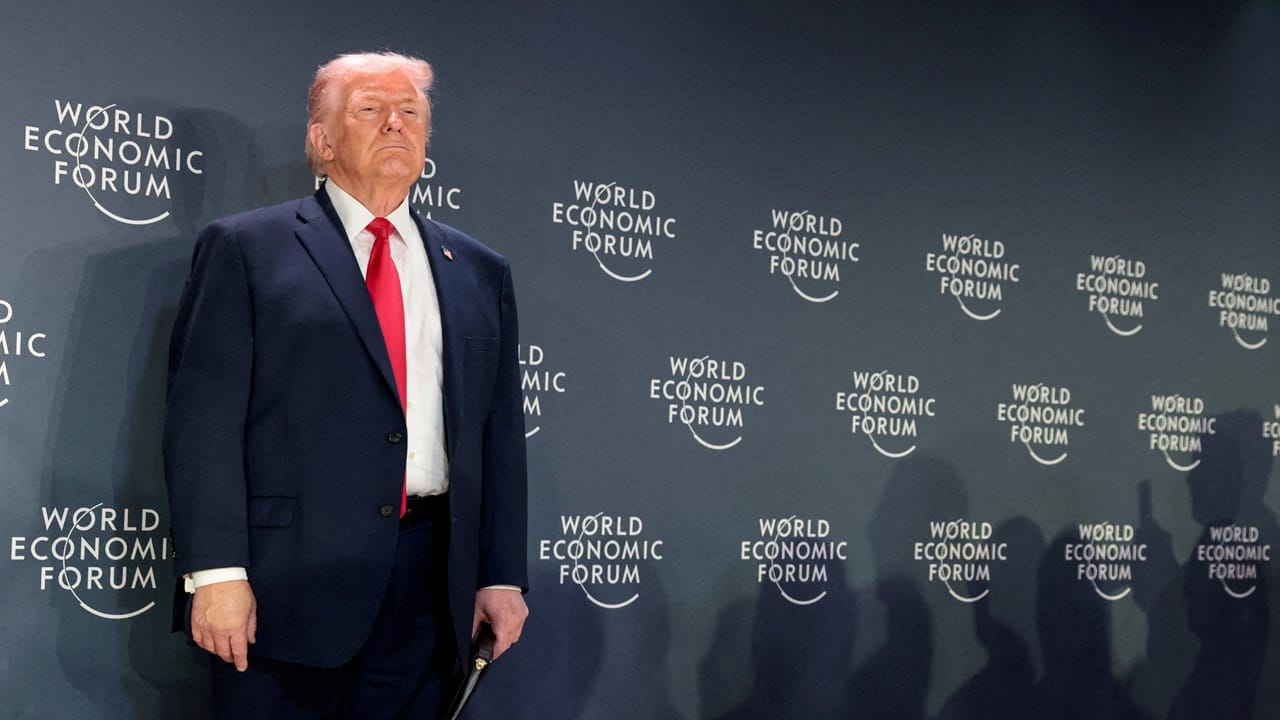
At the turn of this millennium, when political scientist Samuel Huntington coined the metaphor Davos Man, he could hardly have imagined a moment when an American President would arrive in Davos only to demolish the very idea he developed.
Addressing the annual gathering of the world’s most powerful executives at the World Economic Forum (WEF) in the Swiss ski resort on Tuesday, US President Donald Trump effectively wiped-out Huntington’s notion of Davos Man. In its place, he crowned himself the New Davos Man.
What Huntington meant
When Huntington introduced this metaphor in 2004, it carried a very different meaning. Davos Man represented a class of CEOs and global elites who assembled every year at Davos to debate development through a corporate lens. Those associated with the WEF believed that national borders were obstacles to growth and that the world needed to be unshackled from them.
With diminishing loyalty to their own nations, these elites argued that national governments were outdated and largely irrelevant in an increasingly globalised world. They claimed that private capital, corporate expertise, and philanthropy could build infrastructure, reduce inequality, and deliver progress more efficiently than governments.
Goodman and Davos Man
Two decades into the 21st century, the Covid pandemic put these claims to the test. In the post-Covid period, American business journalist Peter S. Goodman published a book titled Davos Man, offering a sharp critique of the borderless billionaire class.
Goodman questioned their assertion that they could solve global problems such as climate change. Their relentless lobbying for lower taxes, deregulation, and free-market experimentation, he argued, collapsed during the pandemic. The conduct of many billionaire CEOs during this crisis painted a bleak picture. Their much-touted philanthropy failed to make a meaningful difference when it mattered most.
Yet Goodman did not end his critique by advocating socialism. He remained committed to capitalism but insisted that governments must reassert themselves, by providing healthcare, building infrastructure, and running schools. Capitalism, in his view, needed the state to function responsibly.
Trump’s visit to Davos
A month before his Davos address, Trump had effectively pocketed Venezuela’s oil reserves through an overnight coup. Not a single country formally protested. Before arriving in Switzerland, he had already warned NATO allies that he wanted Greenland. At Davos, he repeated, “I want that piece of land with ice,” though he added that he would not go to war for it.
In a New York Times column titled China Wins as Trump Cedes Leadership of World Economy, Goodman analysed Trump’s Davos visit and concluded that China had gained strategic advantage. Toward the end of the piece, he made a telling observation.
Trump had imposed a 30 percent tariff on Switzerland despite repeated appeals from Swiss President Karin Keller-Sutter, who explained that her country was small and could not absorb such a blow. Trump raised it further to 39 percent, dismissing her concerns by saying, “She was so aggressive.” What followed was more revealing. “Then,” Goodman wrote, “he got a visit from Rolex, the Swiss watchmaker. Then he (Trump) agreed to reduce the tariff to 15 percent.”
Trump, The New Davos Man
What CEOs and entrepreneurs could not achieve in decades, the creation of a borderless world, a single man demonstrated in Davos through raw power. Venezuela was done; Greenland was next.
Unlike Huntington’s or Goodman’s Davos Man, Trump gave the term an entirely new meaning. He rechristened himself as the New Davos Man. In Trump’s version, a US president can seize nations, and their natural resources so American corporations can set up industries, reap windfall profits, and deliver handsome returns to their shareholders.
The long-debated idea of a borderless world has indeed materialised, but not in the way corporate elites imagined. Trump has little interest in the philanthropic claims of industry captains. He projects himself as the sole custodian of the world order. The Gaza reconstruction plan illustrates this approach.
Characterisation of Trump
Trump evokes memories of European monarchs, particularly Louis XIV of France and James I of England who ruled under the doctrine of the Divine Right of Kings. They believed their power flowed directly from God.
Trump differs, yet in a peculiar way resembles them. Without overtly abandoning Christianity, he conveys an impression that his authority is divine simply because he is the US President. His actions, by virtue of that office, are placed beyond challenge and thus treated as divine, unlike those of the Russian president or the Chinese premier
Seen in this light, Trump’s ethical framework needs a closer examination. His actions lie beyond conventional justification. Because he thinks they are ineffable. His code of ethics does not operate within any recognised boundary of morals. By dismantling the rule of law grounded in ethical norms, Trump has constructed his own grammar of morality.
Time and again, he has shown that attempts to confront him through adversarial methods only backfire, particularly for developing countries. This explains why many nations struggle not merely to counter him, but even to engage with him meaningfully.
Trump and the West
Trump has single-handedly stripped the West of its moral mystique. Countries like Canada and the UK, which once privately claimed that only the West could provide a global ethical framework for institutions, now stand exposed.
To argue that Trump threatens American capitalism is a misdiagnosis. Because, many economists and political commentators insist that Trump creates chaos, assuming it will dissipate once he exits the stage and that American capitalism will return to rule-based multilateralism. That assumption appears flawed. The culture Trump has ushered into American capitalism is unlikely to disappear.
For developing countries like India, this presents a serious challenge. American Corporations that prosper under Trump’s rule are unlikely to revert to cautious adherence to democratic values. For them, shareholders matter far more than the world’s stakeholders.