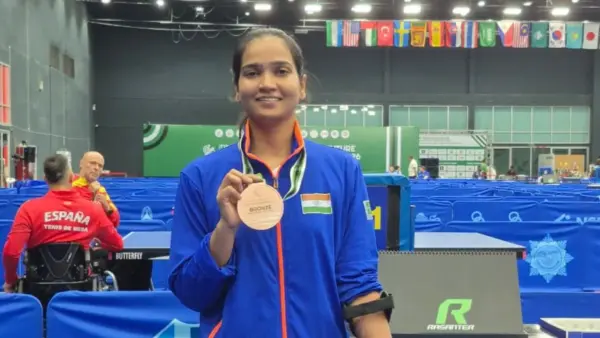
When doctors discovered a tumour in Prachi Pandey’s spine during her teenage years, they did more than diagnose a medical condition.
They also advised her to stay away from sports, warning that physical exertion could aggravate the neurodegenerative disease that would gradually weaken her legs.
More than 18 years later, Prachi has defied that prognosis in remarkable fashion. Ranked World No. 18, Asia No. 3 and India’s No. 1 player in the Class 6 category, the 33-year-old has emerged as one of the country’s leading para table tennis players and is now firmly in contention for a place in India’s squad for the upcoming Asian Games.
The journey has been anything but straightforward. Born with spina bifida Myelomeningocele, Prachi underwent spinal surgery at the age of 14 after doctors found a tumour. The operation was successful, but the condition continued to affect her lower limbs, forcing her to confront the reality of living with a disease that has no cure.
“After the surgery, the disability started affecting my legs. It is a neurodegenerative disease and it will continue to progress. Many people with this condition eventually become paralysed. The doctors told me I was fortunate that I could still walk,” Prachi told SAI Media.
Medical advice was clear. She was asked to avoid sport, wear calipers to prevent deformity and focus on treatment. Yet giving up table tennis was never an option. Having played alongside able-bodied students throughout her school years in Unnao, Uttar Pradesh, she continued to train despite spending nearly a decade undergoing regular dressing procedures and taking medication.
Looking back, Prachi believes that decision has made all the difference.
“If I wasn’t an athlete, I would probably have become completely wheelchair-bound by now. Because I train regularly, I am still able to walk. Every day I think about how I can improve myself physically,” she said.
Although she had always enjoyed table tennis, Prachi entered the para circuit only in 2021. A chance meeting with a para athlete during a train journey in 2019 introduced her to competitive para sports, but recovery from foot surgery and the COVID-19 pandemic delayed her plans. When she finally made her debut, she failed to win a single match.
Instead of discouraging her, the defeats strengthened her resolve.
With no specialised para table tennis facilities in her hometown, Prachi shifted to Kanpur, where she balanced morning practice sessions with a full-time job as a software engineer. An M.Tech graduate from Punjab Engineering College, Chandigarh, she chose to remain financially independent while pursuing her sporting ambitions.
As results began to improve, so did her confidence. Eventually, she made the difficult decision to leave her engineering career behind and dedicate herself entirely to table tennis.
The gamble has paid rich dividends. Prachi has won 11 international medals across singles and doubles competitions, including a bronze medal at the ITTF World Para Future Thailand earlier this month. She has also claimed 18 gold medals at National Championships, National Ranking tournaments and the Khelo India Para Games.
Her progress has accelerated since joining the Sports Authority of India’s National Centre of Excellence in Gandhinagar in September 2023. Access to physiotherapists, nutritionists, psychologists and sports science experts under one roof has allowed her to focus entirely on improving her performance without worrying about financial constraints.
Earlier this year, the progression of her condition resulted in her being reclassified from Class 7 to Class 6. Rather than viewing it as a setback, Prachi adapted her style of play to suit her physical limitations.
“Attacking requires greater mobility and speed. Since my movements are restricted, I prefer a defensive style and wait for the right opportunity before attacking,” she explained.
Using short pimples on her forehand and long pimples on her backhand, Prachi has built a patient, tactical game inspired by Tokyo Paralympic silver medallist Bhavina Patel, whom she regards as her role model.
Even after climbing into the world’s top 20, Prachi believes there is room for improvement. She continues to work on strengthening her forehand, an area she feels can make her more competitive against the world’s best players.
With the Asian Games approaching, Prachi finds herself closer than ever to fulfilling another dream. Her rise is not merely a story of medals or rankings, but of perseverance against a condition that continues to challenge her every day. Years after being advised to stay away from sport, she has turned table tennis into both her profession and, in many ways, the reason she continues to remain on her feet.