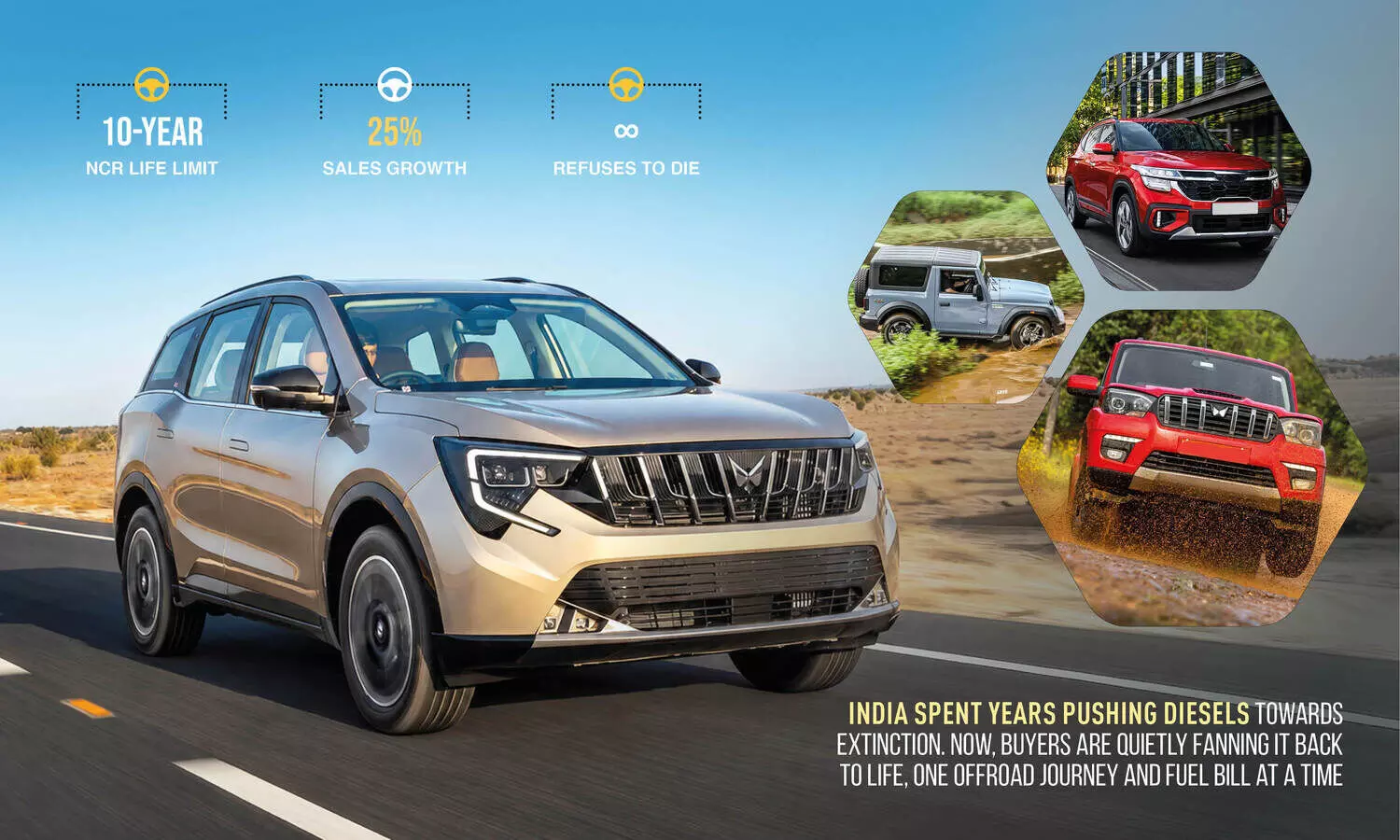
For years, diesel has been treated in India like a troublesome relative: useful, occasionally impressive, but best kept at arm’s length. Petrol has been deemed cleaner, quieter and politically safer. But of late have come torquey SUVs, escalating fuel bills, the E20 fiasco and many motorists discovering that old relationships can actually be rekindled.
The numbers are making the point more eloquently than any auto columnist can. Diesel accounted for 17.73 per cent of passenger-vehicle retail sales in July 2026, up sharply from 16.32 per cent in June. And revealingly, diesel sales in the first half of 2026 were up 15 per cent year-on-year, to 4.56 lakh units. Its share in FY 2026-27 has already climbed to 19.39% per cent, against 18.08 per cent in FY 2025-26. No, diesel is not staging a coup. It is just refusing to die.
Petrol Problem
There is an elephant at every fuel station, one wearing an E20 jumpsuit. India’s nationwide move to force-use petrol containing up to 20 per cent ethanol was driven by respectable objectives—reducing crude-oil imports, saving foreign exchange and cutting emissions. The trouble began when motorists compared the policy brochure with what their cars were doing.
Owners of older petrol vehicles reported poorer mileage, rough running, hard starts and increased maintenance. A July LocalCircles survey found that nearly six in 10 owners of pre-2023 petrol cars reported a mileage drop of more than 10 per cent; while 45 per cent reported unusual wear or higher repair requirements. Workshops have also reported clogged injectors and fuel-system complaints.
The government and oil companies, however, maintain that E20 is safe for compatible vehicles and meets quality standards.
That distinction matters. It would be reckless to declare that E20 is destroying engines en masse when the evidence does not support such a sweeping conclusion. But it would be equally foolish to pretend motorists have imagined every complaint. When a customer believes his petrol-run car has become thirstier, rougher and more expensive to maintain, he is unlikely to compose a grateful letter to the Ministry of Petroleum. He looks at the other side of the showroom.
SUV Imbroglio
The other side happens to be full of SUVs. India has spent the past decade falling obsessively in love with high-riding vehicles. What began as a part-time indulgence has turned into mass-market frenzy. Today, most of the successful diesel vehicles, overwhelmingly, are SUVs and utility vehicles.
The H1 sales list paints the picture. Mahindra’s Scorpio range sold over 86,000 diesel units; Boleros crossed 58,000; XUV 7XOs did more than 42,000. Thar Roxx, Thar and Kia Seltos also posted strong numbers. Six of the ten best-selling diesel models recorded double-digit year-on-year growth.
This is not nostalgia for the clatter of an old-school diesel. Modern diesels are vastly more refined and produce the low-end torque that suits heavy SUVs, loaded vehicles, steep roads, long highway runs and, occasionally, the Indian conviction that a muddy track is merely an unpaved invitation. Petrol engines can be wonderfully quick. Diesels remain wonderfully muscular.
Money Talks
Then there is the classic Indian automotive argument: Kitna deti hai. Diesel cars usually cost more to buy and their emissions-control hardware can make them more expensive to maintain. For a low-mileage urban user, petrol, CNG, hybrid or electric power can make considerably more sense. But India is not one market. A taxi operator, a highway commuter, a family doing 25,000 km a year or someone hauling seven people and luggage has a different spreadsheet.
Diesel’s superior fuel economy becomes more meaningful as annual mileage rises. As does its ability to pull a large vehicle without being worked too hard. With SUVs now accounting for a huge share of new-car demand, the diesel powertrain has found a natural habitat.
There is another irony. For years, manufacturers were encouraged—through emissions rules, taxes and consumer preference—to move away from diesel. Many responded by just killing diesel engines in hatchbacks and sedans. Now, when buyers return to diesel, the menu is considerably shorter. But that scarcity has not killed demand; it has only concentrated it.
Delhi-NCR Lesson
Delhi-NCR adds a layer of absurdity to the story. The 10-year limit on diesel vehicles and 15-year limit on petrol vehicles was forced as an air-pollution measure, with the Hon’ble Supreme Court upholding the restrictions. The policy was intended to push consumers towards cleaner mobility. But it taught an entire generation of buyers to regard diesels as a depreciating asset with a timed-bomb attached. Buy one and enjoy it. But remember that the countdown is on.
Outside NCR, however, the calculus is different. A diesel vehicle can be driven pretty much for ever and its resale value is not shaped by any timed guillotine. Buyers, thus, look at a diesel SUV and see a durable workhorse, rather than a future scrap-yard resident. That difference is important more so as the second-hand market matures and consumers become more sensitive to total ownership costs.
The Comeback
So, is diesel really back? Yes. But not in the way it once was. The age of the diesel hatchback is over. The diesel sedan is a shrinking tribe. What is returning is diesel as a specialist: the powertrain for people who want an SUV, drive distances, carry loads, dislike frequent fuel stops and would rather have torque than a brochure full of promises.
E20 may have accelerated the reincarnation, but it did not create it. The SUV boom, fuel economy, high running costs and the availability of kissable diesel engines were already doing the groundwork.
The bigger lesson is delicious. India spent years telling diesel it was yesterday’s technology. Buyers listened. Then the economics changed, the SUVs got bigger, fuel became more expensive and E20 gave petrol a migraine. Suddenly, yesterday’s diesel looked rather attractive again. Diesel, it turns out, wasn’t dead. It was merely waiting for someone to say: “Fill it up.”