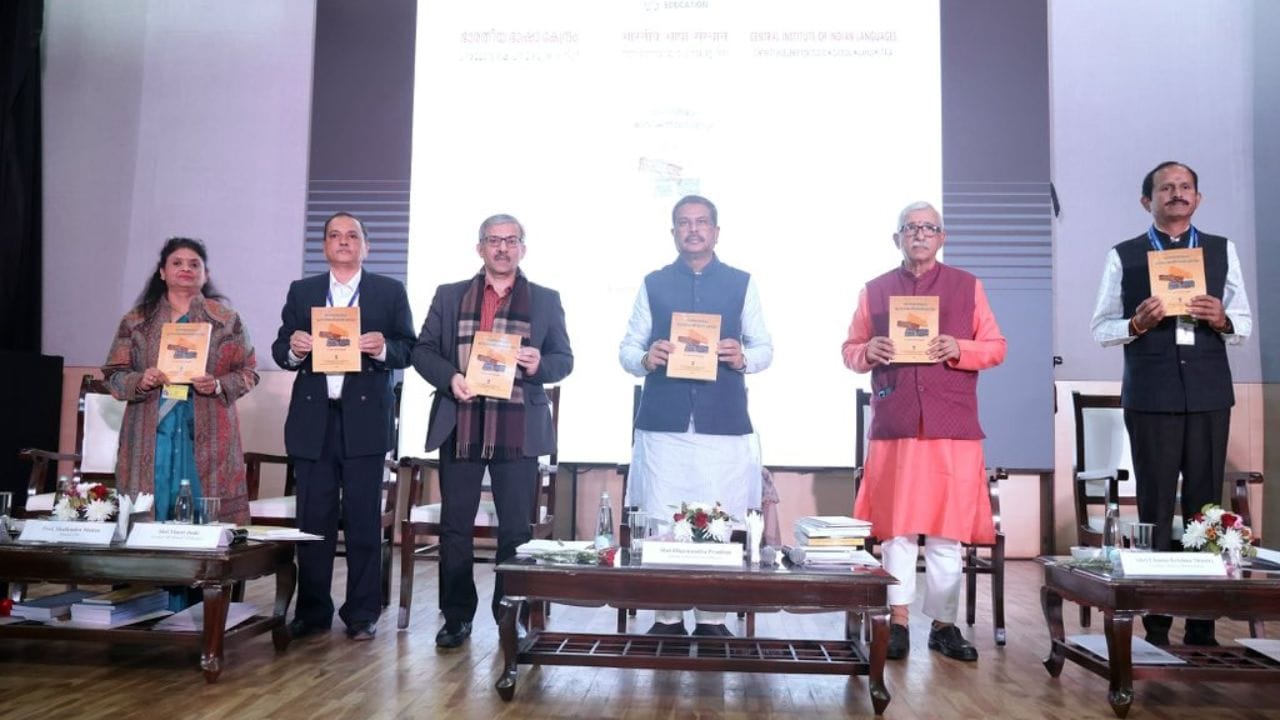
New Delhi: Union Minister for Education, Dharmendra Pradhan, released 55 literary works in classical Indian languages today in New Delhi. The releases include 41 books developed by the Centres of Excellence for Classical Languages under the Central Institute of Indian Languages (CIIL), along with 13 books and a Tirukkural Sign Language series brought out by the Central Institute of Classical Tamil (CICT).
The collection features important scholarly works across Kannada, Telugu, Malayalam, Odia, and Tamil, along with an interpretation of the Tirukkural in Indian Sign Language. These publications are part of a wider national effort to place India’s linguistic heritage at the centre of education and research and to foster cultural pride, while strengthening engagement with classical knowledge traditions.
Speaking on the occasion, Dharmendra Pradhan said that under the leadership of the Prime Minister Narendra Modi, the Government has worked extensively to strengthen and promote all Indian languages such as including more languages in the scheduled list to translating classical texts into Indian languages, and encouraging education in Indian languages. Indian languages have stood the test of time despite the attempts to destroy them, he added.
He further said that India is the mother of democracy and a country of immense linguistic diversity, and that it is the responsibility of society to ensure that the nation’s historical, cultural, and literary wealth is preserved and that future generations are made aware of it. He stated that languages are a unifying force and noted that the Prime Minister Narendra Modi has always emphasised that all Indian languages are national languages.
Pradhan also said that the inclusion of the essence of the Tirukkural in Sign Language empowers the vision of an inclusive India, where access to knowledge is ensured for all, and added that this release is a valuable contribution to India’s intellectual literature.
He further stated that the National Education Policy 2020 advances the vision of education in Indian Languages, and that India remains a vibrant example of unity in diversity, where language serves as a medium to connect society. He said that, in contrast to the Macaulay mindset of the colonial era, Indian civilisation has always regarded languages as bridges for dialogue and cultural harmony.
Pradhan also extended his congratulations and best wishes to the Bharatiya Bhasha Samiti on Indian Languages, the Centres of Excellence, the Central Institute of Indian Languages (CIIL) and the Central Institute of Classical Tamil (CICT) for their efforts to promote Indian languages.
The event was attended by Shri Vineet Joshi, Secretary (Higher Education), Ministry of Education; Chamu Krishna Shastry, Chairman, Bharatiya Bhasha Samiti; Prof. Shailendra Mohan, Director, CIIL; Prof. R. Chandrasekaran, Director, CICT; Ms. Manmohan Kaur, Advisor (Cost), along with the senior officials of the Ministry of Education.