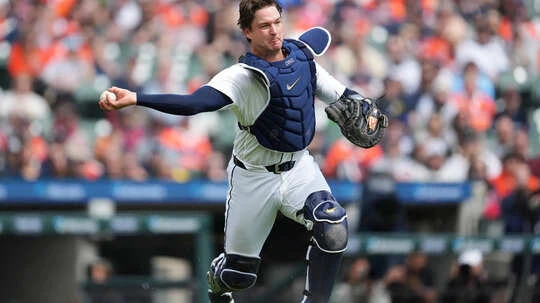
NEW YORK (AP) – In the first full week of Major League Baseball’s challenges to the Automated Ball-Strike System (ABS), catchers outperformed batters, with the Detroit Tigers and catcher David Dingler leading the way.
The overall success rate for challenges was 55.2%, with fielding teams achieving a 59.7% success rate, including 60.4% for catchers specifically.
Performance Statistics
There were only 13 challenges initiated by pitchers, who succeeded in six instances. Batters managed a success rate of 49.8%, winning 124 of 249 challenges.
Catchers from the Detroit Tigers demonstrated exceptional performance, winning 75% of their challenges with a record of 15 out of 20. The Arizona Diamondbacks followed closely with a 71% success rate, while the Baltimore Orioles and Cincinnati Reds each achieved 67%.
Notable Individual Achievements
Minnesota recorded the highest number of challenges at 32, winning 20 for a 63% success rate. Conversely, the Texas Rangers had the fewest challenges, winning 4 out of 10.
Cleveland had the lowest success rate at 32%, followed by Washington at 38% and both St. Louis and Texas at 40%.
Detroit catchers maintained an undefeated record of 8-0, with Dingler contributing seven of those victories.
Impact of ABS on Game Outcomes
The influence of the ABS was particularly evident during a game between Atlanta and Arizona. The Braves were leading 2-1 when Ozzie Albies challenged a strike call on a pitch that missed the strike zone by 1.1 inches, leading to an eight-run rally in a decisive 17-2 victory for Atlanta.
Miami manager Clayton McCullough remarked on the significant impact of ABS on game dynamics, stating, “In some of these games, it’s had a more of a swinging effect on outcomes of at-bats and how things change than maybe even you thought.”
Umpire Performance
Among umpires, Mike Estabrook had 11 of 12 calls overturned, yielding a reversal rate of 91.7%. Others with high overturn rates included Andy Fletcher at 88.2% and Ron Kulpa at 77.8%. In contrast, Will Little had only 1 of 10 calls reversed.
Players are still acclimating to the ABS system, as evidenced by incidents such as Washington’s Jorbit Vivas signaling for an appeal after exhausting their challenges.
Overall Trends in Offense and Pitching
The first week of the 2,430-game MLB season showed a decline in offensive performance, with the league-wide batting average at .234, down from .239 during the same period last year. The historical low batting average of .237 was recorded in 1968.
Fastball velocity has reached an average of 94.6 mph, a slight increase from 94.1 mph last year, continuing a trend of rising velocities over recent seasons.
Cleveland catcher Austin Hedges expressed nostalgia for the slower pitching of previous years, stating, “I wish I was facing the same pitching as I did my rookie year back when guys were throwing 88-mile-an-hour sinkers over the plate.”