New Delhi: Things have heated up significantly when it comes to the tensions between Greenland and the US. A consequence of US President Donald Trump’s insistence on acquiring Greenland, anxieties in Europe over Trump’s expansionism are high.
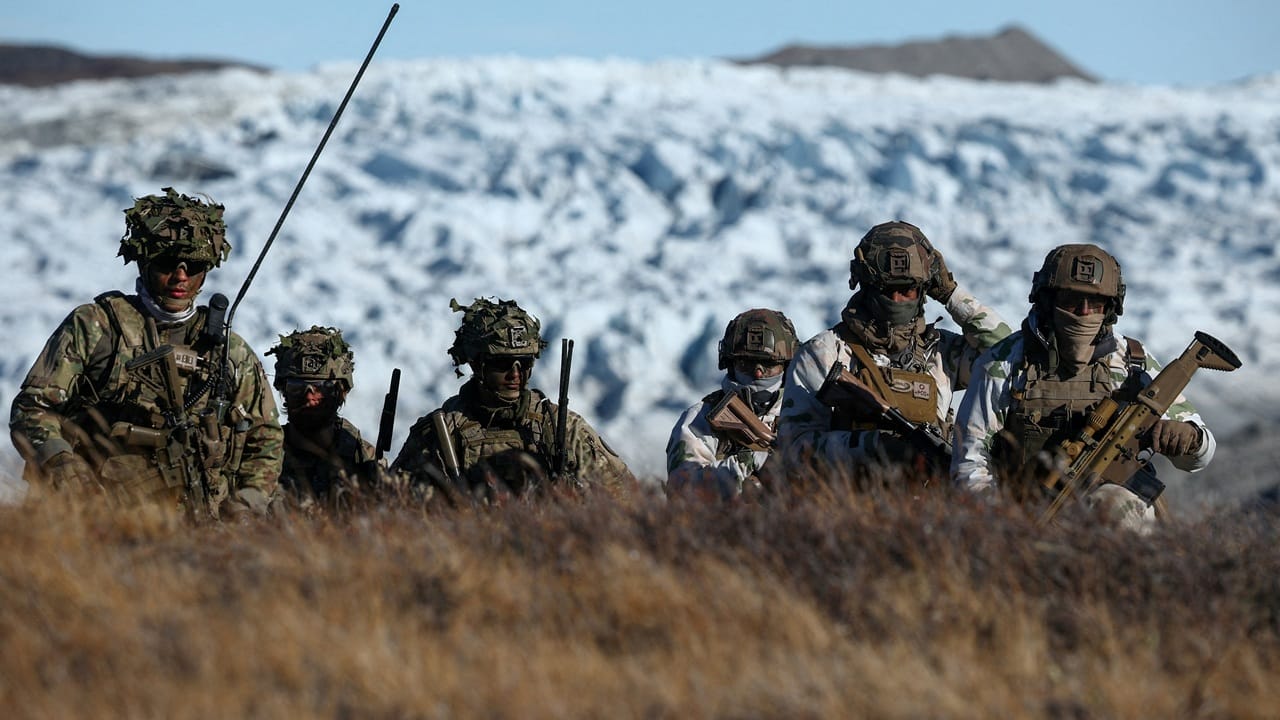
On its part, Denmark is taking Trump’s threat of military action seriously, warning that its troops were under standing orders to “shoot first and ask questions later” if Greenland was attacked by the US. This declaration comes as part of a 1952 military directive that still remains in force under which Danish forces have the freedom to counter-attack invading troops without awaiting formal orders from commanders or the government. Moreover, the Danish defence minister also said Denmark would spend $13.8 billion to rearm Greenland.
Current rhetoric of military escalation
The renewed conversation over Greenland comes after US President Donald Trump’s revived ambitions to bring the Arctic territory under American control. The US President has on several occasions now talked about the strategically essential of Greenland for US national security. Added benefits of acquiring Greenland for the US include its military positioning and access to natural resources.
Trump’s repeated talks of acquisition have become a major cause of tension in Europe. Greenland itself remains geopolitically sensitive, home to critical Arctic air and naval routes, potential resource reserves and the US Thule Air Base, making any signals of forced acquisition deeply unsettling for European allies. Meanwhile Denmark has responded with an unusually firm tone, making clear that Greenland is an integral part of the Danish realm and not for sale or transfer. Danish leaders have stressed sovereignty, self-determination for Greenlanders and the legal protections embedded in international law and NATO frameworks.
What of likely military contest?
While a military action is unlikely, if the current rhetoric is looked at the chances cannot be said to be nonexistent either. If it does occur, in whatever capacity it may, the US would appear to be unilaterally superior.
The United States is one of the world’s most powerful military forces; be it its geographic reach, advanced technology, economic might or space and cyber capabilities. Denmark’s military, though competent and modern, is comparatively small. The main gambit of defence for Greenland and Danish forces would thus be defence through NATO cooperation and not direct attack of any kind.
The statistics also speak to this point clearly. According to Global Firepower rankings, the US is at the top of the chart in terms of military strength while Denmark is ranked 45th. The US has 1.3 million military personnel, compared to the rest of the NATO alliance’s collective 2.1 million personnel. The numbers are heavily skewered. In fact, Denmark has the lowest number of armed forces within NATO, with a strength of roughly 17,300 personnel. When it comes to the technological advancement of weapons, or of the air or naval power as well, the stacks are unkindly stacked against Denmark.
Another challenge for Denmark will be the mobilisation of troops in a short time. Greenland is located nearly 3,000 km from the Danish mainland as massive mobilisation would not be easy. Thus Denmark’s strength lies not in raw military power but in diplomacy, alliances and legitimacy under international law. Collective European support has to turn the conflict from one of traditional warfare to a political, legal, and alliance-driven contest. This remains as the best option for the sovereignty of Greenland and protectionism and integrity of the EU.