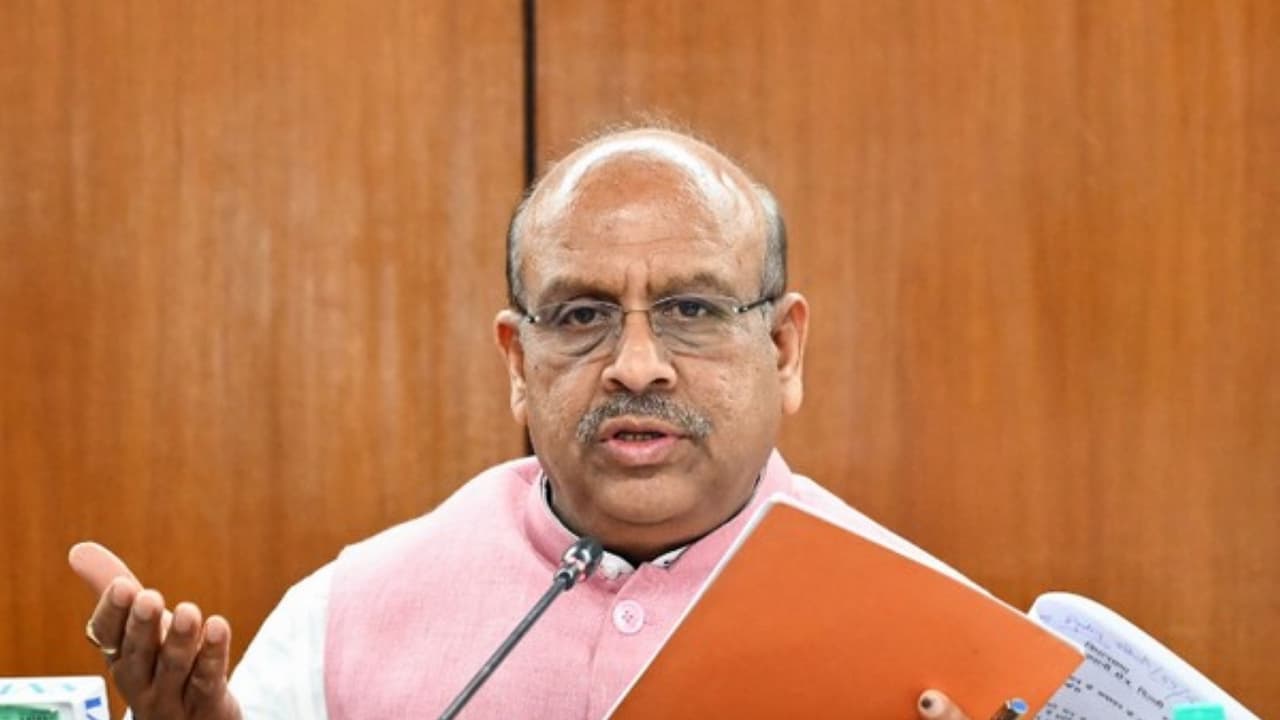
Delhi Assembly Speaker Vijender Gupta calls the nine-day Ram Katha at Bharat Mandapam a moral guide for the future and a call for world peace. Organized by Ahimsa Vishwa Bharati, it features spiritual leader Morari Bapu’s discourse.
Delhi Assembly Speaker Vijender Gupta on Sunday emphasised that the nine-day Ram Katha being organised from January 17 to 25 at Bharat Mandapam in New Delhi is not merely a narration of the past but a moral guide for the future as well.
Addressing the gathering as Convenor at the commencement of the Ram Katha, Gupta said, “Ram Katha is not merely a narration of the past; it is a moral guide for the future and a call for world peace. At a time when the world is confronted with war, violence, and a deep crisis of trust, the life and ideals of Lord Shri Ram remind us that true leadership is anchored in character, compassion, restraint, and moral courage.”
According to an official release, the Ram Katha is being organised under the auspices of Ahimsa Vishwa Bharati, founded by Acharya Lokesh Muni Ji, revered Jain saint and Founder of the World Peace Centre, as part of the World Peace Centre Mission, with Pujya Morari Bapu, spiritual leader and internationally renowned Ram Katha narrator from Gujarat, delivering the discourse.
Gupta on Ram Katha’s Cultural and Spiritual Role
In his address, the Delhi Assembly Speaker stated that Ram Katha has historically served as a powerful medium for spreading the values of morality, fraternity, and humanity, and remains an inseparable part of India’s cultural and spiritual life. He observed that Pujya Morari Bapu ji, through decades of Ram Katha in India and across the world, has carried this message of humanity to the very heart of society. He further noted that dedicating this Ram Katha to the World Peace Centre Mission reflects a conscious and purposeful commitment to the welfare of society, the nation, and the world.
World Peace Centre’s Vision
Gupta further observed that the World Peace Centre has been envisioned as a moral and spiritual platform capable of responding to situations of war, violence, and conflict anywhere in the world through dialogue, compassion, and non-violent engagement. He specifically acknowledged that Acharya Lokesh Muni Ji has played a seminal role in reviving and reaffirming the ancient Jain tradition of Ahimsa (non-violence) and in giving it contemporary relevance through institutional initiatives such as Ahimsa Vishwa Bharati and the World Peace Centre.
Vijender Gupta stated that Ram Katha embodies India’s living civilisation, where spirituality and peace-building are not separate pursuits but are deeply interwoven. He observed that Bharat Mandapam, symbolising India’s global identity rooted in its civilisational heritage, is a fitting venue for a programme of such spiritual, cultural, and moral significance.
Morari Bapu: ‘A Living Spiritual Dialogue’
Pujya Morari Bapu, spiritual leader and Ram Katha narrator from Gujarat, while addressing the gathering, said that Ram Katha is a living spiritual dialogue with humanity, capable of awakening compassion, reflection, and ethical responsibility. He observed that the life of Lord Shri Ram offers timeless guidance on harmony, restraint, and empathy, and stated that dedicating Ram Katha to the mission of world peace is both timely and necessary in an age marked by conflict and division.
Acharya Lokesh Muni on Sanatan Dharma and Ahimsa
Acharya Lokesh Muni Ji, while addressing the gathering, said that Sanatan Dharma is not the name of any single sect, but an eternal, universal principle that guides humanity. He stated that Sanatan consciousness is the unifying civilisational force that binds diverse faith traditions :Hindu, Jain, Sikh, Buddhist and others into a shared moral framework rooted in compassion, restraint, and ethical living.
Emphasising the contemporary relevance of Jain Ahimsa, he said that the principles of non-violence, peace, harmony, and balance taught by Bhagwan Mahavir are urgently needed in a world grappling with war, violence, and growing imbalance. He observed that many global challenges can find meaningful solutions in Mahavir’s philosophy, and added that the World Peace Centre has been envisioned to revive, institutionalise, and give contemporary expression to these timeless values through dialogue, compassion, and moral responsibility. (ANI)
(Except for the headline, this story has not been edited by Asianet Newsable English staff and is published from a syndicated feed.)