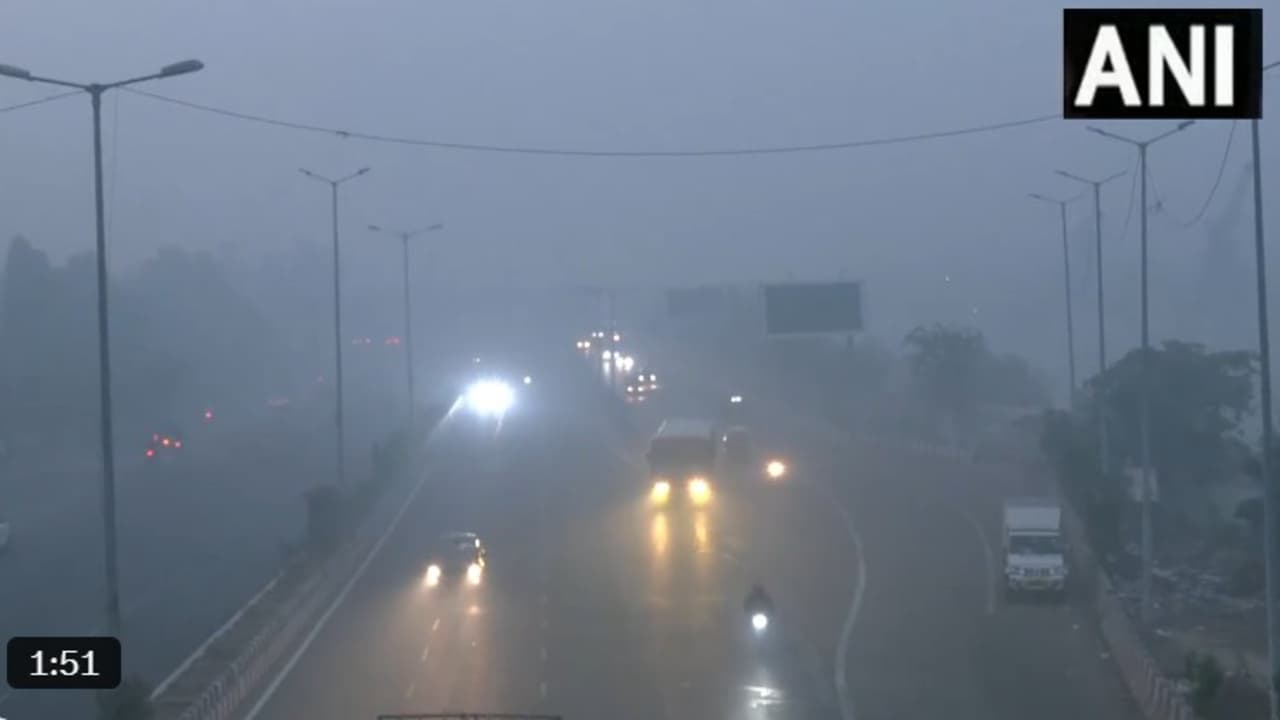
Delhi Smog Alert: Is Delhi really becoming a gas chamber? As soon as AQI reached 462 on Sunday morning, a blanket of dense smog covered the entire city. All 40 monitoring stations are showing red, AQI 499 in Rohini. Why did the air become so poisonous? GRAP-4 implemented, but when will the relief come?
Delhi Smog Air Quality Severe: The national capital Delhi is once again seen wrapped in a blanket of dense smog. The situation worsened so much since Sunday morning that even breathing became difficult. According to the Central Pollution Control Board (CPCB), Delhi’s average AQI at 6 am was recorded at 462, which falls directly into the ‘severe’ category. The most worrying thing is that all 40 air quality monitoring stations in Delhi are showing red alert. From the city roads to the airport, smog is visible everywhere. Visibility has become so low that even flights are feared to be affected.
Why did the smog become so dense in Delhi?
The biggest question is that how did Delhi’s air suddenly become so poisonous? According to the Commission for Air Quality Management (CAQM), this time it is not local pollution but the movement of weather that has become the major reason. A weak Western Disturbance coming from North-West India is stopping the movement of the wind, due to which the pollutant particles are trapped in the sky.
Scroll to load tweet…
Which areas are most affected?
Many areas of Delhi have reached very dangerous levels.
- AQI 499 in Rohini
- AQI 495 in Jahangirpuri
- AQI 495 in Vivek Vihar
It is clear from these figures that North, East and North-West Delhi are most vulnerable to pollution.
What does AQI 462 mean for common people?
AQI i.e. Air Quality Index is a public health tool, which tells how much danger the air poses to health. According to CPCB:
- 0-50: good
- 201-300: bad
- 301-400: very bad
- 401-500: severe
Severe AQI means that even a healthy person can fall ill, and this condition can be extremely dangerous for asthma, heart or lung patients.
What are the elements that make air poisonous?
According to CPCB, these pollutants play an important role in determining AQI – PM2.5, PM10, ozone, sulfur dioxide, nitrogen dioxide, carbon monoxide, lead and ammonia. Among these, PM2.5 is considered the most dangerous because it goes directly into the lungs.
Scroll to load tweet…
What does it mean for GRAP-4 to be implemented?
In view of the increasing pollution, CAQM first implemented GRAP-3 and later GRAP-4. This means that there will be strict restrictions on construction work, diesel generators, heavy vehicles and some industrial activities.
Will the situation improve or worsen in future?
At present, there is little hope of relief until the weather clears. Experts say that unless there is strong wind or rain, it is difficult to completely get rid of smog. Delhi smog and severe AQI is now becoming not only an environmental but also a health emergency. If concrete steps are not taken in time, the situation may become even more scary in the coming days.