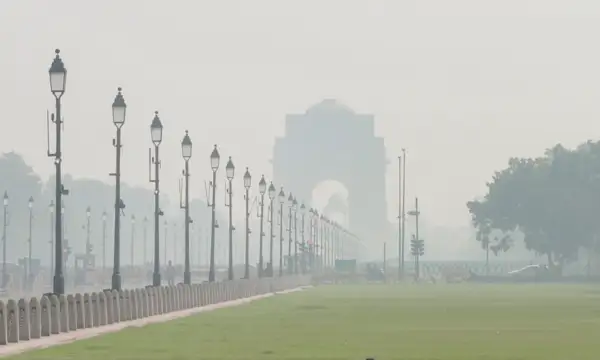
Delhi pollution update: In a matter of good news, residents across the National Capital Region (NCR) experienced much-needed relief as air quality levels improved noticeably across several monitoring stations, supported by favorable weather conditions and stronger wind dispersion.
According to data from the Central Pollution Control Board (CPCB), daytime surface winds helped clear stagnant particulate matter, bringing down overall pollution concentration across key air monitoring sites. Meteorologists credit the shift in local weather patterns and steady wind currents for facilitating the rapid dispersion of airborne pollutants like PM2.5 and PM10.
Temporary drop in air pollution
Environmental authorities continue to track regional atmospheric changes closely, advising citizens to remain updated on daily AQI indices as winter approaches. While the temporary drop in air pollution brings relief, anti-pollution measures and monitoring remain in place to maintain ambient air standards across the capital.
Delhi pollution data from Central Pollution Control Board
According to the Central Pollution Control Board (CPCB), the AQI stood at 223 in the ‘poor’ category, down from 245 on Wednesday. Jahangirpuri recorded ‘very poor’ air quality, with an AQI of 305 at 7 pm, according to the CPCB’s Sameer app. Of the 54 monitoring stations in the national capital, 29 recorded ‘poor’ air quality, one recorded ‘very poor’ air quality, and the remaining stations were in the ‘moderate’ category.
According to CPCB standards, an AQI between zero and 50 is classified as ‘good’, 51 and 100 as ‘satisfactory’, 101 and 200 as ‘moderate’, 201 and 300 as ‘poor’, 301 and 400 as ‘very poor’, and 401 and 500 as ‘severe’.
A ventilation index below 6,000 square metres per second, coupled with an average wind speed of less than 10 kilometres per hour, is considered unfavourable for the dispersion of pollutants.
Among Delhi-based sources, residential emissions contributed 4.9 per cent, industries 4.03 per cent, construction 2.5 per cent, energy 1.8 per cent, waste burning 1.7 per cent, road dust 1.3 per cent and other sources 1.2 per cent.
Among the National Capital Region districts, Jhajjar contributed 6.1 per cent, Gurugram 5.1 per cent, Gautam Budh Nagar 4.4 per cent, Faridabad 3.2 per cent and Rajasthan’s Alwar 2 per cent. Other regional contributors included Sonipat at 3.3 per cent, Panipat at 2.2 per cent, Bahadurgarh at 1.9 per cent, Karnal and Bhiwani at 1.2 per cent each, and Muzaffarnagar at 0.9 per cent.