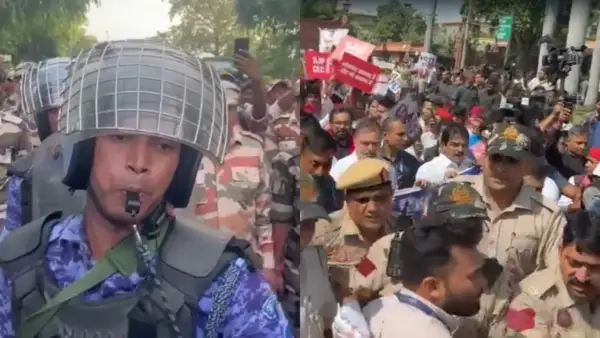
The continuous sound of whistles has become noticeable in videos from recent protests around Jantar Mantar in Delhi. As police stepped up security during demonstrations against Chief Election Commissioner Gyanesh Kumar, protesters were stopped at several points, while large numbers of police and paramilitary personnel were deployed across central Delhi.
But amid the barricades, detentions and heavy deployment, another feature has attracted attention: repeated whistle blasts by police personnel.
An X post discussing the development has described it as a new tactic to disrupt protests. The claim has raised a wider question: What purpose can continuous whistling serve during a protest?
Why Do Police Use Whistles?
A whistle is one of the simplest tools available to police officers for communication in a crowded environment.
In a large gathering, officers may not be able to hear one another over slogans, speeches and general crowd noise. A whistle can cut through some of that noise and quickly attract the attention of other personnel.
It can therefore be used to signal movement, alert colleagues, coordinate a response or draw attention to a particular situation.
However, there is an important distinction between using a whistle occasionally as a signal and repeatedly blowing whistles around a protesting crowd.
How Continuous Whistling Can Affect Protesters
A protest depends heavily on communication. Speakers need to be heard, volunteers need to coordinate people and protesters often rely on slogans and responses to maintain momentum.
Research on noise has established that excessive or persistent sound can interfere with speech and communication. In a protest environment, repeated high-pitched whistles could therefore make it harder for people standing nearby to hear conversations or instructions.
The impact can extend to media coverage. When journalists interview protesters in a noisy environment, continuous background sound can make recordings harder to understand.
This does not establish that Delhi Police is deliberately using whistles to obstruct journalists. There is currently no public statement from the force confirming such an objective.
Can A Whistle Create Psychological Pressure?
Noise can influence the atmosphere of a crowd. Research into protest policing has examined how authorities can alter the atmosphere of demonstrations through different forms of intervention. Scholars have described these interventions as attempts to affect the “atmosphere” of a crowd.
Persistent noise can also become irritating and tiring, particularly when people are exposed to it for extended periods.
In a protest, that could potentially contribute to frustration and make communication more difficult. If a crowd cannot easily hear its own speakers or instructions, maintaining coordination can become harder.
But again, the effect should not automatically be presented as proof of police intent.
The Bigger Issue: Controlling The Protest Environment
The recent Jantar Mantar protests have already involved barricading, restrictions on gatherings and the deployment of thousands of security personnel. Delhi Police said prohibitory orders were imposed to maintain public order and ensure public safety, while reports said protesters attempting to reach restricted areas were detained.
Against this backdrop, the whistle has become an interesting part of the visual and audio landscape of the protests.
Its traditional role is straightforward: communication and coordination between police personnel.
But when whistles are blown repeatedly in close proximity to protesters, they can also affect the sound environment in which the demonstration takes place. That can interfere with conversations, slogans, speeches and recordings, whether or not that is the intended objective.
For now, the most accurate conclusion is that the whistle can serve a practical crowd-management purpose, while its repeated use may also have secondary effects on protest communication.
Whether those effects are intentional is a question that only Delhi Police can conclusively answer.