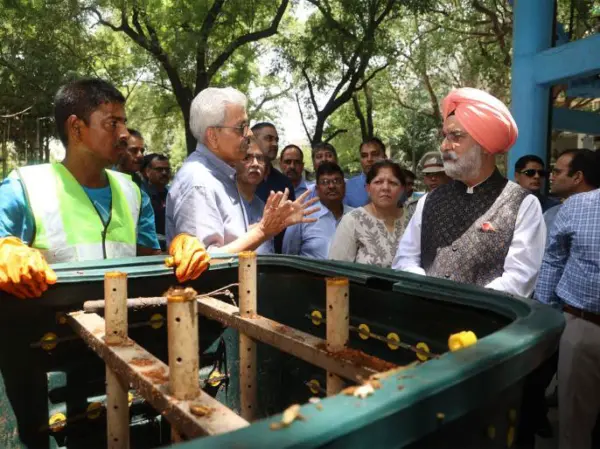
Delhi Lieutenant Governor Taranjit Singh Sandhu on Tuesday visited Navjeevan Vihar in South Delhi to inspect its successful ‘Zero Waste Colony’ model and lauded the community-led transformation as one of the best practices in the national capital.
During the visit, the Lieutenant Governor inspected the colony’s Reduce-Reuse-Recycle (RRR) Centre, decentralized aerobic composting units, strict source-segregation mechanisms, and the locally installed rainwater harvesting system.
Terming it as one of the best practices in Delhi, he commended the exemplary community-driven initiative for demonstrating how collective civic responsibility can create a cleaner, greener, and more sustainable urban environment.
Highlighting the urgent need to scale this success, the Lieutenant Governor directed the Municipal Corporation of Delhi (MCD) to actively encourage and support other Resident Welfare Associations (RWAs) to adopt this self-sustaining model, according to a release.
To ensure equitable development, he instructed the MCD to explore dedicated funding mechanisms to replicate such decentralized zero-waste and composting projects in not-so-well-off colonies.
He also said that Corporate Social Responsibility (CSR) funding should be systematically tapped to build the necessary infrastructure, such as Aerobins and RRR centres, in these areas.
Laying emphasis on strong behavioural shift, the Lieutenant Governor stated that government agencies cannot achieve sustainable waste management without active public contribution and a deep sense of ownership among citizens.
He stressed the importance of team spirit, noting that the journey from waste to wealth begins at home.
Remarking that there is no need to look at other cities or nations for solutions “when such best practices are emerging from our own people,” the Lieutenant Governor urged RWAs across Delhi to prioritize source segregation at the household level.
He appreciated the dedicated efforts of the RWA and the residents.
The Lieutenant Governor noted with satisfaction that under the active leadership of the community, the colony has sustained this decentralized model for nearly eight years, successfully diverting over 10 lakh kilograms of waste from Delhi’s overburdened landfill sites.
Reaffirming the government’s commitment, the Lieutenant Governor stated that such collective RWA efforts deserve full institutional support and assistance.
He called upon all stakeholders to recognize their legal and environmental mandate, practice mindful resource utilization, and work collectively towards building a secure, inclusive, and world-class Viksit Dilli.
In a post on X, the Lt Governor said that the community-led transformation reflects the vision of Prime Minister Narendra Modi’s Mission LiFE and the principles of a circular economy
“Visited Navjeevan Vihar today, an inspiring model of a ‘Zero Waste Colony’ in the capital. Inspected their Reduce-Reuse-Recycle (RRR) Centre, decentralized composting units, source-segregation mechanisms, and the locally installed rainwater harvesting system. This remarkable community-led transformation reflects the vision of Hon’ble Prime Minister Shri @narendramodi Ji’s Mission LiFE and the principles of a circular economy under the Waste to Wealth initiative,” he said.
“I commend the dedicated efforts of the RWA and residents for sustaining this model for nearly eight years and successfully diverting over 10 lakh kilograms of waste from Delhi’s landfill sites,” he added.
The Lt Governor noted that the journey from waste to wealth begins at home. “Sustainable waste management cannot be achieved by government efforts alone; it requires active public participation and lasting behavioural change. I urge RWAs across Delhi to study and adopt this decentralized model, prioritize source segregation, and work collectively towards building a cleaner, greener, and more sustainable #ViksitDilli,” he said.
He also shared glimpses from his insightful visit to Navjeevan Vihar.
“This exemplary community-driven initiative demonstrates how collective civic responsibility can create a cleaner, greener, and more sustainable urban environment. The residents’ commitment to waste segregation, recycling, composting, and water conservation is indeed commendable. Such RWA efforts deserve our full support & assistance,” he said.