India’s largest carmaker, Maruti Suzuki India Ltd, has questioned the Delhi government’s decision to remove incentives for strong-hybrid cars from its final electric-vehicle policy, saying the move puts the cleaner technology on the same tax footing as diesel vehicles.
The draft Delhi Electric Vehicle Policy 2026-30 had proposed a 50 per cent exemption from road tax and registration charges for strong-hybrid cars priced up to Rs 30 lakh. However, the benefit was left out of the policy approved by the Delhi Cabinet.
“We welcome the policy because it has incentives for EVs. In the draft policy, there was some benefit for strong hybrids as well. It was very surprising that it was removed from the final policy,” Maruti Suzuki Senior Executive Officer (Corporate Affairs) Rahul Bharti said.
“Strong hybrids and diesel are now on the same platform. Treating a polluting fuel such as diesel in the same way as a strong hybrid is difficult to understand,” he said during a media interaction on the company’s June and first-quarter sales.
The draft policy published by the Delhi Transport Department in April had proposed a complete exemption from road tax and registration fees for electric cars priced up to Rs 30 lakh and a 50 per cent exemption for strong hybrids in the same price band. Both benefits were proposed to continue until March 31, 2030.
The final policy, which came into effect on July 1, retained the tax and registration waiver for eligible electric cars but removed the proposed benefit for strong hybrids.
Strong hybrids use a petrol engine along with an electric motor and battery. They can recover energy during braking and operate on electric power in some driving conditions, reducing fuel consumption. However, unlike battery-electric vehicles, they continue to produce tailpipe emissions.
Delhi’s policy is focused primarily on increasing the share of zero-tailpipe-emission vehicles. It aims to electrify at least 30 per cent of the city’s vehicle fleet by March 31, 2030, while expanding the charging network and introducing incentives for buyers replacing older vehicles.
Maruti continues hybrid investments
Bharti said the exclusion would not change Maruti Suzuki’s wider clean-technology strategy.
“We have invested in lithium-ion cells and electrodes for making strong hybrids. We will continue our efforts across clean and green technologies, whether it is biofuels such as ethanol, CNG and CBG, strong hybrids or electric vehicles,” he said. The company is also researching hydrogen-based mobility, he added.
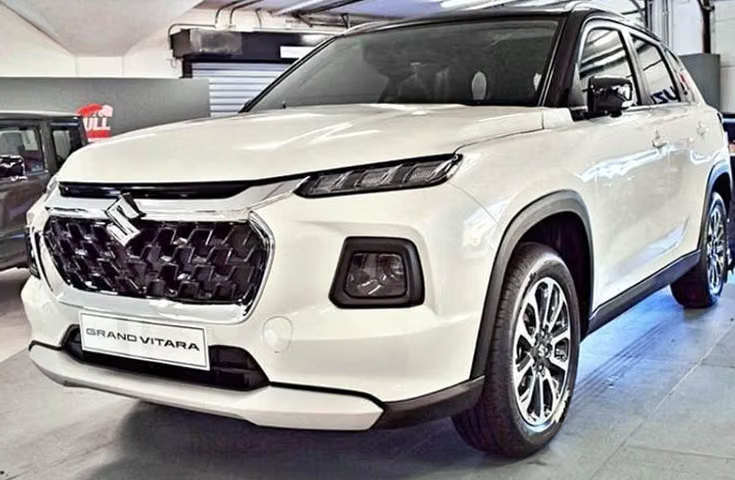
Maruti Suzuki currently offers strong-hybrid powertrains on the Grand Vitara, Invicto and Victoris. The technologies allow these models to use electric assistance and, under some conditions, move using only the electric motor.
In August 2025, Suzuki and its partners began local production of lithium-ion battery cells and electrodes for strong-hybrid vehicles at TDS Lithium-Ion Battery Gujarat. Maruti Suzuki said this marked Suzuki’s first local cell-and-electrode manufacturing operation in India for strong hybrids.
The local investment is part of Maruti Suzuki’s effort to reduce imported content and build scale for hybrid powertrains. Strong-hybrid versions have also become an important part of the company’s premium utility-vehicle portfolio.
Bharti said policymakers should recognise the difference in emissions and fuel consumption between cleaner powertrains and conventional petrol or diesel vehicles.
“We hope the government takes cognisance of this fact and differentiates between cleaner fuels and those that are not as clean,” he said.
e-Vitara supply to remain restricted
Maruti Suzuki has welcomed the incentives offered to battery-electric vehicles under the Delhi policy. However, the company will not be able to increase domestic supplies of the e Vitara, its first electric vehicle, before September because of export commitments.
“At present, we are not going to increase production for the domestic market until September because we have commitments. We will have to wait,” Maruti Suzuki Senior Executive Officer (Marketing and Sales) Partho Banerjee said.
The e Vitara is manufactured at Maruti Suzuki’s Gujarat plant for India and overseas markets. India serves as the global production base for the model, which is being exported to Europe and other markets.
Maruti Suzuki exported 5,172 e Vitaras in June, taking cumulative exports of the electric SUV beyond 40,700 units, according to the company’s management. Domestic supply remained limited by available capacity and overseas commitments.
Banerjee said Maruti Suzuki would promote other lower-emission technologies in Delhi until it could raise its electric-vehicle supply.
“We appreciate the Delhi EV policy. But if we do not have sufficient production capacity for electric vehicles, we will promote other clean-energy solutions such as CNG so that we can support the Delhi government’s mission of cleaning the environment,” he said.
The company has been following a multi-technology strategy that includes electric vehicles, strong hybrids, CNG, compressed biogas, ethanol flex-fuel vehicles and hydrogen research.
Maruti Suzuki has argued that India will need several powertrain technologies because charging availability, vehicle affordability and customer usage vary considerably across markets.