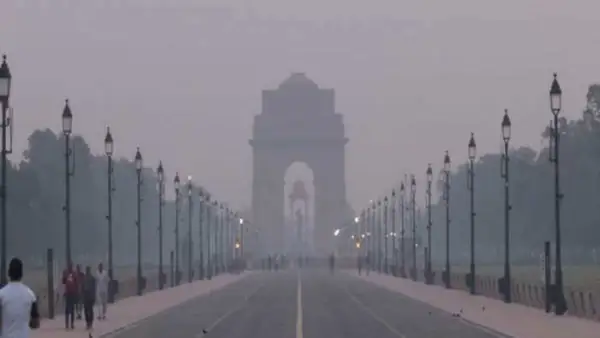
Delhi AQI Today: Delhi’s air quality remained in the ‘poor’ category on Tuesday morning, November 17, with the national capital recording an Air Quality Index (AQI) of 246 at 7:05 am, according to the Central Pollution Control Board (CPCB).
Several monitoring stations across the city recorded AQI levels in the ‘very poor’ category, with Siri Fort reporting the highest reading of 341.
Commonwealth Sports Complex recorded an AQI of 338, followed by NSUT Jaffarpur at 336 and ITO at 335. Talkatora Garden recorded an AQI of 326, while Pusa stood at 322. Burari Crossing reported 318, Chandni Chowk 316, NIH Narela 313, North Campus 310 and DTU 303.
Delhi AQI Today: Areas with moderate air quality
Among the monitoring stations, Cantonment Area recorded the lowest AQI at 151.
Air quality remained in the ‘moderate’ category at several locations, including IMD Lodhi Road (182), Major Dhyan Chand National Stadium (185), Badarpur (188) and Okhla Phase-2 (192).
According to the CPCB, PM2.5 remained the prominent pollutant in the national capital. Light smog also blanketed Delhi on Tuesday morning.
Delhi Pollution: GRAP III measures in place
Meanwhile, the Delhi government has been undertaking several pollution-control measures to minimise the impact of particulate matter. These include deploying water sprinklers across the state as part of efforts to control pollution.
Earlier, Delhi’s air quality deteriorated following Diwali celebrations on November 8, with several monitoring stations recording AQI levels above 400 in the ‘severe’ category in the days after the festival.
The pollution situation has been compounded by falling temperatures and moderate fog, with smog continuing to affect visibility across the capital.
The CAQM had invoked Stage III of the Graded Response Action Plan (GRAP) across Delhi-NCR on November 6, three days before Diwali, amid concerns over a further deterioration in air quality.
Under Stage III, existing restrictions continue alongside additional pollution-control measures, increased enforcement and directions to concerned agencies to prevent further deterioration. The emergency action plan covers Delhi and adjoining districts of Haryana, Uttar Pradesh and Rajasthan.
GRAP is a four-stage emergency framework implemented by the CAQM in coordination with the CPCB and regional state governments. Restrictions become progressively stricter as air quality deteriorates. The measures are triggered based on meteorological and pollution forecasts provided by the India Meteorological Department (IMD) and the Indian Institute of Tropical Meteorology (IITM).
How is AQI classified?
Under CPCB guidelines, the AQI is classified into six categories based on pollution levels: 0-50 ‘good’, 51-100 ‘satisfactory’, 101-200 ‘moderate’, 201-300 ‘poor’, 301-400 ‘very poor’, and 401-500 ‘severe’.
The level of AQI between 0-50 is rated ‘good’, which means little or no health effect. While in the case of 51 to 100, the level of AQI is rated as ‘satisfactory’, meaning the quality is still acceptable, but sensitive people as children, elderly persons and those with breathing problems, can feel a little discomfort.
The ‘moderate’ category, which is assigned from 101 to 200, indicates the rise of pollution levels, which can cause persons with asthma, lung or heart disease to have difficulty in breathing.
An AQI of 201 to 300 means ‘poor’, which is a period where the air is bad enough that even healthy people with no prior issues can complain about discomfort. This has become a common scenario during winter in some areas of the capital city.
The ranges of levels from 301 to 400 are termed ‘very poor’, which might lead to developing respiratory diseases even for healthy people if the exposure is long-term. With the levels of 401 to 500, the air is found very polluted coming under the category of ‘severe’. At this point, air becomes a dangerous thing for everyone.