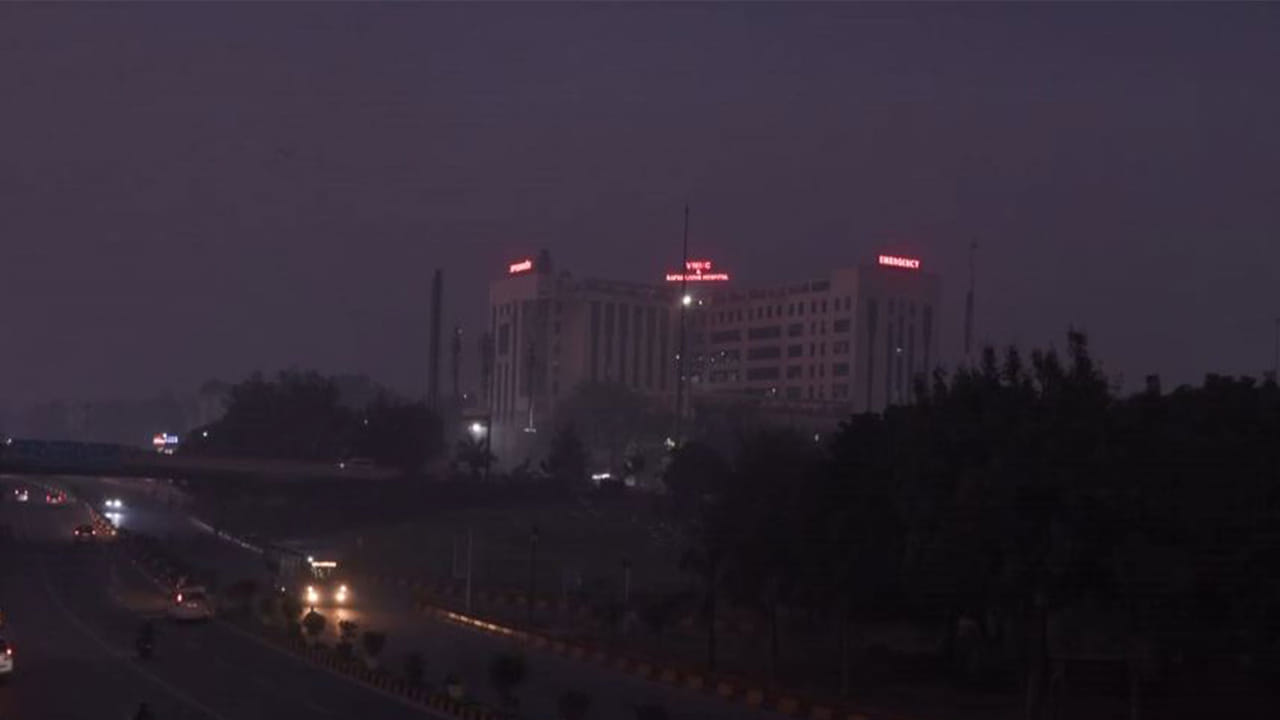
Delhi’s AQI remains in the ‘poor’ category at 286, with several city locations reporting ‘very poor’ air quality. Despite some restrictions being revoked, government authorities are intensifying road cleaning and dust-control measures.
Delhi Air Quality Status
Delhi’s overall Air Quality Index (AQI) stood at 286 in the ‘poor’ category on Thursday, according to the Central Pollution Control Board (CPCB), with several locations across the national capital recording ‘very poor’ air quality. As per CPCB data, AIIMS recorded an AQI of 354, placing it in the ‘very poor’ category, while Chandni Chowk registered 344. Bawana recorded an AQI of 322, and IIT Delhi stood at 313, both falling under the ‘very poor’ category. Other monitoring stations also reported elevated pollution levels. Wazirpur recorded an AQI of 299, while IGI Airport (T3) registered 282. Anand Vihar recorded 265, Narela 266 and RK Puram 268. Meanwhile, the AQI around India Gate and Kartavya Path stood at 232, falling under the ‘poor’ category.
Under the CPCB classification, an AQI between 0 and 50 is considered ‘good’, 51-100 ‘satisfactory’, 101-200 ‘moderate’, 201-300 ‘poor’, 301-400 ‘very poor’ and 401-500 ‘severe’. Meanwhile, Mumbai’s Wadala Eastern Freeway on Thursday morning showed smog in the area, indicating hazy conditions in the financial capital as well.
Pollution Control Measures
Earlier, the Commission for Air Quality Management (CAQM), on November 17, revoked Stage III of the Graded Response Action Plan (GRAP) in Delhi-NCR, citing an improvement in air quality. According to an official statement issued by the CAQM, its sub-committee on GRAP decided to withdraw the restrictions imposed under Stage III with immediate effect. Consequently, all government, government-aided and recognised private schools in Delhi were directed to resume physical classes for all students. However, restrictions under GRAP Stages I and II continue to remain in force. GRAP is a four-stage emergency framework managed by the CAQM in coordination with the CPCB and regional state governments, with restrictions becoming progressively stricter as air quality deteriorates.
Earlier on Wednesday, Delhi Chief Minister Rekha Gupta reviewed the capital’s pollution-control measures at a high-level meeting held at the Delhi Pollution Control Committee’s (DPCC) Integrated Command and Control Centre (ICCC). According to an official press release, Gupta said Delhi had witnessed some relief in November compared with the past decade, but emphasised that the government would continue taking strict action against all sources of pollution. The government is also working to strengthen public transport by adding 2,395 electric buses during 2026. Of these, 1,703 had joined the fleet by October 30, while the remaining 692 are expected by December.