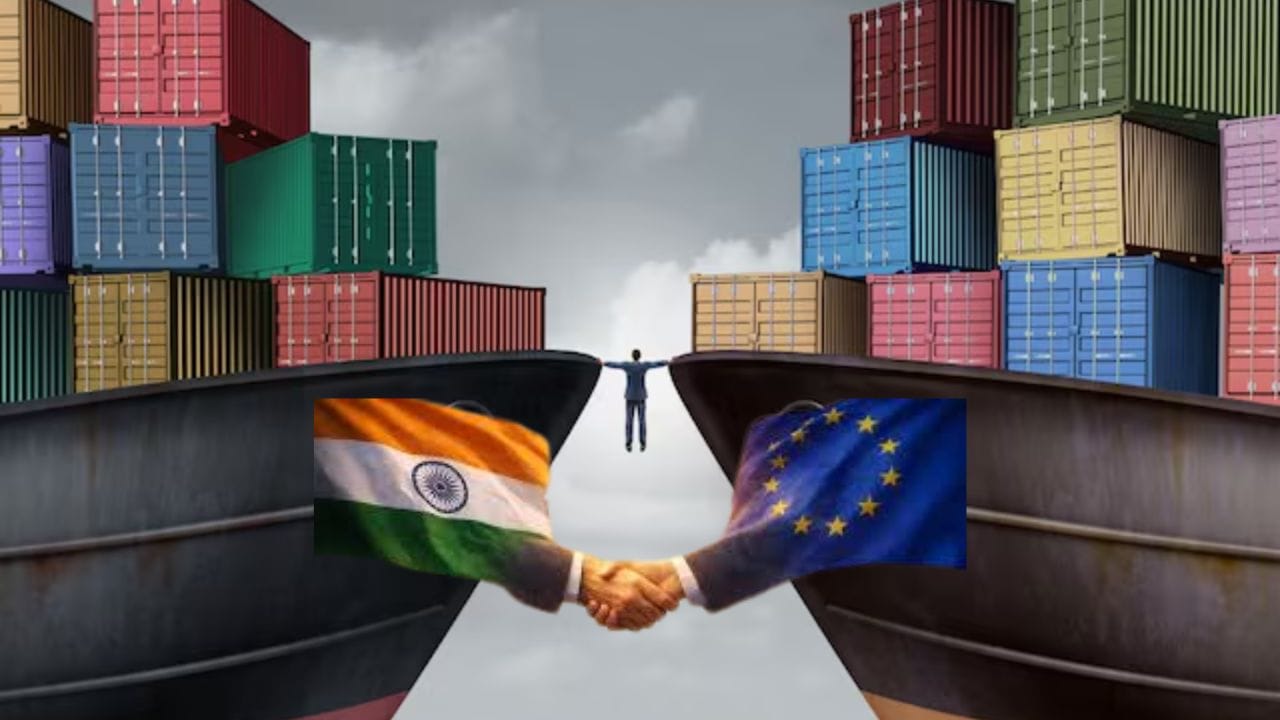
Deal between India and European Union
India and the European Union are expected to announce the end of talks on a free trade agreement on January 27, which leaders on both sides have called the mother of all deals. It is being estimated that India is going to benefit greatly from this trade deal. According to the report, the country’s trade surplus will increase by $50 billion by the financial year 2031.
A comprehensive free trade agreement could increase India’s trade surplus with the European Union by more than $50 billion by FY31, Emkay Global said in a research note on January 25. With this, the share of this block in India’s total exports may increase from 17.3 percent to 22-23 percent in FY25.
european trade policy
The note said that even though India accounts for only 0.8 percent of the EU’s total export market, this deal is becoming increasingly important for Europe as well. Where EU had a trade surplus of $3 billion with India in FY19. At the same time, in FY25 it has changed to a trade deficit of $15 billion. Along with this, Europe is trying to reduce excessive dependence on China and expand its trade to different countries.
It is expected that this increase will come from India’s exports to EU moving to the upper level of the value chain. In this, high-profit sectors like electronics, machinery and chemicals can gain a higher share than traditional labour-intensive goods. This potential increase is important because the EU’s share in India’s total exports has declined to 16.8 percent so far in FY26.
This much trade was done in FY25
Europe’s growing trade deficit with India, reducing dependence on Russian energy and efforts to expand the supply chain away from China to other countries have already increased the demand for Indian refined fuels, electronics and chemicals. FTA may further accelerate these trends. India-EU goods trade stood at more than $136 billion in FY25, of which India’s imports were $60.7 billion and exports were $75.9 billion. GTRI founder Ajay Srivastava said that most of India’s exports to the EU such as smartphones, clothes, shoes, tyres, medicines, auto parts, refined fuels and polished diamonds do not directly compete with the EU’s domestic industries. These goods are replacing imports from countries where the EU has already outsourced production.
He said that exports from EU to India such as advanced machinery, aircraft, critical electronic components, chemicals, high quality medical equipment and scrap metal strengthen Indian factories, recycling industry and MSME sector. This increases production capacity and export competitiveness. The India-EU FTA is expected to reduce or eliminate tariffs on India’s labour-intensive sectors, while the EU may get greater access to the Indian market for its high-end cars and wines.
Trade volume will increase
Srivastava said that since both the economies are strong in different sectors, eliminating tariffs does not harm any one sector but helps in reducing costs. In this way, India-EU FTA will increase trade volumes, deepen mutual engagement and strengthen competition among industries on both sides, at a time when common sense trade agreements are increasingly in decline.
In February 2025, India and EU had decided to accelerate negotiations on the proposed free trade agreement. It initially aimed to complete the deal by the end of the same year, to avoid disruptions caused by changing and volatile trade policies. The India-EU trade deal, which has been going on for more than a decade, includes a total of 24 chapters covering goods and services.
Also read- India can become a sustainable data center hub, right policy is needed