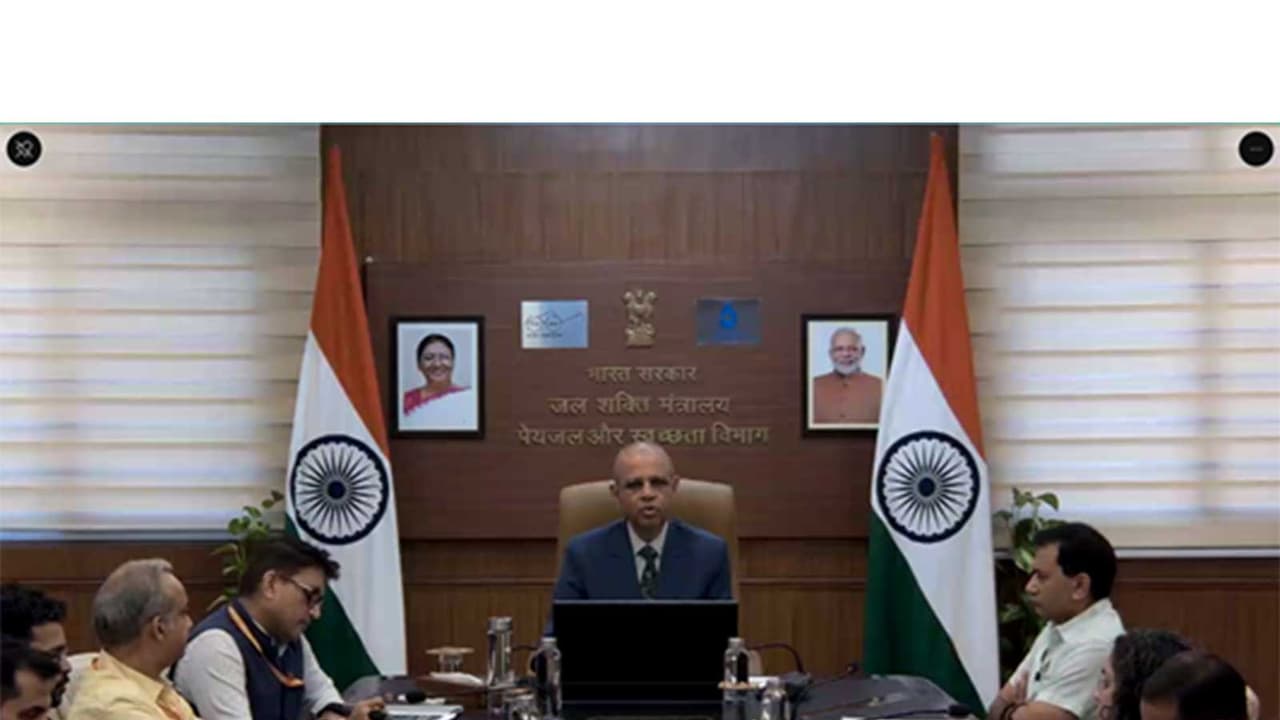
The Ministry of Jal Shakti held a virtual conference to align JJM 2.0 with Finance Commission grants, aiming to improve rural water sustainability and service delivery through strengthened Gram Panchayat-led planning and infrastructure management.
Virtual Conference on Rural Water Sustainability
New Delhi [India], October 22 (ANI): The Department of Drinking Water and Sanitation (DDWS), Ministry of Jal Shakti, on Thursday organised the fourth virtual conference with States and Union Territories as part of a series of thematic consultations being held in follow-up to the Departmental Summit on Water 2026 held on 1-2 September. The conference focused on strengthening convergence between Jal Jeevan Mission (JJM) 2.0 and the 16th Finance Commission to advance source sustainability, water security and Gram Panchayat-led planning for sustainable rural drinking water service delivery.
The virtual conference brought together senior officials from State PHEDs/Rural Water Supply Departments, Panchayati Raj Departments and representatives from the Ministries of Panchayati Raj, Ministry of Rural Development, Government of India and National Informatics Centre. State rural water supply departments, including Karnataka, Odisha and Madhya Pradesh, shared best practices and field experiences on leveraging Finance Commission grants for strengthening rural water supply systems, improving O&M arrangements, enhancing community participation and strengthening local governance mechanisms.
Focus on Sustainability and Local Governance
Addressing the conference, Ashok K.K. Meena, Secretary, DDWS, stated that with the extension of JJM 2.0, the focus now shifts from infrastructure creation to ensuring functionality, sustainability and quality service delivery. He emphasised that the true measure of success lies not merely in asset creation but in ensuring that rural households continue to receive reliable and safe drinking water through well-maintained and financially sustainable systems.
Meena underlined the pivotal role of Gram Panchayats in rural water governance and noted that the 73rd Constitutional Amendment places drinking water and sanitation among the key responsibilities of local self-governments. He stressed that Gram Panchayats must take leadership in preparing comprehensive annual O&M plans, mobilising local resources, managing service delivery and ensuring accountability for water supply infrastructure created under JJM and other programmes.
Strategic Use of Finance Commission Grants
Referring to the 16th Finance Commission framework, he highlighted that tied grants provide a significant opportunity to strengthen the sustainability of drinking water and sanitation services at the grassroots level. He noted that of the total Rural Local Body (RLB) grants recommended by the 16th Finance Commission, a substantial share has been earmarked for water and sanitation-related activities. He emphasised that these grants should be utilised primarily for operation and maintenance, source sustainability, water quality management, service delivery improvements and strengthening local institutional capacity rather than creation of new infrastructure where existing assets require maintenance and support.
The Secretary focused on three key pillars of sustainable financing for rural water supply systems such as effective utilisation of Finance Commission grants, ii. convergence with other available programmes, and iii. schemes, and progressive strengthening of user-charge collection mechanisms. Referring to successful examples from several States, he encouraged States and Gram Panchayats to adopt sustainable revenue models that support recurring O&M expenditure and reduce dependence on a single funding source.
Institutional Capacity and Implementation
Emphasising capacity building as a critical requirement, Meena called upon States to utilise resources available under the Rashtriya Gram Swaraj Abhiyan (RGSA) and other programmes for training Panchayat representatives and local functionaries. He urged States to translate and disseminate Operation and Maintenance Manuals in local languages and ensure that Panchayats clearly understand the permissible activities, funding mechanisms and reporting requirements under the Finance Commission framework.
Kritika Kulhari, Deputy Secretary, NJJM, made a detailed presentation on the 16th Finance Commission Grants and utilisation of tied grants for water and sanitation, outlining the grant structure, release conditions, reporting requirements, permissible activities and planning framework. Participants were informed that the total Rural Local Body allocation under the 16th Finance Commission exceeds ₹4.35 lakh crore, with nearly ₹1.74 lakh crore earmarked for water management and sanitation over the award period.
State-Level Success Stories
During the State experience-sharing session, Karnataka presented its integrated approach to rural water supply management through innovations such as Jala Sankalana, JalaAasthi and Jeevajala, which combine GIS-based asset management, real-time monitoring, community participation and evidence-based O&M planning. The State highlighted its experience in water budgeting, volumetric tariff collection, preventive maintenance and strengthening community ownership of drinking water systems.
Odisha shared its institutional model built around close convergence among Rural Development, Panchayati Raj and Drinking Water departments. The State presented its integrated O&M framework, bottom-up budgeting process, digital monitoring systems, local mechanic training programmes and technology-driven interventions such as solarisation, automation and IoT-based monitoring systems aimed at ensuring long-term sustainability of drinking water services.
Madhya Pradesh highlighted its recently notified O&M Rules, 2026, which enable Gram Panchayats to utilise multiple funding streams for water supply and sanitation activities. The State showcased simplified procurement processes, district-level WASH technical committees, structured training programmes, digital systems for user-charge collection and extensive efforts to build technical capacity among Panchayat representatives and engineers.
In his concluding remarks, Kamal Kishore Soan, AS&MD, NJJM reiterated that Finance Commission grants should be viewed as an opportunity to institutionalise sustainable rural water governance and strengthen Panchayat ownership of water supply systems. The conference concluded with a shared commitment by the Centre and States/UTs to strengthen Panchayat-led planning, improve financial sustainability, enhance interdepartmental convergence and ensure that the substantial investments made under Jal Jeevan Mission translate into reliable, continuous and sustainable drinking water and sanitation services for rural households across the country. (ANI)
(Except for the headline, this story has not been edited by Asianetnews Editorial staff and is published from a syndicated feed.)