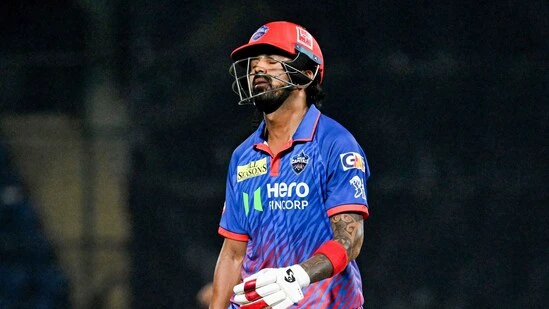
Delhi Capitals needed one big hand when Gujarat Titans put up 210/4 at the Arun Jaitley Stadium. Shubman Gill’s 70 and Washington Sundar’s 55 had already pushed the game into the kind of zone where one batter had to carry the chase deep.
Rahul did exactly that, making 92 off 52, but DC still fell one run short at 209/8.
That is what makes Rahul’s night so interesting from a balance-sheet angle. On the surface, this was the innings that finally made his IPL 2026 campaign look alive. In the monetary layer, it was his first proper recovery game. But once the noise of the thriller is stripped away, the numbers still say Delhi Capitals are waiting for a much bigger financial correction from their ₹14 crore batter.
Before this match, KL Rahul’s first two outings had already dug a serious hole. His running deficit from those games stood at ₹1.9182 crore. That is the kind of early-season damage that can make even an established batter’s campaign look heavy. Premium players are not just bought for class or reputation. They are bought to keep the ledger stable from the start.
Against Gujarat, Rahul finally produced a match worthy of that bracket. His 92, packed with 11 fours and 4 sixes, gave him a match worth of ₹1.232 crore in the monetary model against a notional per-match cost of ₹1 crore. In simple terms, this innings generated a profit of ₹23.2 lakh.
Good return. Strong recovery. But not nearly enough to reset the season.
Because when that ₹23.2 lakh gain is measured against the earlier ₹1.9182 crore hole, Rahul has recovered only about 12.1% of the damage from his first two matches. That still leaves Delhi Capitals carrying an unrecovered deficit of roughly ₹1.6862 crore on their season ledger.
That is where the story becomes more interesting than the scorecard.
A 92 in a 210 chase should normally feel like a statement innings. And cricket-wise, it was. Rahul kept DC in the game, controlled phases, and ensured the match stayed alive much longer than it should have. But in the economics of a premium IPL slot, one high-class innings does not automatically equal a clean comeback. It only means the repair work has begun.
Rahul’s 92 brought relief, not closure
Think of Rahul’s campaign like a blue-chip stock that opened the season with a sharp fall. The company is still valuable, and the market still trusts the name, but the first two sessions have already hurt investors. Then comes a strong rebound day. It stops the panic, but it does not wipe out the earlier slide.
That is exactly where Rahul stands right now.
His ₹23.2 lakh recovery from this game is not a small number in real life. That is enough to buy a premium SUV outright in many cases, or cover the annual rent of a luxury apartment in several Indian cities. On most days, that would be a perfectly respectable sports-business return.
But the remaining ₹1.6862 crore hole is the real headline. That is not loose change on a franchise ledger. That is the sort of number that sits in luxury-car territory and still leaves change. It is the kind of deficit that reminds you that one good night has improved the mood, not restored the investment thesis.
And that is the right way to read Rahul’s 92.
It was valuable. It was timely. It gave DC a chance in a 210 chase and finally put his own campaign into profit for a single game. But the broader financial read is still demanding. Delhi Capitals did not spend ₹14 crore for one correction innings in three appearances. They spent it on repeated insulation against exactly this kind of early wobble.
So yes, Rahul is finally moving in the right direction. But the balance sheet is still telling a harsher truth than the highlights reel. The scorecard says KL Rahul is back. The ledger says he still has ₹1.68 crore left to recover.